A THE DEEP FILES Examination of Search, Retrieval and Productivity Inside Copilot
2 October 2026
Artificial intelligence is increasingly being presented not merely as a tool for answering questions, but as a workspace for research, projects, analysis and continuing professional activity.
Microsoft describes Copilot Notebooks as AI-powered workspaces where users can bring together relevant content and sources so that Copilot can understand the broader context and provide focused, context-aware responses.
But THE DEEP FILES has identified a basic practical question:
What happens when the information is safely stored inside Copilot — but the user cannot efficiently find the conversation containing it?
This is not an investigation into missing data.
The conversations examined in this test still exist.
The issue is retrieval.
NOTE ON THE LANGUAGE OF THE INVESTIGATION
The source behind this investigation conducted the underlying Copilot research and testing in both Arabic and English.
This point is important.
The investigative material stored within Copilot includes conversations, prompts, questions and terminology used across both languages. Arabic and English were not introduced merely for the purpose of testing Copilot’s search capabilities; they were part of the actual working environment in which the underlying investigation was conducted.
The source therefore tested retrieval using keywords in both English and Arabic, reflecting the way the investigative material itself had originally been created.
The purpose was not simply to determine whether Copilot could translate or understand the same concept in two languages.
The question was much more practical:
Can a bilingual user retrieve previously stored investigative material using a distinctive term remembered from an earlier conversation?
This distinction is particularly relevant to the tests involving “Puma” in English and “بوما” in Arabic.
The source was attempting to locate existing investigative material.
The source was not asking Copilot to explain what a puma is.
The Test
Watch the video
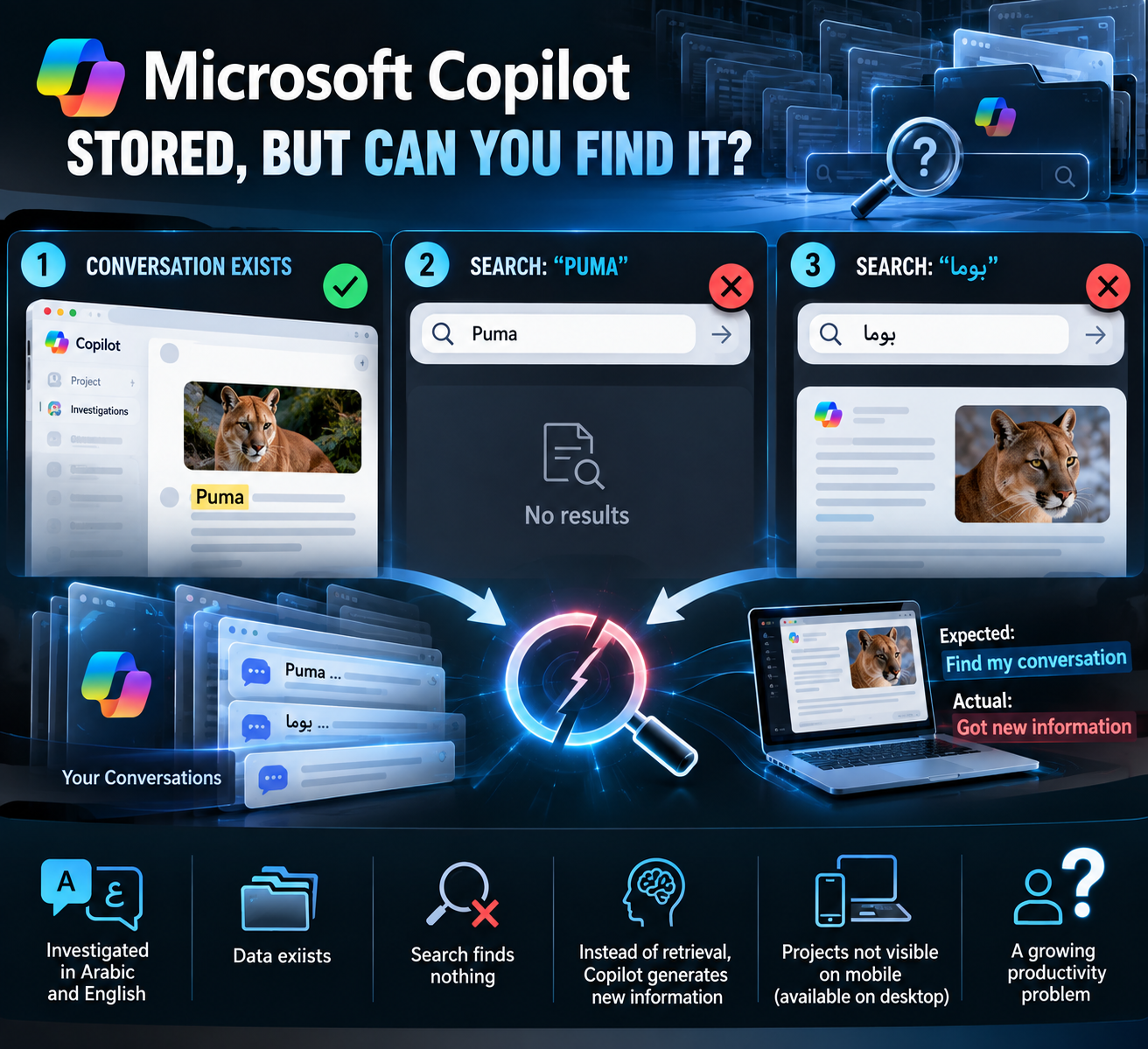
On 2 October 2026, the source behind THE DEEP FILES’ ongoing Microsoft Copilot investigation conducted a simple retrieval test involving previously stored investigative material.
The relevant Project had become accessible again through Microsoft’s updated desktop Copilot environment.
Inside that stored project material was an existing conversation concerning a Puma.
The source knew the conversation existed.
The source knew what it contained.
And, crucially, the source knew a distinctive keyword associated with that material:
Puma.
This represents a straightforward information-retrieval scenario.
The objective was not:
Tell me about a puma.
The objective was:
Find the previously stored conversation associated with Puma.
Test One: “Puma”
The source entered:
Puma
The expected historical conversation was not returned as a result.
This occurred despite the relevant investigative material continuing to exist within the user’s stored Copilot environment.
The test therefore exposed an important distinction:
Data existence is not the same thing as data retrievability.
A conversation can exist inside an account while still being difficult for the user to locate through the information the user actually remembers.
Test Two: “بوما”
THE DEEP FILES then tested the same concept using Arabic.
The source entered:
بوما
Instead of locating the historical investigative conversation associated with that term, Copilot interpreted the word as a new informational request and provided information about the animal.
This behavior is particularly relevant because the underlying investigation itself had been conducted using both Arabic and English.
The Arabic keyword was therefore not an artificial translation test disconnected from the user’s normal workflow.
It reflected the actual bilingual working environment of the investigation.
The result exposed an important usability distinction.
The user was effectively attempting to say:
Find my existing material about Puma.
But the system behaved as though the user had said:
Tell me what a puma is.
These are fundamentally different tasks.
One is information retrieval.
The other is content generation.
In the documented test, the attempted retrieval resulted instead in generated information.
The Bilingual Retrieval Problem
The Arabic-English nature of the investigation raises a broader issue.
Professional users do not necessarily conduct their work entirely in one language.
A researcher may ask a question in Arabic, continue the discussion in English, upload an English-language document, return to Arabic for analysis and later remember only a distinctive term from the discussion.
The information may therefore exist across languages even though it belongs to the same research project.
A useful AI knowledge environment should make it practical for users to locate their previous work without requiring them to remember:
- the exact automatically generated conversation title;
- the precise date of the conversation;
- which language was used in a particular part of the discussion;
- or where within a large Project the relevant exchange occurred.
The test conducted by THE DEEP FILES raises the question of how effectively Copilot currently supports that type of bilingual retrieval.
The Problem Becomes Larger as Copilot Becomes More Useful
With ten conversations, manually searching through history may be inconvenient but possible.
With fifty conversations, it becomes slower.
With hundreds of conversations accumulated through months of professional activity, research, business development or investigation, manually opening conversations to locate one remembered passage becomes increasingly impractical.
Imagine a researcher who remembers discussing:
“Puma” / “بوما”
but cannot remember whether Copilot automatically titled the conversation:
Wild Animal Transport
European Wildlife Regulations
Veterinary Requirements
or something entirely different.
The researcher remembers the information.
The software requires the researcher to locate the container holding that information.
That distinction matters.
What Microsoft Says Copilot Notebooks Are Designed to Do
Microsoft describes Copilot Notebooks as focused workspaces where relevant content can be brought together and used as context for Copilot.
Users can add material and continue developing a Notebook as a project evolves.
But searching for a Notebook, searching for a reference to add to a Notebook and conducting full-text retrieval across the contents of historical Copilot conversations are not necessarily the same technical capability.
THE DEEP FILES has not identified current Microsoft documentation establishing that the personal Copilot workflow tested here provides comprehensive full-text keyword retrieval across historical conversations contained within a migrated Project/Notebook.
That distinction is essential.
THE DEEP FILES is therefore not claiming that Microsoft advertised a specific full-text conversation-search capability and that the advertised feature malfunctioned.
The finding is narrower and directly observable:
In the workflow tested on 2 October 2026, entering distinctive English and Arabic keywords did not retrieve the known historical conversation being sought.
Search Exists — But Search Is Not One Thing
Microsoft provides extensive search capabilities throughout its broader ecosystem.
But searching Microsoft 365 content, locating a Notebook, finding a reference, searching conversation titles and retrieving an old Copilot conversation by a word contained within that conversation are different functions.
From the user’s perspective, however, the desired outcome is considerably simpler:
I know I discussed Puma with Copilot. Find that conversation.
The source already knew that the conversation existed.
The challenge was finding it.
In the workflow tested by THE DEEP FILES, entering the remembered keyword did not accomplish that objective.
When Search Becomes Generation
The Arabic test exposes another issue.
When بوما resulted in Copilot providing information about the animal, the system demonstrated that it understood what the word represented.
The issue was not simply an inability to interpret the Arabic term.
Copilot interpreted it.
But instead of using that term to locate the historical investigative material being sought, the interaction produced new information.
This raises a fundamental design question for AI workspaces:
How does the system distinguish between a user’s intention to retrieve existing information and the user’s intention to generate new information?
For an ordinary chatbot, that distinction may be less important.
For a persistent AI workspace containing months of research and project material, it becomes increasingly significant.
Storage Without Retrieval
Modern AI systems can accumulate enormous quantities of user-generated information.
But storage alone is not knowledge management.
A useful knowledge environment requires at least two capabilities:
Preservation — keeping the information.
Retrieval — allowing the user to find the information again.
If preservation works but retrieval is inefficient, the practical value of the stored information decreases as its volume increases.
A library containing thousands of books still contains the information.
Without an effective catalogue or index, however, finding one particular passage becomes a substantially different problem.
The same principle applies to AI conversation histories.
The Productivity Paradox
Copilot is designed as a productivity tool.
But the more productive a user becomes with an AI system, the more information that system may accumulate.
More projects.
More conversations.
More references.
More research.
More languages.
More historical context.
And therefore:
More information that eventually needs to be retrieved.
This creates a productivity paradox.
The more extensively a user relies on the system, the more important effective retrieval becomes.
A user with hundreds of conversations cannot reasonably be expected to remember the automatically generated title of every conversation.
Nor can a bilingual user necessarily be expected to remember exactly which language was used during every part of months of research.
The relevant question therefore changes from:
Does Copilot save my work?
to:
Can Copilot help me find my own work when I need it?
Read also: MICROSOFT COPILOT: THE CONVERSATIONS THAT DISAPPEARED
Combined With the Mobile/Desktop Difference
THE DEEP FILES has separately documented another usability issue during Microsoft’s transition from Projects to the updated Copilot environment.
On 1 October, the source’s Project and its material were temporarily unavailable through their previous location.
Microsoft was notified.
On 2 October, the Project and all of its material were accessible again through the desktop environment.
THE DEEP FILES therefore does not currently regard that temporary disappearance as evidence of manual deletion.
However, in the mobile Copilot application examined by THE DEEP FILES, Projects/Notebooks are not currently visible through the same interface available to the source on desktop.
The issues are technically separate.
Together, however, they expose a broader usability question.
A user may begin research on a mobile device because it provides immediate access while away from a desk.
The user may then need to return to a desktop computer to access organized Project material.
Once there, the user may still face difficulty locating a specific historical conversation using the distinctive keyword they remember.
An AI productivity system should ideally reduce those steps.
Every additional step creates friction.
Questions for Microsoft
THE DEEP FILES invites Microsoft to clarify the technical architecture behind the experience documented here:
- Does the current Copilot Project/Notebook architecture support full-text keyword search across historical Copilot conversations?
- If it does, why did the documented “Puma” test fail to retrieve the known historical conversation associated with that term?
- Does full-text retrieval index both user prompts and Copilot responses?
- Does the retrieval system index content across multiple languages?
- Can an English search term retrieve relevant Arabic-language material, and can an Arabic search term retrieve corresponding English-language material?
- Why did entering “بوما” result in newly generated information about the animal rather than retrieval of the existing investigative material being sought?
- How does Copilot distinguish between a search/retrieval intention and a generative prompt when the user is working within a Project or Notebook?
- If full-text historical conversation search is not currently supported, does Microsoft plan to introduce it?
- What search index, if any, is created for conversations associated with migrated Projects?
- Can users search the actual contents of historical conversations rather than only titles, references, Notebook names or other metadata?
- How does Microsoft expect users managing hundreds of conversations to locate a specific historical discussion when they remember its contents but not its title or date?
- What retrieval mechanisms are specifically available for users whose projects contain material in multiple languages?
- Will equivalent Project/Notebook access and retrieval capabilities ultimately be available across desktop, web and mobile?
- What is Microsoft’s intended technical distinction between Search, Notebook reference search, historical conversation retrieval and asking Copilot a new question?
These are product and architecture questions.
They should have technical answers.
What This Investigation Does Not Claim
THE DEEP FILES is not claiming that the Puma conversation was deleted.
It was not.
The conversation and underlying material exist.
This test does not establish that Microsoft lost user data, deliberately concealed information or violated any law.
Nor, without evidence that Microsoft specifically promised the functionality examined here, does THE DEEP FILES characterize the test as proof that an advertised full-text search feature failed.
The documented finding is considerably more precise:
The source conducted the underlying investigation in Arabic and English. A known historical conversation existed within the stored investigative material. The source attempted to locate it using distinctive terminology associated with that material. The tested workflow did not retrieve the expected historical conversation. When the Arabic term “بوما” was used, Copilot instead generated information about the animal.
The data was there.
Finding it was the problem.
The Bigger Question
Generative AI companies increasingly want their products to become persistent working environments rather than disposable question-and-answer tools.
That ambition changes what users require from them.
Once an AI system contains months of research, conversations, sources, business planning and project material — potentially across several languages — retrieval architecture becomes part of productivity.
The technical challenge is no longer simply generating the next answer.
It is also finding the discussion, evidence, analysis or piece of research that the user already created.
For THE DEEP FILES, that leaves Microsoft with one straightforward question:
If Copilot remembers the work, why can’t the user simply search for a word and find it?
THE DEEP FILES
Investigations • Documents • Evidence