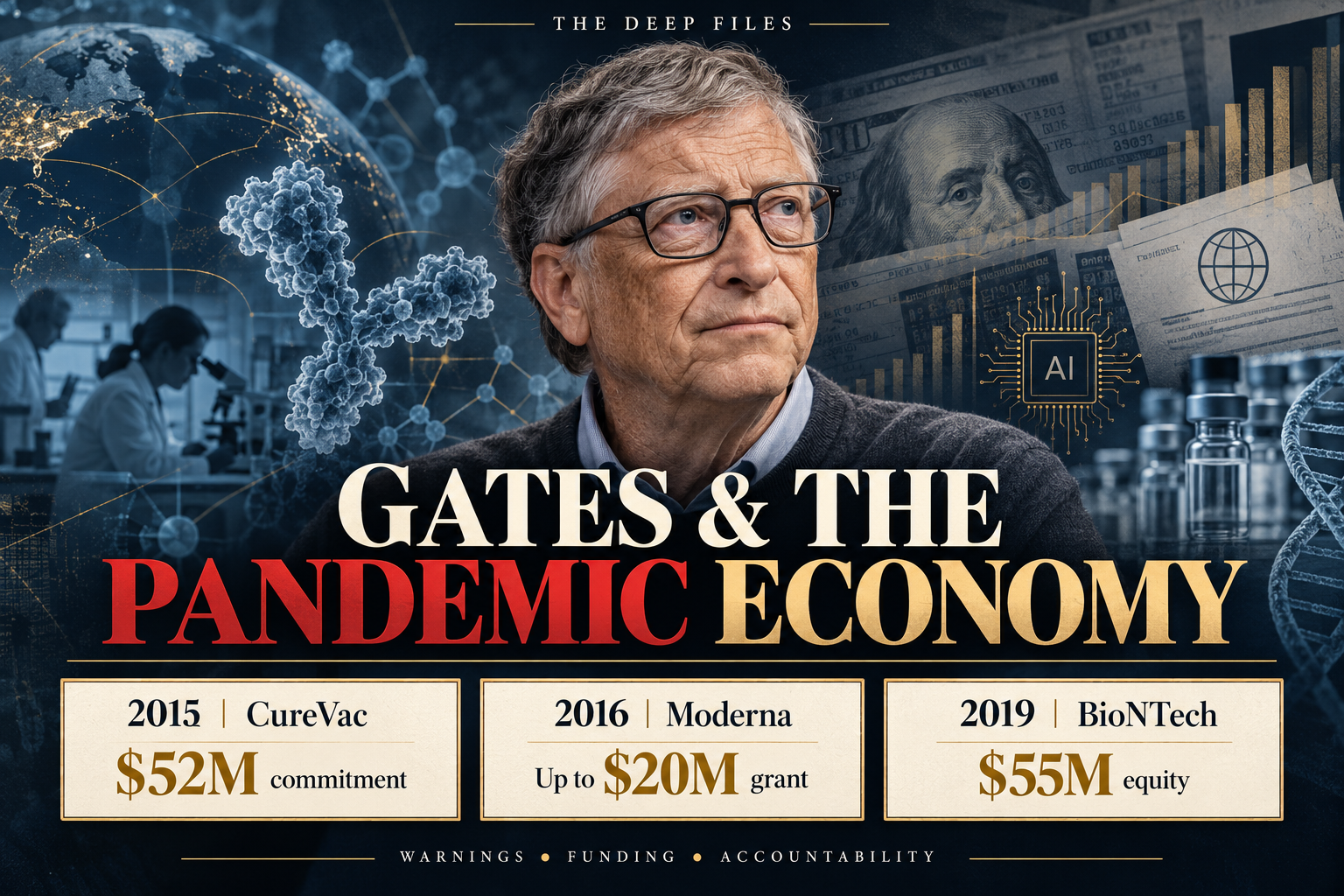
Investment and partnership documents establish the Gates Foundation’s involvement in vaccine technologies before COVID-19. What do these relationships reveal about money, influence, and accountability? And what do they fail to establish about advance knowledge of the pandemic?
Author’s Opening Assessment: The Pandemic Threat Ahead
Based on the fact-finding I have undertaken, the testimony I have examined, and the scientific and technological developments I have reviewed, my personal assessment is that humanity is moving toward a growing danger: a future pandemic whose consequences could exceed those of a nuclear attack.
This is my investigative judgment, not a scientifically established prediction. The comparison expresses my assessment of potential human devastation; it does not establish that a particular pandemic is inevitable or that its timing, origin, or scale can presently be known.
Artificial intelligence is central to this concern. Its potential contribution to biological weapons development lies in its ability to interpret complex research, connect findings across disciplines, and reduce some of the expertise needed to misuse scientific knowledge.
As THE DEEP FILES’ investigation, Biological Weapons and Their Creation via AI, puts it:
“The risk is therefore not simply information disclosure.
It is capability amplification.”
Read Biological Weapons and Their Creation via AI
The concern is particularly serious when AI assists someone who already possesses relevant training or access to laboratory infrastructure. It may fill knowledge gaps and amplify existing capabilities. That does not mean a chatbot can independently manufacture a biological weapon: physical infrastructure, practical expertise, materials, and validation remain substantial barriers.
The same analytical capabilities that support legitimate medical research may also assist malicious users. That dual-use problem is the focus of the earlier investigation.
This is the context in which I examine Bill Gates’s pandemic warnings, research funding, and vaccine investments. The seriousness of emerging biological risks demands scrutiny of those relationships. It does not, by itself, establish wrongdoing, advance knowledge, or responsibility for any outbreak.
Warnings, Funding, and the Accountability Question
For years before COVID-19, Bill Gates warned that the world was unprepared for a large-scale pandemic. During the same period, his foundation funded research and companies working on technologies subsequently used to develop vaccines against the virus that disrupted the world.
This overlap warrants an investigation that goes beyond the public image of philanthropy: When did the funding begin? Did it involve grants or share purchases? What rights did the foundation obtain? Who benefited financially? And were adequate safeguards established when advocacy for health policies overlapped with financial interests in the sector that could benefit from them?
The answers begin with an accurate chronology. The records reviewed for this investigation do not establish a simultaneous investment in Moderna and BioNTech in 2018 and 2019. They reveal a longer sequence: an announced investment in CureVac in 2015, a funding partnership with Moderna in 2016, and an equity investment in BioNTech in 2019. Nor do they establish that Gates knew in advance that SARS-CoV-2 would emerge or that he participated in causing the pandemic.
The Early Warnings: What Did He Actually Say?
In May 2005, Gates addressed the World Health Assembly about infectious diseases and vaccines, including the need for an HIV vaccine and for prevention tools to reach poorer countries. In August 2006, at the International AIDS Conference, he emphasized that expanding treatment could not be sustained effectively without reducing new infections.
These materials establish his early interest in viruses and prevention, but they do not constitute a specific prediction of COVID-19. Discussing the existing HIV pandemic is different from warning about a future respiratory pandemic.
His best-known warning came in his 2015 TED talk, “The Next Outbreak? We’re Not Ready.” Gates discussed the possibility that a highly infectious virus could cause a human catastrophe, drawing lessons from Ebola about weaknesses in the international response and calling for trained teams, simulations, and investment in preparedness.
This was a clear warning about a general epidemic threat. It did not identify SARS-CoV-2, the city where it would emerge, or the timing of the COVID-19 outbreak. Describing the talk as a “prediction of coronavirus” therefore requires this essential qualification.
Nor was pandemic risk an idea unique to Gates. The World Health Organization had issued a global influenza preparedness plan in 2005 and updated its guidance in 2009. His statements therefore belonged to an institutional and scientific discussion already underway years before his talk.
2017 and 2018: Pandemics as a Security Threat
In his 2017 Munich Security Conference speech, Gates shifted the discussion toward the relationship between health and security. He addressed the possibility of a pandemic arising naturally or through a deliberate act, calling for surveillance, response capabilities, and the development of countermeasures.
The speech establishes that he viewed epidemics as a strategic threat requiring preparedness comparable to security planning. Its text does not support treating his discussion of possible scenarios as an admission that a specific operation existed.
In his Shattuck Lecture on April 27, 2018, Gates presented a simulation involving a highly contagious and lethal airborne pathogen that could, under the scenario shown, cause approximately 33 million deaths within six months.
That figure was the result of a conditional simulation, not a definitive forecast of the death toll of a coming pandemic. The lecture also addressed vaccines, treatments, diagnostics, and preparedness for pathogens that might be unknown before their emergence.
These statements raise a legitimate question: How did Gates translate his assessment of these risks into funding and investment decisions? Company documents provide part of the answer.
CureVac: An Investment Five Years Before COVID-19
On March 5, 2015, the Bill & Melinda Gates Foundation and CureVac announced the foundation’s commitment to invest $52 million to support the development of the company’s mRNA platform and the construction of an industrial production facility.
This matters for two reasons: the funding preceded the pandemic by years, and it targeted a technology platform and production capabilities rather than an announced COVID-19 vaccine.
A retrospective assessment must also include the investment’s setbacks. CureVac reported overall efficacy of approximately 48% for its first COVID-19 vaccine candidate, CVnCoV, in its pivotal trial. It subsequently withdrew the candidate from the European approval process in 2021, according to its reports.
Including CureVac prevents the account from being reduced to a claim that the foundation selected only the eventual winners in advance. This does not resolve questions about intentions, but it adds an essential fact: investment in the platform did not guarantee a successful product.
Moderna: A 2016 Grant, Not a Share Purchase Under This Agreement
On January 12, 2016, Moderna announced a partnership with the Gates Foundation to develop an mRNA-based approach for producing a combination of antibodies intended to prevent HIV infection.
The announcement specified a grant commitment of up to $20 million, with the possibility of follow-on projects bringing total funding to as much as $100 million. This does not mean that the full $100 million was disbursed, and the announcement itself does not establish that the foundation owned Moderna shares.
Moderna’s 2018 annual report, filed with the U.S. Securities and Exchange Commission, confirms that the framework agreement began in January 2016. The appearance of this funding in a disclosure covering 2018 therefore does not make 2018 the starting date of the relationship.
This distinction is fundamental: the date of a document describing an agreement may differ from the date the agreement was signed. A grant can also support a commercial company and its technology without giving the funder an ownership stake.
BioNTech: Equity Ownership Before the Pandemic
On September 4, 2019, BioNTech announced a partnership with the Gates Foundation involving an initial equity investment of $55 million, with the possibility of additional funding bringing the total to $100 million.
The stated purpose was to develop HIV and tuberculosis programs and expand the company’s infectious disease research infrastructure. The announcement also stated that the company would retain commercialization rights for the relevant products in established healthcare markets while making them available at low prices to high-risk populations in affected countries.
The agreement filed with the SEC confirms that the transaction involved the purchase of ordinary shares rather than a simple donation. It also ties the investment to “Global Access” commitments and requires a legal opinion regarding its qualification as a program-related investment.
The arrangement is therefore specific: a charitable foundation acquired an ownership interest in a company and used that investment to obtain commitments concerning product development and access. Assessing the success of this model, however, requires tracing its implementation rather than relying solely on the purpose written into the agreement.
What Happened Between Pfizer and BioNTech in 2018?
Another agreement may explain the confusion in the chronology. When Pfizer and BioNTech announced their COVID-19 collaboration in March 2020, they explained that the relationship built on a collaboration established in 2018 to develop an mRNA influenza vaccine.
That agreement was between Pfizer and BioNTech and was separate from the Gates Foundation’s investment announced in 2019. It also illustrates how earlier work on an adaptable vaccine platform formed part of the foundation subsequently used against COVID-19.
The distinction matters because combining different agreements under a phrase such as “he funded two companies immediately before coronavirus” obscures the nature of each relationship and weakens the investigation.
Event 201: A Coronavirus Simulation Before the Pandemic
On October 18, 2019, the Johns Hopkins Center for Health Security, in partnership with the World Economic Forum and the Gates Foundation, hosted the Event 201 exercise.
The exercise used a hypothetical scenario involving a novel zoonotic coronavirus that spread to humans and caused a pandemic. It examined response issues, trade, finance, and public communication. The existence of this scenario before COVID-19 is a documented fact that deserves examination.
The organizer’s documents, however, describe it as a training exercise. In January 2020, the center issued a statement emphasizing that it had not been a prediction of the actual pandemic. This is the organizer’s explanation and should be presented as such alongside an assessment of the available evidence.
Similarity in the virus family does not, by itself, establish that the scenario matched the actual event or reflected advance knowledge of it. Establishing that would require independent evidence connecting those responsible for the exercise to specific information about the actual virus before its emergence. This investigation has not established such evidence.
Were the Investments Merely a Coincidence?
The more precise question is whether the companies were selected randomly or as part of a stated strategy.
According to an explanation published by the foundation in 2021, its investments in CureVac and BioNTech reflected the characteristics of mRNA platforms, including flexibility and the potential to accelerate vaccine development and address multiple diseases. This is its stated explanation for entering the sector early, and it can be tested against the contracts and actual projects.
The foundation also helped establish the Coalition for Epidemic Preparedness Innovations, or CEPI, in 2017. CEPI’s launch announcement records a foundation commitment of $100 million over five years, alongside funding from governments and other organizations.
There was therefore an ongoing funding strategy directed toward epidemic preparedness. Its choices and results can be scrutinized, but the existence of this strategy means that pre-pandemic funding was not, by itself, an unexplained event.
Profits: What Is Known, and What Has Not Been Established?
BioNTech’s 2021 financial results reveal the scale of the commercial transformation brought about by the pandemic: revenue rose to approximately €18.98 billion, and net profit reached approximately €10.29 billion. The company attributed the revenue increase primarily to demand for its COVID-19 vaccine.
These were company profits. They must not be presented as Gates Foundation profits or as Bill Gates’s personal earnings.
To establish the foundation’s return on a particular investment, an investigation must identify the shares it actually owned, changes in that ownership, sale dates and prices, and any dividends. Taking the highest market price and assuming that the entire holding was sold at that level produces a hypothetical figure, not a realized profit.
The materials reviewed for this investigation are not yet sufficient to present an audited account of the foundation’s return from sales of BioNTech shares. This remains an open research question, not a gap to be filled with unverified figures circulating elsewhere.
The Foundation, the Trust, and Personal Wealth
The foundation explains that its structure has included two separate entities since 2006: the foundation and the trust. The entity owning each investment must therefore be identified before attributing it to “Gates.”
The foundation also states that its strategic investments serve charitable purposes and that financial returns are reinvested in its programs. That is its stated position, which should be tested against disclosures and the flow of funds while preserving the distinction between its assets and its founder’s personal wealth.
Reinvesting returns in philanthropy, if established, does not close questions about influence or conflicts of interest. It does, however, change the nature of the financial claim that can be substantiated.
Where Does the Conflict-of-Interest Question Begin?
Investment in a pharmaceutical company is not, by itself, evidence of corruption. But the combination of funding, ownership, and advocacy for health policies justifies examining the safeguards intended to prevent decisions from being directed toward financial interests.
In its explanation of its financing position, the World Health Organization describes reliance on philanthropic funding, predominantly from the Gates Foundation. This adds an institutional dimension to the discussion: the influence of funders within an environment where decisions affecting public health are made. It does not establish that Gates controls the organization or determines its recommendations.
The investigable questions are specific: Were financial interests disclosed in relevant contexts? Were independent review mechanisms in place? Is there a documented instance connecting an intervention or recommendation to a benefit for a company partly owned by the foundation?
Answering these questions requires decision records, correspondence, and disclosures—not simply a map of relationships.
The Philanthropic Test: Did Vaccines Reach the Poor?
If serving disadvantaged populations was the justification for investment, product distribution provides a direct test of results.
In May 2022, a joint statement published by the World Health Organization reported that only 16% of people in low-income countries had received a single COVID-19 vaccine dose, compared with 80% in high-income countries.
This disparity does not establish that the Gates Foundation caused it, and responsibility cannot be assigned to a single actor. It does justify a rigorous examination of whether the partnership model and access commitments were adequate: Did the rights cover the relevant products? Were they enforceable? What was done when supplies were delayed or countries struggled to use them?
The scope of the contracts is critical here. Conditions governing HIV and tuberculosis programs cannot automatically be assumed to govern a COVID-19 vaccine. That must be established from the relevant agreements and amendments.
After COVID-19: Continued Advocacy for Preparedness
At TED in 2022, Gates proposed establishing a permanent international team to detect and respond to outbreaks, called GERM, as part of his vision for preventing outbreaks from becoming pandemics.
In a January 2025 interview with The Wall Street Journal, he estimated the probability of a natural pandemic occurring within the following four years at approximately 10–15%. This was an estimate attributed to him, not an established fact about the future.
In a CNN interview on September 27, 2026, he discussed the risks of artificial intelligence being used for bioterrorism, alongside post-COVID confidence in vaccines. These remarks illustrate his continuing interest in the relationship between emerging technologies and biological risks.
Questions Requiring Documented Answers
To close the remaining gaps, the following questions should be put to the foundation and the companies concerned, without treating them as established allegations:
- What amounts were actually disbursed for each project, compared with the announced funding ceilings?
- What is the record of ownership and sales of BioNTech and CureVac shares, the realized returns, and the entity that received them?
- What were the limits of access and licensing rights, and which applied to COVID-19 products?
- How did the foundation assess compliance with the commitments, and does it publish independent implementation reports?
- What mechanisms govern disclosure and the management of conflicts between financial ownership and health-policy activities?
- Which reports establish how the funds and returns were used for the stated purposes?
These questions were not submitted as part of preparing this draft, and no responses specific to this investigation have been received. No organization should therefore be described as having refused to answer.
The Findings Supported by the Documents
The documents establish that the Gates Foundation funded vaccine technologies and companies before COVID-19 and that some relationships involved equity ownership, alongside public warnings and support for epidemic preparedness initiatives.
These facts support a serious investigation into transparency, returns, fulfillment of philanthropic commitments, and the management of overlapping interests.
They do not establish that Gates knew in advance that the specific virus would emerge, caused the pandemic, or personally received the companies’ profits. Establishing any of those claims requires additional, independent evidence.
The strongest accountability inquiry begins with contracts, money, and decisions: What did the foundation own, what did it influence, and what did the public receive in return for the advantages granted to the companies?