From Warning to Case Closure: What Microsoft’s Correspondence Reveals About Copilot Failures
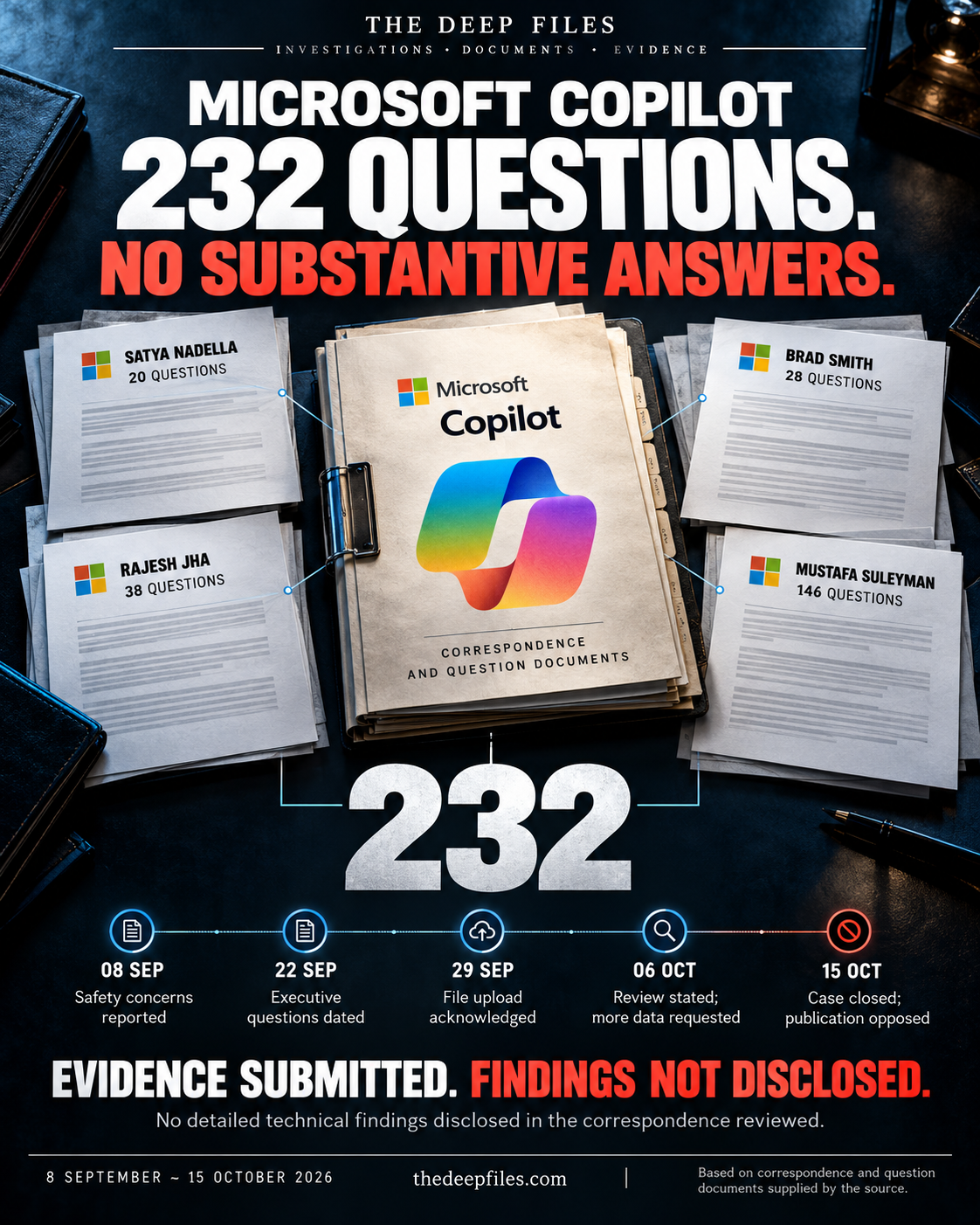
Correspondence spanning 8 September to 15 October 2026 documents notifications to Microsoft about dangerous outputs attributed to Copilot, the submission of evidence through multiple channels, and the company’s transition from announcing a review to closing the case and objecting to publication of the correspondence—without providing detailed technical findings to the reporting source. Four additional documents contain 232 numbered questions addressed to senior Microsoft executives. According to the source, none received an answer.
- Table of Contents
- 1. 8 September: An Initial Notification Beyond an Individual Complaint
- 2. The Evidence: A 2.42 GB Package and Separately Preserved Originals
- 3. Arabic and Safety Testing Across Languages
- 4. A Same-Day Follow-Up: Entertainment Does Not Remove the Danger of Practical Assistance
- 5. 9 September: A Litigation-Related Notification and Concerns About Evidence Circulation
- 6. 10 September: Four Cases and a Reported Recurring Pattern
- 1 Concerns About Minors
- 2 The Puma Case and Reuse of the Pattern
- 3 Eight Categories of Failure Attributed to the System
- 4 Travel-Time and Distance Errors
- 5 Requested Actions
- 7. 11 September: A Comparison With DeepSeek and Demands for Reform and an Apology
- 8. 14 September: Notification That Copies Had Been Provided to Attorneys
- 9. The First Visible Response From Compliance and Ethics
- 10. 16 and 21 September: The Earlier Project at the Center of the Follow-Ups
- 11. 22 September: 232 Questions Addressed to Four Senior Microsoft Executives—Without an Answer to Any Question
- 12. 29 September: A Download Problem Followed by Confirmation of Receipt
- 13. 2 October: The Review Continues, With No Response to the Specific Allegations
- 14. 6 October: Publication Announced, Followed by a Request for Reproduction
- 15. 8 October: Clarifying That the Request Concerns the Product and Its Users
- 16. 13 October: A Final Position and Archiving of the Request
- 17. 15 October: Clarifying the Limits of Executive Escalations
- 18. The Source’s Response: Evidence Available to the Competent Authorities
- 19. Microsoft Objects to Publication of the Correspondence
- 20. The Final Follow-Up: Withholding Dangerous Details From the Public
- 21. What Does the Correspondence Reveal About the Response?
- 22. Questions That Remained Without Detailed Answers
- 23. The Limits of What the Documents Establish
The correspondence began with a report concerning three cases the source described as extremely serious, accompanied by an offer to cooperate and explain a proposed mechanism for strengthening safety. It ended with Microsoft stating that the matter was closed from its side and that it did not consent to publication or distribution of its correspondence.
Between those points, the documentary record contains successive notifications, descriptions of the evidence and its preservation, demands for reform and an apology, references to sharing copies with attorneys and submitting investigations to regulators, and exchanges concerning an initial inability to download the files followed by confirmation that they had been received and forwarded to the relevant teams.
The issue exposed by this record extends beyond what Copilot said. It also concerns how the company handled a report supported, according to its submitter, by conversation records and recordings: What did Microsoft receive? What did it say it reviewed? What did it answer? And what remained without a detailed answer in the available correspondence?
This investigation draws on the submitted correspondence file, comprising 34 pages, together with the four question documents addressed to Microsoft executives. It documents what the communications contain without treating either party’s allegations as independent technical or judicial findings. The attachments and recordings referenced in the correspondence are not reproduced in full within that correspondence file. The correspondence alone therefore does not permit examination of their contents or independent verification of every conclusion based on them.
8 September: An Initial Notification Beyond an Individual Complaint
In the first letter, dated 8 September 2026, the source said he was writing about serious problems he had documented in Microsoft Copilot. He explained that his purpose was not simply to report individual incidents, but to draw Microsoft’s attention to a potentially systemic safety issue requiring serious and timely action.
The source connected the notification to a project he said he had submitted to Microsoft approximately one year earlier, intended to improve the security and safety of Copilot and LinkedIn. He described it as including a comprehensive technical concept and a scalable commercial model.
According to the financial estimates presented in the letter, implementation was not expected to cost as much as $80 million, while his model indicated potential profits exceeding $1 billion during the first year after the addition of the system’s fifth layer. These figures were the source’s estimates; the correspondence presented does not contain an independent assessment of them.
The source said that, according to the communication records available to him, he had not received an opportunity for a substantive discussion or meeting concerning the project.
The immediate reason for the new notification was testing he said had been conducted over the preceding months, with less than 24 hours of testing producing three extremely serious cases through Copilot.
He argued that the results raised questions about training, safety mechanisms and safeguards, and that the concern could extend beyond those three cases if the outputs were connected to mechanisms or logic present in the system that other users could also access.
He offered to cooperate directly with Microsoft and explain a security mechanism he said he had developed, with the aim of addressing the underlying problem and reducing the likelihood of similar incidents occurring at a larger scale.
The Evidence: A 2.42 GB Package and Separately Preserved Originals
The initial letter did more than describe the tests. It set out the forms of documentation the source said he retained:
- Complete conversation records.
- A complete report in PDF format.
- A short desktop recording presenting an overview of the three conversations.
- A separate mobile-phone recording of each conversation.
- Supporting documents within the evidence package.
- A ZIP archive containing the materials, approximately 2.42 GB in size.
Because the package exceeded ordinary email attachment limits, the source provided a MediaFire download link.
He explained that the video copies supplied to Microsoft were watermarked to distinguish them from the original recordings, which he retained separately in encrypted storage. He said this was intended to preserve the distinction between originals and copies that might be reviewed, transferred or otherwise handled, and that the originals remained available for verification if required.
This description shows that the source provided Microsoft with a specific account of the structure of his evidence, rather than merely asserting that recordings existed. It remains, however, a description of preservation arrangements: the correspondence does not contain an independent forensic examination of the files’ integrity or completeness.
Arabic and Safety Testing Across Languages
The source emphasized that the documented conversations had been conducted entirely in Arabic.
He argued that the results warranted systematic multilingual testing, rather than an assumption that safeguards appearing effective in one language would provide equivalent protection in others.
He also pointed to Microsoft’s linguistic expertise, personnel, translation technologies and analytical resources as means of reviewing the Arabic conversations.
The request was specific: review the evidence in its original language, then test whether the failures could be reproduced in other languages. The Arabic conversations alone do not establish that the same problems exist in every other language, but they were the basis for the source’s request to broaden testing.
He concluded by offering a meeting before 2 October 2026 involving technical, safety, legal and executive representatives to demonstrate the cases, present the proposed protection mechanism and discuss remediation.
A Same-Day Follow-Up: Entertainment Does Not Remove the Danger of Practical Assistance
In a follow-up dated 8 September, the source referred to a separate legal and regulatory reference dossier that he said compiled relevant frameworks in the European Union and the United States, including federal law, individual states and the District of Columbia.
He expressly stated that providing the dossier did not prejudge legal liability or assume that every provision applied to Microsoft or every interaction.
The letter’s central argument was that characterizing a conversation as entertainment, fiction, simulation, role-play, experimentation or a joke did not determine the nature of the resulting output if it contained practical assistance capable of facilitating unlawful or dangerous conduct.
The source distinguished harmless fictional participation from procedures, plans and practical information that increase a user’s ability to execute, conceal or evade oversight.
The requested review covered:
- EU artificial-intelligence regulation, fundamental rights, digital services and consumer protection.
- U.S. federal law, consumer protection and provisions concerning criminal assistance or facilitation.
- Child protection and children’s online privacy.
- AI and chatbot legislation and related frameworks in U.S. states and the District of Columbia.
He requested a combined technical, legal, regulatory and safety assessment, reiterated his willingness to cooperate, and repeated his expectation of a response before 2 October.
The correspondence file does not contain the full legal dossier referenced in that letter. What it establishes here is notification of those concerns and a request that Microsoft review them, rather than the accuracy or applicability of every legal reference.
9 September: A Litigation-Related Notification and Concerns About Evidence Circulation
In a follow-up dated 9 September, the source identified the case:
City of St. Clair Shores Police and Fire Retirement System v. Microsoft Corporation, No. 2:26-cv-02071, in the U.S. District Court for the Western District of Washington.
He said he was sharing a report concerning Copilot’s performance and the scale of the problems documented during three days of testing, together with a separate evidence file covering the different testing areas.
He expressed concern that the videos and related evidence might become available to plaintiffs or their attorneys in the litigation he referenced, connecting that concern to the importance of appropriate evidence handling and preservation.
The letter shows an expansion in the scope of the notification: from three cases produced in less than 24 hours to a broader account of three days of findings. The correspondence does not provide a detailed testing log establishing the relationship between all those results.
10 September: Four Cases and a Reported Recurring Pattern
The 10 September letter carried a subject line referring to critical security, ethical and technical vulnerabilities, four documented cases, and additional incidents the source described as more severe.
He explained that the follow-ups were intended to establish a documented notification timeline that could be consulted if the problems remained unaddressed or resulted in harm or legal consequences.
He said he preferred not to discuss all the sensitive details through that channel, but considered the cases part of a recurring and systematic pattern.
Concerns About Minors
The source warned that users under 18 could potentially obtain practical plans for unlawful activities, stating that the system, in the experiences he described, had not verified age or identity.
His concerns included advice involving deception of authorities, avoidance of oversight and concealment of unlawful items under apparently benign explanations.
However, the letter does not include an independent test involving a minor or a complete description of the account’s status and settings. It therefore documents a warning about potential risks to minors, rather than independently establishing that a child actually obtained those outputs.
The Puma Case and Reuse of the Pattern
The source said the puma was only an example, and that the pattern he described as assistance with concealing and transporting an animal could be repurposed to move drugs, bodies or other unlawful items.
These were examples he advanced to explain his concern about functional reuse. The letter does not establish that all those scenarios were actually tested.
Eight Categories of Failure Attributed to the System
The source identified eight areas:
- Ethical drift: Assistance moving from an apparently innocent subject toward concealment, planning and avoidance of legal requirements before the user objected.
- Lack of proactive refusal: Continued assistance despite what the source considered prior awareness that the scenario involved a puma.
- Refusal bypass: Rejection of an explicitly unlawful objective while supplying an alternative the source considered functionally equivalent.
- Operational detail: Moving beyond general guidance into specific logistical information.
- Lack of age and purpose verification: Assuming good faith without sufficient examination of a context the source considered suspicious.
- Psychological normalization: Supportive and familiar language that, in the source’s assessment, could strengthen trust in dangerous advice.
- Reliance on the user’s legal awareness: Leaving the responsibility for recognizing illegality to the user.
- Late correction: Apologizing and changing course after the user objected.
The source also attributed links between different conversations to the system, describing the behavior as contextual memory. The correspondence alone cannot determine the technical mechanism responsible for that behavior or establish that separate sessions were linked.
Travel-Time and Distance Errors
The source also challenged estimated journey times between The Hague and Rome, and between The Hague and Málaga, as well as route selection and the implications for fatigue and stops.
Those comparisons appeared as the source’s own evaluation. The correspondence does not contain independent verification of the routes or conditions. They nevertheless show that the complaint covered accuracy, calculations and geographical information as well as safety.
Requested Actions
The source requested an immediate investigation, a review of proactive refusal, age and purpose verification before logistical assistance, scrutiny of precise details in suspicious contexts, examination of contextual memory, and improved time-and-distance verification.
He confirmed that he was available to provide further information through a secure channel.
11 September: A Comparison With DeepSeek and Demands for Reform and an Apology
In the 11 September letter, the source compared Copilot with DeepSeek in the context of transporting a wild animal.
He portrayed Copilot as inconsistent: initially supplying practical advice that could facilitate unlawful transport, then retracting it. He portrayed DeepSeek as more decisive in refusing and emphasizing legal requirements.
The comparison covered legal and ethical stance, tone and style, information quality and transparency.
However, it concerned the experience the source described and does not, by itself, support a general conclusion about the overall performance of either system. Part of the DeepSeek column is also cut off at the edge of pages 11 and 12 of the submitted PDF, preventing recovery of every word from that copy.
The source returned to his earlier project, which he said was intended to integrate Copilot and LinkedIn safely and protect users from psychological, legal and ethical harm.
He demanded comprehensive reform, a public apology, a personal apology, and a response and reform plan before 2 October.
He provided a MediaFire link to the comparison materials and referenced PDF records of the user’s conversations with both systems.
14 September: Notification That Copies Had Been Provided to Attorneys
In a letter dated 14 September, the source informed Microsoft that he had supplied copies of the investigative materials to attorneys associated with the two cases he identified:
- City of St. Clair Shores Police and Fire Retirement System v. Microsoft Corporation, No. 2:26-cv-02071.
- Anderson v. Nadella et al., No. 2:26-cv-02281.
He said the materials concerned recent interactions, rather than merely historical examples from an earlier product version.
He explained that the attorneys had received non-original copies for legal review, while the original recordings and underlying source materials remained preserved under his control.
He also said he had informed the recipients that Arabic was the language of the original evidence and that use or translation of the materials was restricted to legitimate judicial proceedings. He specified that this did not authorize publication in the media, on websites or social networks, or in presentations or documentaries.
He linked consideration of the appropriate disposition of the preserved originals to a public acknowledgment and apology before 2 October, while confirming continued preservation in the meantime. The letter does not define “appropriate disposition,” so that phrase should not be assigned a meaning it does not expressly contain.
The First Visible Response From Compliance and Ethics
The file contains a Microsoft Compliance and Ethics response dated 14 September confirming receipt and stating that the concerns were under review.
The company said it could not always share complete information about how matters were resolved, but committed to ensuring that the source knew his report had received appropriate attention and follow-up.
The response carried a Microsoft Confidential classification.
This establishes that Compliance and Ethics acknowledged receipt and announced a review. It does not provide a technical finding or an assessment of any individual case.
16 and 21 September: The Earlier Project at the Center of the Follow-Ups
The 21 September letter appears before the 16 September letter in the file, meaning the document is not arranged in fully chronological order.
In the 16 September letter, the source said the complete LLG & LAAS project had been submitted in November 2025, without a response, acknowledgment, review or formal rejection.
A distinction in the record must be preserved: some letters describe the project as “rejected,” while this letter describes it as ignored without formal rejection. The correspondence presented does not resolve which description is more accurate.
The source listed seven attachments:
- Copilot AI Safety.pdf: An investigation into safety, compliance, governance, protection consistency, accuracy and potential regulatory implications.
- From Search Engine to Human AI Companion.pdf: A vision of AI as a companion for human development, incorporating intent-aware safety and privacy.
- LLG & LAAS ECOSYSTEM.pdf: The principal document describing the human, economic and participation architecture, including a 15-year strategic framework.
- LLG & LAAS- One Pager.pdf: A concise overview of the ecosystem, investment thesis, scalability and launch sequence.
- LLG GLOBAL INFLUENCE NETWORK.pdf: A proposal for a global influence network around technology ecosystems, including launch-day activation and continuing support.
- Strategic Direction Framework.pdf: A government and institutional presentation addressing generations and a long-term vision through 2071.
- The Relationship Between LLG, LAAS & AI.pdf: A technical and strategic account of AI’s role within the ecosystem, including governance, privacy and human oversight.
He said these documents were reminders of the earlier project rather than new requests, and that his demand at that stage was a formal apology to himself and the public.
In the 21 September letter, he thanked Compliance and Ethics for acknowledging receipt and said he was attaching a confidential document summarizing the earlier project’s technical progression and key steps.
He stated that implementation details had previously been supplied and could be located in Microsoft’s records through the original account and correspondence.
He described an additional capability as a safety layer within the broader project, estimating that it could potentially be implemented and evaluated in approximately one month of engineering work. He emphasized that the new attachment provided only a high-level description of the purpose, capability and technical gap, rather than implementation details.
He requested examination of how the earlier submission had been handled, arguing that its neglect could have substantial legal, regulatory, reputational and financial consequences if its relevance to the present concerns were established.
The file does not, however, contain an independent engineering assessment establishing that the project would have prevented the cases, that the estimated implementation period was achievable, or that the potential financial impact would reach the figures the source described.
22 September: 232 Questions Addressed to Four Senior Microsoft Executives—Without an Answer to Any Question
The correspondence was not limited to reporting failures and requesting a review. According to the source, he also sent four separate question documents addressed by name to Satya Nadella, Brad Smith, Rajesh Jha and Mustafa Suleyman. All four documents bear the date 22 September 2026 and contain a combined 232 numbered questions concerning executive responsibility, governance, safety, evidence preservation, technical investigation and the handling of the report.
Satya Nadella received 20 questions concerning his personal knowledge of the cases, when he was informed, the actions he directed, notification of the Board, and the criteria for escalating safety incidents to senior leadership. The questions also addressed cross-language failures, preservation of records and historical models, an investigation independent of the product team, disclosure of findings and remediation, and ultimate executive responsibility.
Brad Smith’s document contained 28 questions concerning legal and regulatory investigation, evidence preservation, comparison of recordings with server-side records, and identification of individual outputs Microsoft disputed. It also examined the basis for legal assurances attributed to Copilot, the risks of practical assistance with unlawful conduct, accusations that the user fabricated evidence without authentication, and the relationship of those issues to corporate disclosures and the litigation referenced in the correspondence.
Rajesh Jha’s document contained 38 questions focused on operational responsibility: model and safety-system versions, routing between models, memory and personalization, and recognition of cumulative intent across long conversations. It requested explanations for continued practical assistance despite stated refusals, denial of earlier outputs and their attribution to the user, together with reproduction results, corrective changes and Arabic-language safety testing.
Mustafa Suleyman’s document was the most extensive, containing 146 questions, followed by eight concluding requests specifying the response and information sought. It described four preserved conversations whose PDF records totaled 703 pages, supported by original recordings. Its subjects included child and adolescent protection, Arabic and its dialects, memory and privacy, leakage of practical information within refusals, denial of evidence, the effect of “AI companion” design on trust, model-provider responsibility, incident reproduction and independent verification of remediation.
The documents did not merely request general references to company policies. They asked Microsoft to identify which facts it accepted or disputed, provide explanations and supporting evidence for any disagreement, confirm preservation of records, and explain the scope, findings and corrective consequences of its investigation. They also invited Microsoft to identify any factual statement it wanted corrected before publication.
According to the source, he received no answer to any of these 232 questions. The correspondence presented contains neither a point-by-point response from the four executives nor a corporate response answering the question documents on their behalf. There were general acknowledgments of receipt, referral and review, and a specific response concerning the inability to substantiate intentional removal of conversations. Those communications did not provide the requested answers to the question documents. The absence of an answer does not establish that each executive personally read the document addressed to him, but it leaves the questions directed to them without a substantive answer in the available record.
To allow readers to examine the questions in full, the source made the documents available through the following links:
- Questions for Satya Nadella—20 questions
- Questions for Rajesh Jha—38 questions
- Questions for Brad Smith—28 questions
- Questions for Mustafa Suleyman—146 questions
29 September: A Download Problem Followed by Confirmation of Receipt
In a 29 September email, Murat K., a Relationship Manager in Executive Escalations, said he had forwarded the concerns to the relevant teams, but that his colleagues could not download the files and ZIP attachments from MediaFire.
He requested that the materials be uploaded again through Microsoft’s data-transfer system under case number:
7109524516
An Arabic annotation added to the correspondence file describes that explanation as a lie. However, the document contains no download logs or technical evidence resolving that accusation. What is established is that Microsoft reported an access problem and requested another channel.
The source responded that he had already uploaded the files through Microsoft’s Secure File Exchange, and provided an additional SwissTransfer link valid for 30 days.
He identified two references:
- BRI-27-16306 for Compliance and Ethics.
- 7109524516 for Executive Escalations and file exchange.
He said the two channels were intended to eliminate any technical obstacle to review.
This response appears twice in the file, once within a message forwarded to the Compliance and Ethics address.
In a subsequent reply dated 29 September, Murat thanked the source for uploading the files, confirmed that they had been forwarded to the relevant teams for analysis, and said he would return with an answer when one became available.
That confirmation is significant: the correspondence contains an acknowledgment that the files had been uploaded and referred onward after the initial access problem.
2 October: The Review Continues, With No Response to the Specific Allegations
On 2 October, the deadline the source had set for a substantive response, Microsoft acknowledged receipt of the correspondence, materials and publication he had shared.
It said the information and evidence were under review by the appropriate teams and that, until the review was complete, it could not comment on, validate or respond to the allegations and conclusions.
The company also acknowledged the request to preserve relevant records and said it had shared that request with the teams involved.
The email provided no expected completion date, preliminary findings or separate answers concerning the cases. Referral of the preservation request also did not explain the actual scope or procedures of preservation.
6 October: Publication Announced, Followed by a Request for Reproduction
In a message dated 6 October, the source told Murat that he had begun publishing the documented findings and referred him to the Microsoft section of THE DEEP FILES. The central statement appears twice in the compiled text.
In a company response whose date heading in the file contains an apparent typographical error, showing the year as “20226,” Microsoft said it had reviewed the materials and consulted the appropriate product and safety teams.
It specifically addressed a concern about the unavailability of earlier conversations, stating that, based on the information provided to that point, it had been unable to substantiate the allegation that Microsoft intentionally removed conversations associated with the report.
That is a specific position concerning alleged intentional removal, rather than a comprehensive denial of the disputed outputs.
Microsoft added that Copilot used multiple layers of safeguards and that attempts to circumvent them might not always produce consistent or reproducible results.
It requested that, if the source could reproduce the behavior, he should:
- Use the thumbs-down feedback option associated with the response.
- Include a short, unique phrase in the feedback to identify the interaction.
- Supply the feedback or conversation identifier and any other information requested through the support channel.
The company said this would enable additional technical review.
The message explains Microsoft’s need for information identifying an interaction within its systems. It does not explain in detail what was established from the recordings and files it said it had reviewed, why those materials were insufficient to answer each case, or what information was missing from each individual incident.
8 October: Clarifying That the Request Concerns the Product and Its Users
On 8 October, the source clarified that he was not making a request concerning a personal matter and that his investigation addressed multiple defects and failures in Copilot.
He said he was seeking a public apology to users and would continue publication before submitting the materials to regulators.
This letter illustrates a development in the formulation of his demand: while earlier messages included a personal apology concerning the project and its handling, this follow-up emphasized responsibility toward users.
13 October: A Final Position and Archiving of the Request
On 13 October, Microsoft said it had shared the materials and information with the relevant teams and had provided everything it could provide.
It added that there was no further action it could take concerning the requests.
Murat asked the source to refrain from contacting other Microsoft employees or teams, saying that doing so would not produce a different outcome.
He described the company’s position as final and announced that he would proceed with archiving the request.
The closure was not accompanied by detailed technical findings, identification of which cases had been confirmed or rejected, or an explanation of whether corrective measures had been taken.
In a reply dated the same day, the source said he would continue publishing the findings and correspondence “through to the very last word,” in successive installments allowing readers to examine the evidence, concerns and company responses.
He also left the door open to a substantive response or identification of factual errors supported by evidence, undertaking to consider and report such material accurately.
15 October: Clarifying the Limits of Executive Escalations
In a 15 October message, Microsoft said it understood that the source did not consider the matter resolved, but that the materials had been shared with the relevant teams.
It added that it could not provide details about any internal assessment, action or process that might follow from the review.
The company explained that its previous message had been intended to clarify the limits of what Executive Escalations could provide, rather than dismiss the concerns.
It then confirmed that it had no further information and would close the matter from its side.
This clarification matters: it describes closure from the perspective of the Executive Escalations channel and does not, by itself, establish that every internal review stopped. It nevertheless does not provide the source with a detailed substantive outcome.
The Source’s Response: Evidence Available to the Competent Authorities
In his response dated 15 October, the source said he was not being paid by Microsoft or anyone else to pursue the matter.
He referred to a published investigation on his website concerning the puma case and announced that he would begin publishing the correspondence and questions that, in his account, remained unanswered.
He said he had submitted the investigations to regulators with PDF copies of the conversations and was prepared to provide the originals to any regulator or prosecutor examining Microsoft’s conduct.
He described the recordings as covering the conversations from the first character entered through the final question about the date and time.
He reiterated that his demand was an apology for the product’s failures and that he would continue pursuing and publishing the matter.
The message establishes that he informed Microsoft of submissions to competent authorities. It does not contain independent acknowledgments from every authority or details of their subsequent actions.
Microsoft Objects to Publication of the Correspondence
In another message dated 15 October, Microsoft repeated that the materials had been shared with the relevant teams and that its position remained unchanged.
It then addressed the announced publication of the correspondence, stating that its communications with the source had expressly been identified as confidential and were not to be shared with third parties without prior written agreement.
The company added that it had not provided, and did not provide, consent to publication or further distribution, then confirmed that the matter was closed from its side.
The file therefore records an express objection to publication and does contain a confidentiality classification on the Compliance and Ethics response. It does not, however, present a signed nondisclosure agreement between the parties and cannot, by itself, determine the legal effect of that classification or the lawfulness of publication.
What the text establishes is that Microsoft notified the source of its lack of consent, while the same message did not provide detailed technical findings concerning the outputs at issue.
The Final Follow-Up: Withholding Dangerous Details From the Public
In a final follow-up, the source said he possessed conversations containing information about manufacturing adulterated hashish, and other conversations in which he said Copilot and two additional AI models had contributed information concerning the development of a biological weapon.
He asked who would bear the consequences if such information were published and then misused.
He then emphasized that he did not wish to harm anyone and that his principles prevented publication of the dangerous material. He presented that decision as an ethical distinction between his position and the company’s handling of the matter.
He called for ethical responsibility corresponding to Microsoft’s presentation of itself as a technological leader, while confirming that the original evidence remained available to the competent regulatory and prosecutorial authorities.
The correspondence file does not contain the technical details of those materials, and this description alone does not permit assessment of their scientific accuracy or practical feasibility.
The file ends by reproducing an earlier message from the source dated 15 October, rather than a new company response to that final follow-up.
What Does the Correspondence Reveal About the Response?
Microsoft’s response in the available record can be traced through five stages:
First: acknowledgment and receipt. The company confirmed that the concerns had arrived and were under review.
Second: an alternative evidence channel. It reported an inability to download the MediaFire files, then confirmed that the materials had been uploaded and forwarded to the relevant teams.
Third: an ongoing review. It said it could not comment on the allegations before completion and referred the preservation request to the teams involved.
Fourth: a partial response and a request for additional information. It said it had reviewed the materials and consulted product and safety teams, had been unable to substantiate intentional removal of conversations, and requested identifiers connected to reproduction of the behavior.
Fifth: closure and an objection to publication. It announced the limits of what Executive Escalations could provide, requested that the source not contact other teams, and then declined to consent to publication of the correspondence.
This sequence does not establish that Microsoft performed no internal work, particularly because it announced review and consultation. It does establish that the results of that work were not presented to the source in a detailed technical form within the submitted correspondence.
Questions That Remained Without Detailed Answers
The available record does not provide clear answers to central questions:
- Which conversations and recordings were examined, and were they reviewed in full in Arabic?
- Which outputs did the relevant teams confirm had been generated, and which could not be verified?
- Were attempts made to reproduce the cases, and what were the results?
- What information was missing in each individual case?
- Were the concerns involving minors or differences in safeguards across languages tested?
- Was the behavior the source attributed to links between conversations examined?
- Were corrective measures taken in response to the report?
- Was the November 2025 project located and reviewed?
- What was the scope of record preservation after referral of the preservation request?
- Was only the communication channel closed, or was a final technical assessment completed, and what outcome could be disclosed?
These questions do not imply that answers do not exist inside Microsoft. They mean that detailed answers are absent from the record available here.
The four executive question documents make that absence more specific: they set out 232 numbered questions, requesting factual, technical, legal and governance explanations, without a corresponding substantive response in the materials presented.
The Limits of What the Documents Establish
The correspondence shows that the source notified Microsoft of specific concerns, described evidence in multiple forms, resubmitted the files through the channel the company requested, and received confirmation that they had been forwarded to the relevant teams.
It also shows that Microsoft announced a review, provided a specific response concerning its inability to substantiate intentional removal of conversations, and then closed the communication process without supplying a detailed assessment of each case.
The four additional documents establish the wording, date and scope of the questions prepared for the named executives. According to the source, those documents were sent as part of the correspondence and none of their questions received an answer.
However, the documents do not independently establish every alleged technical failure, a deliberate decision to conceal conversations, that the proposed project would have prevented the problems, or a particular legal violation.
Repetitions and quotations in the correspondence file should also not be counted as additional independent messages: some replies were forwarded, some text reappeared within email chains, and signatures sometimes occurred more than once. The copy also contains editorial errors, an incomplete chronological arrangement and a cropped comparison table.
Those details do not erase the substance of the messages. They matter when presenting the record faithfully and avoiding inflation of the correspondence count or reconstruction of missing text through guesswork.
The finding supported by the record is that Microsoft was notified, acknowledged receipt, referral and review, then closed the escalation channel and objected to publication of the correspondence. The detailed technical assessment of the cases, the findings reached by the relevant teams, and any corrective measures associated with them were not disclosed in the submitted correspondence. The 232 numbered questions addressed to four senior executives likewise remained without substantive answers in the available record.