How One of PIF’s Largest Housing Bets Went From a Project Targeting Nearly 400,000 Homes to a Dispute Over Funding, Accountability, and Bonuses
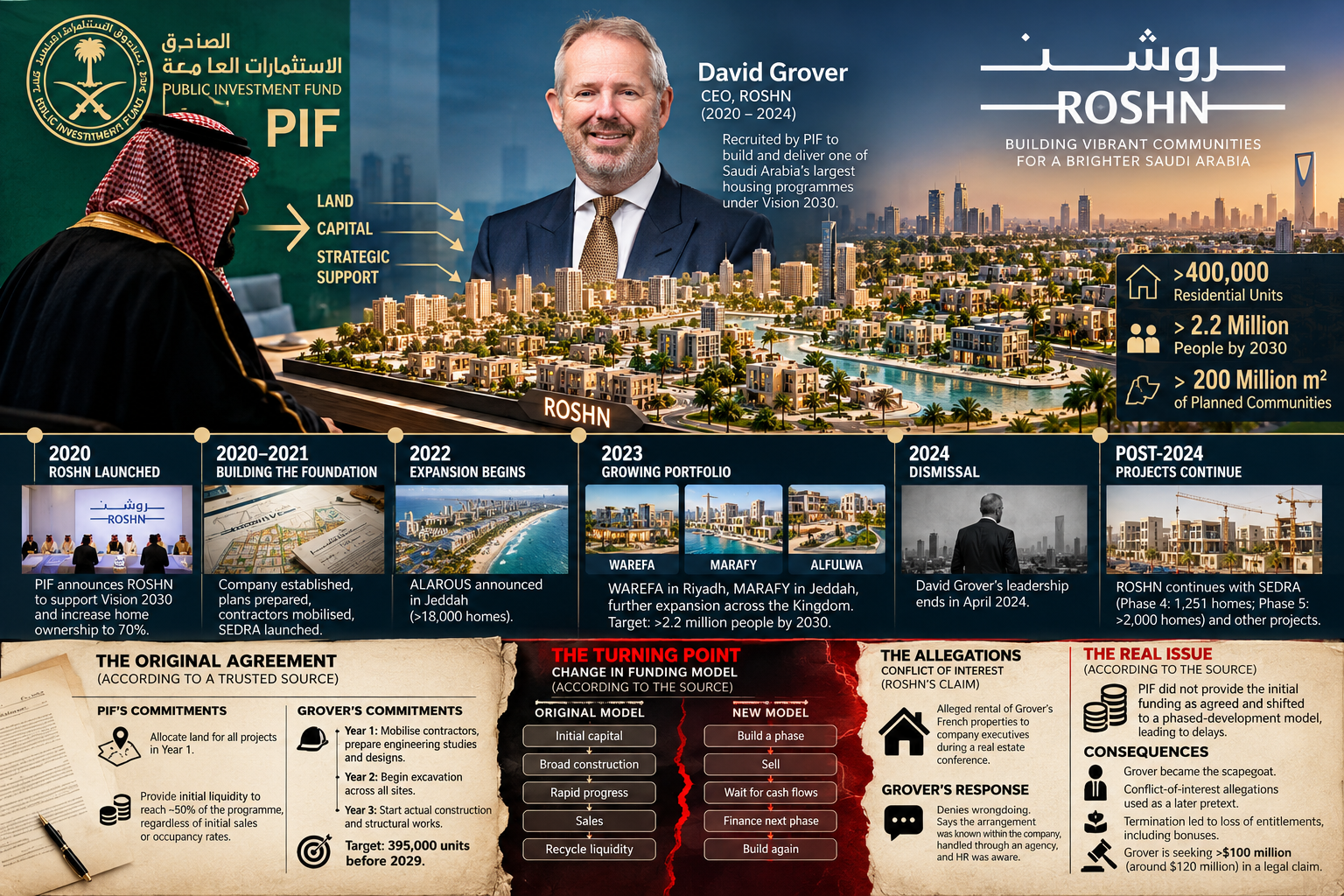
On 19 August 2020, Saudi Arabia’s Public Investment Fund (PIF) announced the launch of ROSHN Real Estate Company. This was not the announcement of a conventional real estate developer, but of an entity expected to play a direct role in achieving one of the most important objectives of Vision 2030: increasing home ownership in the Kingdom to 70%, building integrated communities, stimulating the construction, building-materials and infrastructure sectors, and creating jobs.
Later, the publicly stated scale of the ambition became enormous: more than 400,000 residential units and more than 200 million square metres of planned integrated neighbourhoods.
But less than four years after the company was launched, the man brought in to lead it, David Grover, was gone and became involved in a legal dispute in which he sought more than $100 million, while ROSHN maintained that his termination was connected to a conflict of interest, and Grover argued that his dismissal was wrongful and that bonuses and contractual amounts due to him had not been paid.
According to information obtained by this investigation from a trusted source, however, behind this dispute lies a story far deeper than a case involving properties in France or an alleged conflict of interest.
According to the source, the issue began with the funding itself.
1. August 2020: PIF Establishes ROSHN
The initial official announcement was clear about the strategic responsibility.
PIF launched the company, owns it, and linked its establishment to its investment strategy and the Vision 2030 programme. The objective was to create integrated urban communities across the Kingdom, develop the housing sector, attract private-sector participation, and support the construction and building-materials industries.
In PIF’s 2021–2025 strategy, ROSHN’s scope was described as extending across four regions and more than nine major cities. The first community in Riyadh alone was planned across more than 20 million square metres and was expected to contain more than 30,000 homes.
From the outset, therefore, this was not a small project.
It was a national programme requiring land, liquidity, contractors, infrastructure, planning, engineering, and an enormous supply chain.
This is where David Grover entered the picture.
2. Why David Grover?
Grover came from a long British background in construction and development and had previously held a senior executive position at Mace.
According to later reporting concerning the legal dispute, PIF recruited him in 2020 to lead ROSHN and contribute to the implementation of the housing programme associated with Vision 2030.
This is a very important point when assessing subsequent responsibility.
Grover did not inherit a company that had been operating for decades.
He effectively entered during the establishment phase of a company that had to build its administrative structure, prepare its plans, recruit contractors and suppliers, and then move into implementation on a national scale.
According to the source who spoke to this investigation, the agreement was not simply:
“Go and build 400,000 homes.”
There was a specific implementation and funding plan, with responsibilities divided between PIF and ROSHN’s management.
3. The Original Agreement According to the Source: PIF Funds, Grover Executes
According to the investigation’s trusted source, the business plan and agreements between the parties contained reciprocal obligations.
PIF was required, according to the source, to allocate the land required for the projects during the first year and provide the liquidity necessary to reach approximately 50% implementation of the programme, irrespective of initial sales levels or occupancy rates.
Why?
Because, in its initial phase, a project cannot sell homes that have not yet been built quickly enough to finance the construction of hundreds of thousands of units.
Initial funding, according to the source, was the fuel required to start the project’s economic cycle.
In return, Grover and his management team had responsibilities that were clearly distributed over time: the first year was for mobilising contractors and preparing engineering studies, plans, and designs; the second year was for beginning excavation works across the sites simultaneously; and the third year was for moving into actual construction and structural works.
The source says that the contractual target was 395,000 residential units before 2029.
That figure is extremely close to the scale PIF itself would later publicly describe as 400,000+ homes.
4. Grover Begins Implementation: SEDRA
ROSHN did not remain merely a plan.
SEDRA became the company’s flagship project in Riyadh.
ROSHN today describes SEDRA as a community covering 20 million square metres and containing approximately 30,000 homes across eight phases.
This matters when evaluating Grover’s performance.
The company’s initial years were not years of complete inactivity. ROSHN moved from being a newly established entity to a company with a master plan, actual projects, contracts, sales, and construction activity.
5. Expansion Beyond a Single Project
In May 2022, ROSHN announced ALAROUS in Jeddah.
That project alone covers approximately 4 million square metres and targets more than 18,000 residential units. ALAROUS was ROSHN’s second integrated community project.
Expansion continued.
WAREFA emerged in eastern Riyadh, with Grover himself announcing the project as a continuation of the company’s mission to establish new communities across the Kingdom.
ROSHN’s portfolio also expanded into the Eastern Province and other projects.
By 2023, the company was publicly discussing SEDRA, ALAROUS, WAREFA, and ALFULWA.
Then came an even more ambitious project.
6. MARAFY: Grover Moves ROSHN to Another Level of Development
In 2023, ROSHN launched MARAFY in Jeddah, a mixed-use development centred around a massive man-made canal.
Grover described it at the time as a project capable of becoming a game changer in the real estate development sector.
By 2023, therefore, the company he had taken over during its infancy was no longer merely an idea on paper.
It had projects in Riyadh, Jeddah, and the Eastern Province and was developing communities and multi-asset projects.
In June 2023, PIF itself announced that ROSHN aimed to develop homes capable of accommodating more than 2.2 million people by 2030.
Grover was the chief executive publicly representing the company and explaining its vision.
7. So, Did Grover Fail to Build a Company?
This question must be separated from an entirely different question: did ROSHN complete the entire original programme?
The answer to the second question is no.
But the claim that Grover failed to build and operate the company does not sit easily with the publicly available record.
During his leadership, ROSHN went from an establishment announcement in August 2020 to a portfolio of major projects across several regions, successive phases of SEDRA, and the development of ALAROUS, WAREFA, MARAFY, and others.
More importantly, SEDRA was not merely a master plan; it later became an inhabited community. ROSHN says today that thousands of residents live there and that schools, shops, and facilities have begun operating.
The correct question, therefore, is not:
Why did Grover do nothing?
It is:
Why did this initial momentum not translate into simultaneous implementation on the scale originally planned?
And here, the source’s information leads directly to the funding issue.
8. The Turning Point: Changing the Funding Model
According to the investigation’s trusted source, a fundamental change occurred after the agreement.
The source says PIF did not continue with the initial funding model upon which Grover’s plan had been built.
Instead of providing the liquidity required to push a large number of sites and phases into construction simultaneously, the programme moved towards a phased-development model, tying expansion more closely to sales, project-generated cash flows, and fundraising.
If this account is correct, the change was not a minor accounting detail.
It changed the entire programme.
The first plan, according to the source, was:
Large initial capital → broad simultaneous construction → rapid progress → sales → recycling liquidity into subsequent phases.
The alternative model becomes:
Build a phase → sell → wait for cash flows → finance another phase → build again.
There is an enormous difference between the two models when discussing a programme approaching 400,000 homes.
9. Why Was Initial Funding Critical?
According to the source, the contractor-payment mechanism itself was designed to reduce the burden on PIF.
The entire value of the project did not have to be paid on day one.
Payments were linked to stages of completion.
This meant that providing initial financing would allow sites to be opened, excavation to begin, construction to start, and contractor payments to be made progressively as work advanced.
The source’s account says that if ROSHN had reached even approximately one-quarter of the planned stages by the end of 2024, a substantial base of units would have become saleable, or advanced enough in construction to generate cash flows, allowing the programme gradually to begin financing part of itself.
This leads to the investigation’s central hypothesis:
The problem was not necessarily that the project was incapable of generating money, but that insufficient initial capital was provided to reach the point at which it could generate money at the required scale.
10. Who Was Responsible for the Gap?
If the contractual plan was indeed as described by the source, responsibility becomes clearer.
Grover was responsible for building the organisation, preparing the projects, mobilising contractors, designing, and executing.
PIF, according to the source, was responsible for the land and initial capital.
During Grover’s years, the company demonstrated that it could launch projects, contract, construct, and sell.
But according to the source, it did not receive financing at the scale required to allow it to turn dozens of sites and phases into simultaneous construction zones.
The investigation therefore raises the question:
How can a chief executive be held responsible for failing to execute a plan if the owner itself changed one of the most important assumptions upon which that plan was built: funding?
11. April 2024: The Dismissal of the Man Who Built ROSHN
In April 2024, Grover’s leadership of the company ended.
At this point, two radically different accounts emerge.
According to information that later surfaced in the legal dispute, ROSHN says the case involved a conflict of interest connected to the rental of properties owned by Grover in France to company executives or employees during a real estate conference.
Grover denies wrongdoing and says the arrangement was known within the company, that the transaction was handled through an agency, and that human resources were aware of it.
But the source who spoke to this investigation provides an entirely different explanation.
According to the source, the conflict-of-interest issue was not the fundamental reason for removing Grover.
It was a subsequent pretext.
12. The Source’s Account: The Problem Was the Failure of Funding
According to information obtained by the investigation, the central problem was that PIF did not provide liquidity according to the original model and did not successfully raise sufficient financing from the market during the initial years to maintain the implementation schedule.
The result was clear:
The programme fell behind its original trajectory.
But acknowledging that the cause resulted from a change in funding strategy would have placed responsibility elsewhere.
According to the source, Grover became the scapegoat.
The source says that conflict-of-interest allegations were used to provide another explanation for terminating his employment, while the Saudi public was not given the complete picture concerning the original plan, the scale of financing that was supposed to be provided, and what was subsequently changed.
13. The Paradox: Grover Is Dismissed While the Results He Built Continue
There is another aspect that deserves scrutiny.
After his departure, ROSHN did not abandon SEDRA or the broader community-development model developed under his leadership.
Instead, it continued selling and developing phases of SEDRA.
SEDRA Phase 4, for example, was launched in early 2024 and included 1,251 homes in one release.
Today, SEDRA has moved into Phase 5, adding more than 2,000 additional homes.
This creates an important question:
If Grover had failed administratively to an extent sufficient to justify his dismissal, why did the company continue after his departure to build upon the projects, strategy, and real estate product developed during his leadership?
That fact alone does not prove that his dismissal was wrongful, but it makes examining the actual reasons for his termination significantly more important.
14. Then Came the $100 Million Case
Grover did not accept the termination.
Published reporting concerning the legal dispute says that he sought more than $100 million, with the figure reported at later stages reaching approximately $120 million.
The claims reportedly concern what Grover considers wrongful termination, performance-related bonuses, and rights arising from a multi-year contract that was supposed to run until 2029.
This is where the funding issue connects directly with the dismissal.
If the chief executive’s bonuses were linked to performance, and if the assessment of that performance depended upon implementation of a massive programme, and if implementation depended upon financing that the owner was responsible for providing, the question becomes:
Can the CEO be held responsible for targets that became impossible to achieve according to the original timetable after the company’s owner itself changed the funding model?
15. Was the Conflict-of-Interest Issue the Cause or the Instrument?
This is one of the investigation’s most important questions.
An allegation emerged in the context of the dispute.
Grover denied it.
And according to the source, there is a funding story that predates and outweighs the French-property issue.
The chronology must therefore be reconstructed:
2020: PIF launches ROSHN and recruits Grover.
2020–2021: The organisation is built, plans, contractors and designs are prepared, and SEDRA is launched.
2022: Expansion into Jeddah through ALAROUS.
2023: WAREFA, MARAFY, geographic expansion, and a larger portfolio, alongside the announcement of a target to house more than 2.2 million people by 2030.
During the same period, according to the source: the gap between the original funding model and the financing actually available widens.
2024: Grover leaves/is dismissed.
Later: conflict of interest emerges as the justification, while Grover pursues a major legal claim involving his dismissal and bonuses.
This chronology makes the question of causation legitimate:
Which actually came first: the Grover problem, or the funding problem?
16. This Investigation Is Not a Defence of David Grover
This investigation does not need to assume that Grover never made a mistake.
If there was a conflict-of-interest violation, it should be proven and investigated.
But the existence of a potential violation — even if established — does not automatically answer a different question:
Who was responsible for the disruption of ROSHN’s implementation timetable?
Nor does it erase the question of whether PIF changed its funding commitments.
And it does not, by itself, explain why Grover is seeking substantial amounts connected to his contract and bonuses.
17. Deprivation of Entitlements
According to the investigation’s trusted source, the dismissal was not merely an attempt to shift responsibility for the delay.
It had a direct financial impact on Grover.
The source says the termination deprived him of his entitlements, including bonuses.
This partially intersects with information already in the public domain: Grover is indeed pursuing performance-related bonuses and rights arising from a contract that was supposed to run until 2029.
The question therefore becomes more serious:
Was the contract terminated because of a genuine and independent violation, or did the manner of termination also provide a basis for refusing to pay substantial sums to the chief executive?
18. Who Benefited From the Dismissal?
At this point, it would be wrong to jump to an unproven accusation, but the question must be asked.
If Grover was entitled to significant bonuses and contractual payments upon satisfying certain conditions, terminating his contract for disciplinary reasons or a conflict of interest could have financial consequences very different from terminating the contract because the owner changed its strategy or failed to provide financing.
This is why the following must be disclosed:
The original contract, its amendments, performance indicators, the bonus mechanism, termination provisions, the value of entitlements upon termination without cause, and the value of entitlements in the event of termination for misconduct.
The financial difference between these scenarios could be the key to understanding the entire case.
19. The Bigger Question: What Would Have Happened If the Funding Had Arrived?
Here lies the source’s most important hypothesis.
According to the source’s account, had PIF fulfilled its initial funding commitment, ROSHN would today be far closer to completing the programme and might not have needed to wait until 2029 to reach a substantial proportion of the target.
The reason is not that PIF would have had to pay hundreds of billions of riyals in a single payment.
Contractors are paid according to progress.
As tens of thousands of units move into advanced stages, sales begin generating liquidity.
A cycle then emerges:
Funding → construction → sales → liquidity → additional construction.
If the programme was deprived of the first stage of that cycle at the required scale, the rest of the cycle would automatically slow.
20. What Remained After Grover?
Today, ROSHN continues to operate and expand, while PIF presents a target of more than 400,000 homes and more than 200 million square metres of planned communities.
SEDRA alone remains planned for approximately 30,000 homes.
ALAROUS is planned for more than 18,000.
There are also WAREFA, MARAFY, ALFULWA/ALDANAH, ALMANAR, and other projects and assets.
But this does not eliminate the historical question:
Could ROSHN today have been in a substantially more advanced position if the original funding plan had been implemented?
21. Responsibility Does Not Stop With Grover
If the source’s information is established, the investigation should not begin with David Grover and end with him.
It must move upward to the level of the company’s owner.
Who approved the original plan?
Who committed to providing the capital?
Who decided to move to phased development?
When was that decision made?
What was its financial justification?
Who warned about its impact on the timetable?
Did Grover warn senior management?
Who decided to dismiss him?
And who approved using the conflict-of-interest issue as the basis for that decision?
These are not personal questions.
They are governance questions concerning a company wholly owned by a sovereign wealth fund managing public wealth.
22. The Conclusion Presented by the Source
According to information provided to the investigation by its trusted source, the explanation of what happened is radically different from the simplified picture that later emerged.
David Grover was not dismissed because the ROSHN programme had fallen behind as a result of an execution failure on his part; rather, the original timetable was disrupted after PIF failed to implement the funding model upon which the plan had been built, and Grover was subsequently made responsible for the consequences of a problem whose financial solution was outside his control.
According to the source, the conflict-of-interest allegations were subsequently used as a pretext to terminate the relationship, while the fundamental cause of the crisis was funding.
The dismissal, according to the source, also deprived him of entitlements and bonuses that he considered due to him.
The public record, meanwhile, establishes at least one important point: the man who arrived in 2020 to lead a newly created company left in 2024 after ROSHN had become a major multi-project developer, with SEDRA, ALAROUS, WAREFA, MARAFY, and other developments already in its portfolio, while the company was publicly announcing an ambition to house more than 2.2 million people by the end of the decade.
Conclusion: If the Money Was Not There, Who Failed?
The David Grover case is not merely the story of a foreign executive dismissed from a Saudi company.
If the information obtained by this investigation is accurate, it exposes a deeper problem of accountability within the PIF ecosystem.
There was a target.
There was a chief executive.
There was land, contractors, planning, projects, and sales.
But the element that the company’s owner was supposed to provide — the capital required to execute the programme at the agreed scale and speed — was not provided according to the original model, the source says.
Then the plan changed.
Implementation slowed.
After that, the chief executive left.
And then he became the man blamed for the failure.
The question that should therefore be directed at PIF and ROSHN is not simply:
Why was David Grover dismissed?
The more important question is:
Who changed the plan that David Grover had been recruited to execute?
And who decided that a programme targeting nearly 400,000 homes could be shifted from an initial-funding model towards one relying more heavily on phased development and sales?
If the funding change caused the timetable to slip:
Why was the chief executive held responsible instead of the party that changed the financial equation?
If the conflict-of-interest allegations were genuinely the reason for the dismissal:
When were they discovered? Who investigated them? Who had previously approved or been aware of the transactions in question? And what was the precise financial effect of classifying the termination in this manner on Grover’s bonuses and contractual entitlements?
Finally, there is one question that is not fundamentally about Grover at all.
It is about the Saudi citizen:
How many years of construction were lost, and how many homes could have been standing today, had the funding upon which the plan was originally built been provided from the beginning?
That is the issue that deserves investigation.