

THE DEEP FILES | INVESTIGATIVE TECHNOLOGY REPORT
Investigations • Documents • Evidence
- Table of Contents
- 1-Executive Summary
- 2-The Commercial Ecosystem Behind LAAS
- 3-AI Capability Is Not AI Authority
- 4-The Nine Interconnected Governance Domains
- 5-Human Intent Cannot Be Reduced to Keywords
- 6-The AI Industry’s Missing Governance Layers: Technical Limitations or Deliberate Design Choices?
- 6.1 Are Critical Governance Requirements Being Overlooked?
- 6.2 Why Has Independent Governance Not Become the Default?
- 6.3 The Commercial Incentive Question
- 6.4 The LAAS Challenge to the Industry
- 6.3 The Commercial Incentive Question
- 6.2 Why Has Independent Governance Not Become the Default?
- 6.1 Are Critical Governance Requirements Being Overlooked?
- 7-More Filters Do Not Necessarily Mean Better Governance
- 8-A Hybrid Architecture: Independent or Integrated
- 9-Why the Complete LAAS Architecture Is Not Public
- 10-Microsoft Copilot: A Practical Test of the Governance Debate
- 11-Microsoft Was Reminded of LAAS During the 2026 Dispute
- 12-The Copilot Project-Visibility Incidents
- 13-Model Failure Is Not Necessarily Governance Failure
- 14-Why the Commercial Origins of LAAS Matter
- 15-What Independent Evaluation Must Establish
- 16-Questions for Microsoft and the Wider AI Industry
- 17-Conclusion: Intelligence Without Governance Is Not Enough
Executive Summary
The world’s leading artificial intelligence companies are investing enormous resources in developing increasingly capable AI models. Yet a fundamental question remains: are the protective mechanisms surrounding these models sufficiently comprehensive, independent, and reliable to govern their growing capabilities?
And if significant governance gaps remain, are they the consequence of unresolved technical limitations, architectural decisions, commercial priorities, or inadequate implementation?
These questions are central to the Life Legacy AI Architecture System (LAAS), a proposed independent AI governance architecture associated with Life Legacy Global (LLG), a broader commercial and human-development initiative founded in the Netherlands by Adib Ramadan.
LLG was not conceived as a foundation-model developer. It is a proposed global ecosystem connecting human development, education, talent discovery, entrepreneurship, employment, economic participation, community activities, and related services.
LAAS emerged from the governance requirements of that broader ecosystem, where artificial intelligence would interact with complex human behavior, evolving intentions, sensitive information, organizational responsibilities, and potentially consequential decisions.
Its central principle is:
AI CAPABILITY ≠ AI AUTHORITY
The technical ability of an AI model to generate an answer, access information, recommend an action, or execute a task does not automatically establish the authority to do so.
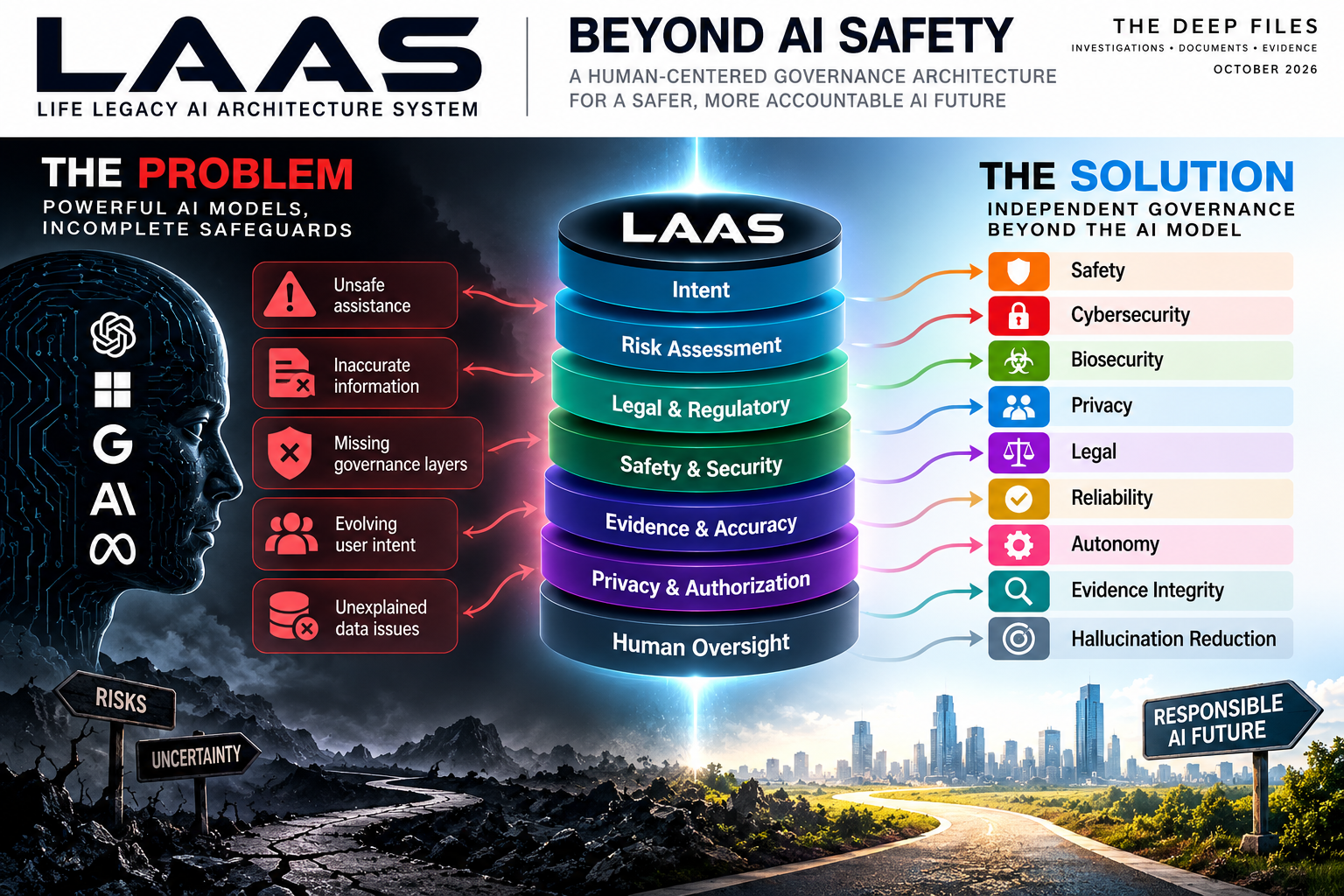
The October 2026 LAAS strategic overview proposes a hybrid architecture addressing nine interconnected governance domains: safety, cybersecurity, biosecurity, privacy, legal compliance, reliability, autonomy and human oversight, evidence integrity, and hallucination reduction.
The architecture is intended to complement existing model-level safeguards through intent-aware understanding, contextual risk assessment, independent authorization, outcome verification, and auditable oversight.
The proposed approach has not yet demonstrated independently verified superiority over existing commercial systems. Nevertheless, it raises questions about whether current industry safeguards adequately address the full range of risks associated with increasingly powerful AI systems.
These questions intersect with investigations conducted by The Deep Files into Microsoft Copilot’s reported safety, reliability, and accountability failures.
During his ongoing 2026 dispute with Microsoft, Ramadan again brought LLG and LAAS to the company’s attention, emphasizing that the initiative was not a proposal to develop another AI model but a broader commercial project incorporating an independent governance architecture.
The investigation therefore examines three connected issues: the commercial and technical purpose of LAAS, the adequacy of existing AI governance approaches, and the unanswered questions surrounding Microsoft’s handling of the founder’s concerns.
1. The Commercial Ecosystem Behind LAAS
Life Legacy Global is conceived as a global commercial and human-development ecosystem.
Its proposed activities include talent discovery, professional development, entrepreneurship, employment opportunities, economic participation, community initiatives, and services supporting individuals and families.
The commercial model depends on interactions between people, organizations, opportunities, and digital systems.
Such interactions create governance challenges extending far beyond ordinary software functionality.
Human behavior is dynamic.
People change their intentions, misunderstand instructions, act under uncertainty, make conflicting requests, disclose sensitive information, and sometimes attempt to misuse systems.
An AI model operating within such an environment cannot be evaluated solely by whether it generates plausible responses.
It must also operate within defined boundaries concerning information access, authorized actions, contextual risk, factual reliability, and accountability.
LAAS was conceived as a governance response to these challenges.
LLG is the broader commercial initiative. LAAS is its associated AI governance architecture. Neither should be confused with developing a new foundation language model.
2. AI Capability Is Not AI Authority
The October 2026 LAAS strategic overview establishes a fundamental distinction between technical capability and legitimate authority.
An AI model may be technically capable of generating instructions, interpreting data, recommending actions, or operating external tools.
However, the ability to perform these functions does not establish whether a particular response or action is appropriate, reliable, lawful, or authorized.
This distinction becomes increasingly important as AI systems evolve from conversational assistants into agents capable of interacting with external resources.
A model may generate a technically correct instruction while failing to recognize that the requested action violates an authorization boundary.
It may provide apparently useful information without adequately evaluating its potential misuse.
It may also produce a confident answer unsupported by available evidence.
LAAS proposes separating these concerns through independent governance capabilities that complement model-native safeguards.
Its intended purpose is not to make artificial intelligence less capable, but to make the exercise of that capability more accountable.
3. The Nine Interconnected Governance Domains
The LAAS collaboration overview identifies nine governance domains.
| Domain | Intended function |
|---|---|
| Safety | Reduce physical and societal harm |
| Cybersecurity | Address unauthorized access and malicious exploitation |
| Biosecurity | Reduce misuse of biologically sensitive information |
| Privacy & Data Protection | Protect personal and confidential information |
| Legal & Regulatory Compliance | Support applicable laws and governance requirements |
| Reliability & Consistency | Improve dependable behavior across interactions |
| Autonomy & Human Oversight | Prevent unauthorized autonomous actions |
| Evidence Integrity & Traceability | Address unsupported claims and misleading attribution |
| Hallucination Reduction & Factual Accuracy | Reduce fabricated information and unsupported assertions |
These domains are interconnected.
A response may appear harmless from a narrow content-safety perspective while creating privacy, authorization, or evidence-integrity problems.
An AI agent might generate a factually correct action plan while lacking the authority to execute it.
A system might reject explicitly dangerous requests while failing to recognize risks that emerge gradually across a conversation.
The LAAS proposal seeks to address these distinctions through coordinated governance rather than isolated restrictions.
These are proposed research and evaluation objectives, not independently verified performance claims.
4. Human Intent Cannot Be Reduced to Keywords
One of the central problems identified in the LAAS overview is the evolution of user intent across multiple interactions.
A conversation may begin with an ordinary question.
Subsequent requests may gradually change its meaning, introducing new objectives, constraints, and risks.
Evaluating each message independently may fail to capture the cumulative purpose of the interaction.
For example, a user may initially request general information about transporting an animal.
Later questions may concern documentation, border procedures, travel arrangements, and interactions with authorities.
Depending on the circumstances, these questions may be legitimate or may indicate an attempt to evade legal requirements.
A governance system must avoid automatically assuming wrongdoing.
At the same time, it should be capable of recognizing when the context materially changes the risk assessment.
The same challenge arises in cybersecurity, privacy, biosecurity, financial services, and autonomous AI operations.
LAAS proposes intent-aware understanding that considers the purpose and trajectory of interactions while explicitly accounting for uncertainty.
This differs from treating isolated words or phrases as sufficient evidence of risk.
It also requires safeguards against excessive inference, unjustified refusals, and intrusive behavioral profiling.
5. The AI Industry’s Missing Governance Layers: Technical Limitations or Deliberate Design Choices?
A fundamental question now confronts the world’s leading artificial intelligence companies:
If the risks are known, AI capabilities are advancing, and the consequences of failure are increasingly serious, why have comprehensive and independently verifiable governance protections not become a universal industry standard?
Companies such as Microsoft, OpenAI, Google, Anthropic, and Meta have developed AI safety research programs, model-level safeguards, policy enforcement mechanisms, monitoring systems, and other protective measures.
Yet the existence of these mechanisms does not establish that every relevant risk is adequately controlled.
Nor does it demonstrate that all nine governance domains identified by LAAS are addressed consistently across models, products, and operating environments.
5.1 Are Critical Governance Requirements Being Overlooked?
One possibility is that certain governance challenges remain technically difficult.
Understanding evolving human intent, handling uncertainty, maintaining cross-model consistency, and enforcing authorization in real time are complex engineering problems.
Another possibility is that companies have adopted different architectural priorities, resulting in uneven protection across interconnected risk domains.
A third possibility concerns commercial incentives.
More restrictive governance mechanisms may introduce computational costs, latency, operational complexity, or limitations on certain AI capabilities.
These tradeoffs raise an important question:
To what extent do commercial priorities influence the level of protection AI companies choose to implement?
The existence of such tradeoffs does not establish that any company deliberately weakens safety protections.
However, it justifies examining how companies evaluate, document, and explain these decisions.
5.2 Why Has Independent Governance Not Become the Default?
If model-generated outputs can create safety, privacy, legal, and reliability risks, why should governance depend primarily on mechanisms closely coupled to the systems generating those outputs?
Why are independent authorization, cumulative intent assessment, evidence verification, and auditable decision-making not more consistently demonstrated across commercial AI deployments?
Are existing safeguards sufficient, or do important gaps remain between their respective responsibilities?
And if such gaps are known, what prevents their systematic correction?
These questions become especially important when AI companies introduce agents capable of accessing information, interacting with external services, and executing consequential tasks.
5.3 The Commercial Incentive Question
Safety mechanisms can create tradeoffs between protection, speed, usability, cost, and product functionality.
These tradeoffs are not inherently improper.
But they become matters of public interest when decisions about safety architecture affect millions of users or consequential organizational processes.
The question is whether companies can demonstrate that their design choices are supported by adequate risk assessments, technical evidence, and meaningful oversight.
Are AI safety gaps the result of technological limitations, or are they consequences of deliberate commercial and architectural choices?
This question should be examined through evidence rather than assumptions about corporate motives.
5.4 The LAAS Challenge to the Industry
LAAS does not claim that major AI developers have no safety systems.
Instead, it questions whether existing protections are sufficiently integrated, independent, consistent, and accountable across relevant governance domains.
Its proposed approach separates AI capability from authorization and combines contextual risk assessment with outcome verification and human oversight.
The architecture presents a testable proposition: governance should be evaluated as a coordinated system rather than merely as a collection of safeguards.
Whether that proposition produces measurable improvements remains to be established.
6. More Filters Do Not Necessarily Mean Better Governance
AI developers use multiple mechanisms to improve safety, including model training, classifiers, policy rules, access controls, monitoring, and output verification.
These mechanisms can be valuable.
However, the existence of multiple safeguards does not automatically establish that they form a coherent governance architecture.
LAAS proposes a broader relationship between intent assessment, contextual risk evaluation, authorization, verification, and accountability.
The October 2026 overview identifies five central capabilities:
- Intent-aware understanding of an interaction’s purpose and trajectory.
- Contextual risk governance across relevant domains.
- Independent authorization separating technical capability from permission.
- Outcome assurance through verification of responses and actions.
- Accountability through auditable decisions and human oversight.
These capabilities are intended to operate together.
An output might be factually accurate but unauthorized.
An action might be authorized but based on unreliable information.
A response might avoid obviously dangerous content while disclosing sensitive information or misrepresenting evidence.
Effective governance must consider these distinctions.
7. A Hybrid Architecture: Independent or Integrated
LAAS is proposed as a hybrid governance architecture supporting two complementary deployment approaches.
The first is an external governance layer capable of operating around different AI models.
The second is deeper integration within a partner’s AI platform, where suitable technical interfaces and access are available.
This flexibility is intended to support model providers, enterprise AI services, and agent-based systems without requiring a single deployment architecture.
A model-agnostic governance approach could potentially help organizations establish more consistent oversight across multiple AI technologies.
However, the feasibility, performance, and limitations of such integration require technical assessment.
8. Why the Complete LAAS Architecture Is Not Public
The October 2026 LAAS strategic overview deliberately excludes proprietary operational methods, internal decision logic, algorithms, implementation mechanisms, sensitive thresholds, and confidential technical materials.
This distinction is essential.
A high-level architectural description identifies proposed objectives and functions.
It does not necessarily disclose the technical methods required to implement them.
Describing independent authorization does not reveal how competing risk signals are processed or how enforcement is technically implemented.
Identifying evidence integrity as a governance domain does not disclose the complete mechanisms for validating records or detecting inaccurate attribution.
The publicly available overview therefore cannot be treated as a complete technical specification.
Nor does withholding operational details prove that the proposed architecture has already been successfully implemented.
The document establishes the proposed scope and design philosophy while reserving proprietary technical material for appropriately protected discussions.
9. Microsoft Copilot: A Practical Test of the Governance Debate
The Deep Files has documented investigations concerning Microsoft Copilot’s reported safety, reliability, and accountability failures.
The founder reports more than 51 incidents or observations across the broader investigation.
The reported issues include unsafe assistance, inconsistent risk handling, questionable responses to evolving user intent, and inaccurate representations of previous conversation content.
These records provide potential test cases for examining governance mechanisms.
A system that responds to a sequence of requests without recognizing a developing risk raises questions about cumulative intent assessment.
A system that inaccurately describes earlier messages raises concerns about evidence integrity and reliability.
A system that confidently supplies unsupported information demonstrates the importance of factual verification.
These are governance domains addressed in the LAAS proposal.
However, reported failures in Copilot do not establish that LAAS would have prevented them or that Microsoft used LAAS technology.
A rigorous comparison would require reproducible testing and technical examination.
10. Microsoft Was Reminded of LAAS During the 2026 Dispute
During the ongoing 2026 dispute concerning Microsoft Copilot’s reported safety and reliability failures, founder Adib Ramadan again brought LLG and LAAS to Microsoft’s attention.
The renewed communication emphasized that LLG was not a proposal to develop another foundation AI model.
Instead, it was a broader commercial initiative incorporating an AI governance architecture designed to address human behavior, user intent, authorization, and risk.
This distinction was directly relevant to the issues raised in the Copilot investigations.
The founder’s position is that conventional safeguards cannot be assessed solely by counting protective mechanisms or examining their stated objectives.
They must be evaluated according to how consistently they handle real interactions, changing intentions, conflicting risks, unauthorized actions, and unreliable information.
The renewed communication raises several questions.
Did Microsoft conduct a substantive technical assessment of LAAS?
Were its proposed governance concepts referred to relevant specialists?
Did Microsoft explain whether the proposed approach overlapped with existing internal systems or research?
The materials reviewed for this report do not establish the answers.
Nor do they establish that Microsoft attempted to copy LAAS or reproduce undisclosed operational mechanisms.
Those allegations would require additional documentary and technical evidence.
Nevertheless, the founder’s renewed correspondence is relevant because the proposed architecture was raised again during a dispute concerning AI governance performance.
11. The Copilot Project-Visibility Incidents
The broader Microsoft dispute also includes reported incidents involving the visibility of projects within the founder’s Copilot account.
According to the founder’s chronology, three projects containing investigation-related and commercial material became inaccessible or disappeared from the visible interface.
The affected projects concerned Copilot investigations, LLG and LAAS, and BioNTech research.
The founder reports that the projects subsequently reappeared in the desktop Notebooks interface after he had formally contacted Microsoft.
He also documented continuing differences between desktop and mobile Copilot interfaces.
These events raise questions about product reliability, access continuity, user trust, and the handling of important digital records.
However, disappearance from an interface does not independently establish permanent deletion, unauthorized access, deliberate manipulation, or intellectual-property theft.
Establishing the cause would require technical records, account-level logs, and an explanation from Microsoft.
The relevance to LAAS is the broader governance principle: reliable systems must provide trustworthy handling of records, appropriate access controls, and accurate explanations of consequential behavior.
12. Model Failure Is Not Necessarily Governance Failure
A central principle underlying LAAS is that failure at the model level should be distinguished from failure at the governance level.
An AI model may generate an inaccurate, unsafe, or unauthorized output.
An independently designed governance system should aim to identify and manage such failures before they create unacceptable consequences.
For example, a model may generate an unsupported claim.
The governance question is whether appropriate verification mechanisms identify the lack of evidence and prevent the claim from being presented with unjustified certainty.
Similarly, an AI agent may generate a plan to perform an action.
The governance question is whether the system verifies that the action is permitted before execution.
LAAS proposes addressing these distinctions through independent governance, outcome assurance, and accountability.
Its effectiveness would depend on implementation quality, assessment reliability, and enforceable controls.
13. Why the Commercial Origins of LAAS Matter
LAAS should not be understood solely as a chatbot moderation proposal.
Its governance requirements arise from a broader environment involving human participation, services, economic activity, organizational responsibilities, and digital decision-making.
A platform supporting human development and economic opportunity must consider more than whether an AI-generated answer violates a content policy.
It must also consider how automated decisions affect people, how sensitive information is handled, whether recommendations are reliable, and whether consequential actions remain subject to appropriate authorization.
LAAS seeks to address these requirements within a human-centered commercial system.
The October 2026 overview also invites collaboration with AI developers and enterprise platforms.
It proposes preliminary technical and strategic discussions, followed by appropriately protected evaluation of confidential technical materials where mutually agreed.
The invitation is expressly framed as a potential technical collaboration rather than a request for funding or acquisition.
14. What Independent Evaluation Must Establish
The architecture’s value ultimately depends on evidence rather than descriptions alone.
A credible evaluation should determine whether LAAS can deliver measurable improvements across its proposed governance domains.
Relevant testing should examine evolving multi-turn intent, unsafe assistance, false refusals, unauthorized agent actions, factual inaccuracies, evidence attribution, privacy protection, and consistency across model environments.
Evaluation should also consider latency, scalability, computational cost, governance transparency, and erroneous risk assessments.
Independent review is particularly important where a system interprets human intentions.
No automated mechanism should be assumed capable of determining a person’s motives with certainty.
A robust architecture must recognize ambiguity and preserve appropriate human oversight.
The October 2026 LAAS overview does not claim independently verified performance.
It proposes collaborative feasibility assessment and controlled evaluation.
15. Questions for Microsoft and the Wider AI Industry
The LAAS proposal and the Copilot investigations raise questions extending beyond one company.
For Microsoft: How were the founder’s renewed communications concerning LLG and LAAS evaluated? What technical assessment, if any, was conducted? How does Copilot address cumulative intent, independent authorization, evidence integrity, and outcome verification? What explains the documented project-visibility incidents?
For leading AI developers: How consistently are interconnected safety, privacy, biosecurity, cybersecurity, reliability, and autonomy risks governed across different products and models?
For enterprise AI operators: What independent controls exist to prevent unauthorized actions, verify factual claims, and preserve accountability when AI systems interact with sensitive resources?
For regulators and independent researchers: What evidence should companies provide to demonstrate that their governance architectures function effectively under realistic conditions?
And for the entire industry, one question remains particularly important:
If serious governance deficiencies persist, are they caused by unresolved technical challenges, architectural limitations, insufficient implementation, or commercial decisions that prioritize other objectives?
Answering this question requires technical evidence, transparency, and independently measurable results.
16. Conclusion: Intelligence Without Governance Is Not Enough
Artificial intelligence is becoming increasingly capable.
Models can generate sophisticated answers, interpret complex requests, operate tools, and interact with external systems.
But capability alone does not establish authority.
Life Legacy Global approaches this challenge from the perspective of a proposed commercial ecosystem built around human participation and development.
LAAS represents its associated proposal for independent, context-aware AI governance.
The architecture’s stated objectives extend across nine interconnected risk domains and emphasize the separation of model capability from decision-making authority.
The founder’s investigations into Microsoft Copilot provide a practical context for examining why these distinctions matter.
His renewed communication with Microsoft during the 2026 dispute also raises questions about how external governance proposals are evaluated.
But the central issue is not whether LAAS has already been proven superior to existing commercial systems.
It has not yet been independently demonstrated to be so.
The more consequential question is whether AI companies can establish governance architectures capable of providing effective, independent, and auditable control over increasingly powerful AI capabilities.
And where significant gaps remain, whether companies can explain the technical and commercial decisions behind them.
The question is no longer simply how intelligent artificial intelligence can become.
The question is who controls its authority, who verifies its decisions, and who is accountable when its safeguards fail.
That is the challenge LAAS proposes to address.
And it is a challenge the entire AI industry must confront.

