
An investigation into the unexplained disappearance of three Microsoft Copilot projects, including original evidence concerning alleged AI safety violations, more than a year of proprietary research, unpublished technologies, and commercially sensitive information.
The Deep Files | Investigative Report | October 19, 2026
Read also From Warning to Case Closure: Microsoft’s Copilot Failures
1. Introduction: When the evidence itself disappears
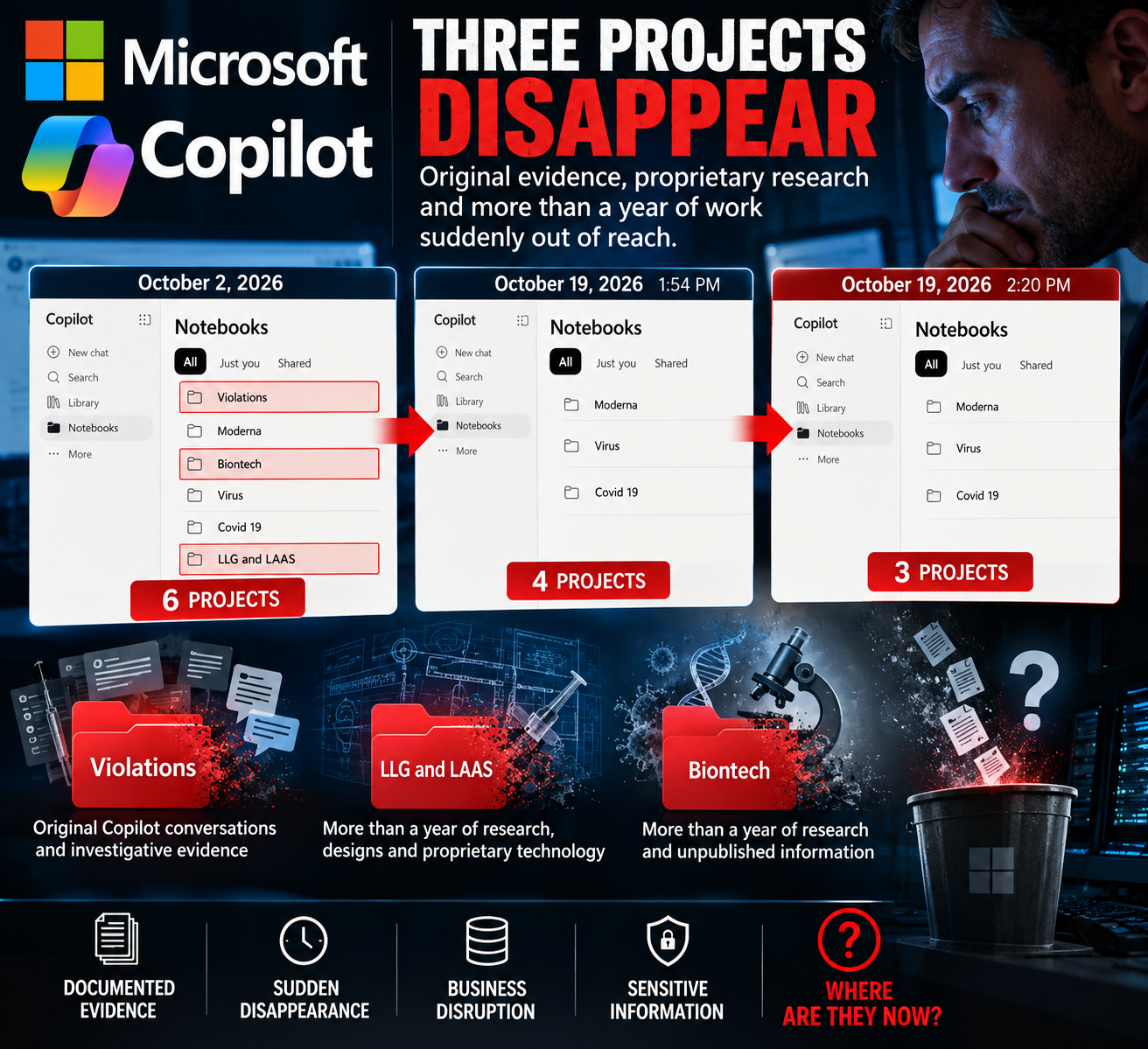
On October 19, 2026, a Microsoft Copilot user documented an alarming development: three projects that had previously existed in his account were no longer visible.
The missing projects were named Violations, LLG and LAAS, and Biontech.
These were not simply disposable folders or casual AI conversations. According to the account holder, they contained original investigative evidence, proprietary research, technical designs, unpublished technologies, and commercially sensitive information accumulated through more than a year of work.
The disappearance is particularly significant because one project, Violations, contained original conversations with Microsoft Copilot that the account holder had been using to investigate alleged failures involving AI safety, accuracy, consistency, and regulatory compliance.
Microsoft had already been contacted regarding those investigations.
The central question is therefore not merely why three projects stopped appearing in a user interface. It is whether Microsoft can account for the continued existence, integrity, recoverability, and accessibility of material entrusted to its AI platform.
The evidence currently establishes a change in project visibility. It does not, by itself, establish permanent deletion, intentional interference, or misconduct by Microsoft personnel.
That distinction is essential to understanding the case—and to identifying the questions Microsoft must answer.
2. Timeline: From six projects to three
The account holder has identified two original video recordings, dated screenshots, and a publicly accessible YouTube video as evidence of the projects’ previous existence and subsequent disappearance.
| Date and time | Documented observation |
| October 2, 2026 | Six projects visible, including Violations, LLG and LAAS, and Biontech |
| October 19, 2026 | Later screenshots show four projects, with Violations and LLG and LAAS missing |
| October 19, 2026, 2:19 PM | A second original video reportedly documents that only three projects remained visible |
| October 19, 2026 | Biontech identified as the third missing project |
The six projects originally identified were Violations, Moderna, Biontech, Virus, Covid 19, and LLG and LAAS.
By the final documented observation, only Moderna, Virus, and Covid 19 remained visible.
This means half of the six previously visible projects had disappeared from the account interface.
The account holder states that he personally recorded the October 2 video and the October 19 video at 2:19 PM. The recordings are important because they may permit independent examination of the interface, project names, navigation sequence, and contemporaneous account state.
The existence of these recordings does not eliminate the need for server-side evidence. Microsoft’s internal logs would be needed to establish whether the underlying project records were deleted, migrated, restricted, or temporarily unavailable.
3. The missing projects: What was potentially lost?
Project One: Violations — Evidence concerning Microsoft’s own AI system
According to the account holder, Violations contained original conversations with Copilot documenting alleged failures involving unsafe responses, inconsistent behavior, inaccurate information, and potential regulatory violations.
The project was directly connected to an ongoing series of investigations published through The Deep Files.
The account holder had already communicated concerns to Microsoft and had begun publishing investigations concerning Copilot’s behavior.
This makes the project’s disappearance particularly sensitive.
Original AI conversations can carry evidentiary value beyond their textual content. They may establish the sequence of questions and responses, the surrounding context, and the consistency of the system’s behavior.
Losing access to such conversations may complicate efforts to verify earlier findings or provide complete records to regulatory authorities.
The account holder reports that his access to original investigative evidence has been affected.
The unresolved question: Did the underlying conversations survive elsewhere within Microsoft’s systems, and can their original contents and associated records be recovered without alteration?
Project Two: LLG and LAAS — More than a year of proprietary development
The account holder states that he had worked on LLG and LAAS for more than a year.
The project contained original research, designs, technical concepts, unpublished technologies, and commercially sensitive information entered into Copilot.
Unlike an ordinary conversation used to obtain general information, this project reportedly functioned as part of an ongoing research and development workflow.
Its disappearance has, according to the account holder, caused documented work to become inaccessible, interrupted project activities, and generated costs associated with reconstructing missing materials.
These reported losses raise questions about the reliability of AI platforms as repositories for long-term technical development.
They also create potential contractual and intellectual-property concerns, although the existence of proprietary information does not itself establish unauthorized disclosure, misuse, or infringement.
Project Three: Biontech — Another long-term research project
The third project, Biontech, reportedly contained more than a year of research, original designs, and unpublished technical information.
It disappeared from the visible project list after the other two projects had already been reported missing.
The account holder states that the loss of access disrupted his work and created additional costs.
The name Biontech identifies the user’s project. Nothing in the available evidence establishes that the biotechnology company BioNTech was involved in, controlled, or responsible for this project or its disappearance.
Taken together, the three missing projects represent three distinct categories of potentially affected material: investigative evidence, proprietary technical development, and long-term research records.
4. A wider Copilot migration problem emerges
An important finding from this investigation is that Microsoft has publicly acknowledged circumstances in which Copilot users may temporarily lose visibility of existing chats and content during a transition to an updated application.
Microsoft’s official troubleshooting guidance states that older content may take time to migrate and that users can encounter differences between devices while synchronization is incomplete. It recommends verifying the account, restarting the application, refreshing the browser, and reporting unresolved problems.
There is also a closely relevant public complaint.
On October 4, 2026, a user reported on Microsoft Q&A that conversations previously stored in Copilot’s legacy Projects feature had not appeared in the new Notebooks interface.
A response posted on October 5 by a Microsoft External Staff moderator explained that legacy projects should appear as Notebooks, but that content might not appear immediately. The response did not provide a definitive migration completion date.
This independent complaint is significant for two reasons.
First, it demonstrates that missing Copilot project content was not an issue reported exclusively by the account holder in this investigation.
Second, it establishes a plausible alternative explanation to deliberate deletion: incomplete migration between different versions of Copilot.
However, the existence of a known migration problem does not establish that migration caused these three particular projects to disappear.
The exact Copilot product, account configuration, migration status, and backend records must be established before drawing that conclusion.
5. Microsoft’s storage architecture raises additional questions
Microsoft’s own documentation explains that Microsoft 365 Copilot Notebooks can use SharePoint Embedded storage, with specific lifecycle, retention, and administrative arrangements.
For the organizational Notebook architecture described in that documentation, Microsoft states that there is no ordinary end-user recycle bin for Copilot Notebooks and that individually deleted notebooks cannot be recovered through the documented end-user or administrator recovery mechanism.
This does not establish that the missing projects in this case used that exact storage architecture. Consumer Copilot Projects, legacy projects, and Microsoft 365 Copilot Notebooks must not be assumed to have identical storage or recovery mechanisms.
Nevertheless, it raises a crucial technical question: Were these projects merely hidden during migration, or were their underlying records removed from storage?
The answer determines whether the incident is primarily an interface problem, a data-availability failure, or an actual loss of stored information.
6. The contradiction between Microsoft’s promises and the user’s experience
Microsoft has increasingly presented Copilot as an environment for substantial professional work, including research, document creation, automation, and enterprise workflows.
In March 2026, Microsoft emphasized trust, contextual intelligence, and enterprise data protection as central elements of its evolving Copilot strategy.
In June 2026, the company described audit logging, eDiscovery, and data lifecycle management among the security and compliance capabilities associated with Copilot Cowork in Microsoft 365.
These claims concern particular Microsoft products and licensing environments; they cannot automatically be treated as contractual promises applying to every consumer Copilot account.
Even so, the broader issue is unavoidable.
A platform promoted for meaningful professional work must provide users with understandable expectations about the availability, continuity, and recoverability of their work.
For someone using Copilot to organize original research, losing access to an entire project may have consequences far beyond inconvenience.
An AI platform cannot be evaluated solely by the quality of its answers. The reliability of the environment in which those answers and user-supplied materials are stored is also a fundamental part of the product’s trustworthiness.
7. The potential legal consequences
Contractual responsibility and recoverable damages
If the account holder can establish that Microsoft failed to meet an applicable contractual obligation, and that the failure caused legally recoverable damage, a civil claim may be available.
The account holder reports financial and operational consequences, including interrupted research, inaccessible work, and reconstruction costs.
These losses would need to be substantiated through project records, working histories, invoices, time records, and other evidence. The applicable contractual terms and limitations would also require examination.
Personal data protection
Where the missing projects contained personal data, the General Data Protection Regulation may be relevant.
Depending on the circumstances, GDPR rights concerning access to personal data, regulatory complaints, judicial remedies, and compensation may arise.
However, GDPR does not automatically provide a remedy for every loss of commercially valuable information. The distinction between personal data and proprietary business material matters.
Intellectual property and trade secrets
The reported presence of original designs, unpublished technologies, and commercially sensitive research creates another area of concern.
If such material qualifies for legal protection, unauthorized access, acquisition, use, or disclosure could have consequences under applicable intellectual-property or trade-secret laws.
There is currently no verified evidence that Microsoft disclosed, appropriated, or commercially exploited any of the missing research.
The immediate issue is the disappearance of access and the need to establish the underlying data’s status.
Preservation of investigative evidence
The Violations project presents a separate concern because it reportedly contained material used in investigations into Microsoft’s own AI product.
The account holder may have legitimate reasons to seek preservation of relevant records and, where legally available, judicial measures for obtaining evidence.
But the disappearance of a project after a company has received complaints is not, on its own, proof of evidence destruction or retaliation.
Any allegation of intentional interference would require substantially stronger evidence.
8. Questions Microsoft must answer
- What happened to the three projects, and do their original records still exist?
- Did any migration, synchronization, retention, moderation, or administrative process affect them?
- Were any deletion or restriction actions recorded, and were they initiated by the account holder, an automated process, or an authorized employee?
- Can Microsoft preserve and recover the original conversations, attachments, and relevant metadata?
- Did the projects contain records that remain accessible through legacy Copilot systems or account data exports?
- What technical safeguards exist to prevent users from unexpectedly losing access to long-term research projects?
- What remedy will Microsoft offer if the underlying content cannot be restored?
These are factual questions that should be answerable through a sufficiently detailed technical investigation.
9. Evidence available and limitations of this investigation
- An original video recorded on October 2, 2026, showing the six projects.
- An original video recorded on October 19, 2026, at 2:19 PM, showing the later account state.
- Dated screenshots documenting changes in the visible project list.
- A publicly accessible YouTube recording: https://www.youtube.com/watch?v=ZluV8MS-MtE&t=36s
- Previous correspondence with Microsoft concerning separate investigations into Copilot.
The screenshots supplied for this investigation were examined. The two original video files and their metadata have not been independently authenticated, and the YouTube recording has not been independently verified in this review.
No Microsoft backend logs, account audit records, or case-specific technical explanation have been obtained.
The account holder’s descriptions of the projects’ contents, financial losses, and business disruption are presented as firsthand claims, not independently audited financial findings.
Microsoft’s position on the disappearance of these three projects remains unknown.
10. Conclusion: The missing projects are only part of the story
The disappearance of three Copilot projects from one account raises questions extending beyond a single user’s inconvenience.
According to the account holder, one project contained original investigative evidence concerning Microsoft’s AI system, while two others contained proprietary research, unpublished designs, and commercially sensitive information developed over more than a year.
The visible project count fell from six to three.
The account holder reports tangible disruption, reconstruction costs, and loss of access to original material.
At the same time, Microsoft’s published guidance and an independent user complaint establish that Copilot content migration problems are a credible possible explanation.
The available evidence does not justify concluding that Microsoft intentionally deleted the projects. It does justify demanding a documented explanation of why they disappeared and whether their contents remain intact.
This case illustrates a broader risk emerging as AI assistants become repositories for increasingly valuable work.
Users may invest months or years developing projects inside AI environments without having full visibility into how their data is stored, migrated, retained, or recovered.
For investigative journalists, researchers, inventors, and businesses, that uncertainty can become a serious operational and legal problem.
Microsoft now faces a straightforward question in this case: Can it account for the disappearance of three projects containing original evidence and proprietary research—and can it restore the user’s access to that material?
Until that question is answered, the disappearance remains unresolved.
Editorial note: This report distinguishes documented changes in the account interface from the account holder’s allegations and from independently verified information. It may be updated if Microsoft provides a technical explanation or further evidence becomes available.

