Wasting the Saudi people’s money
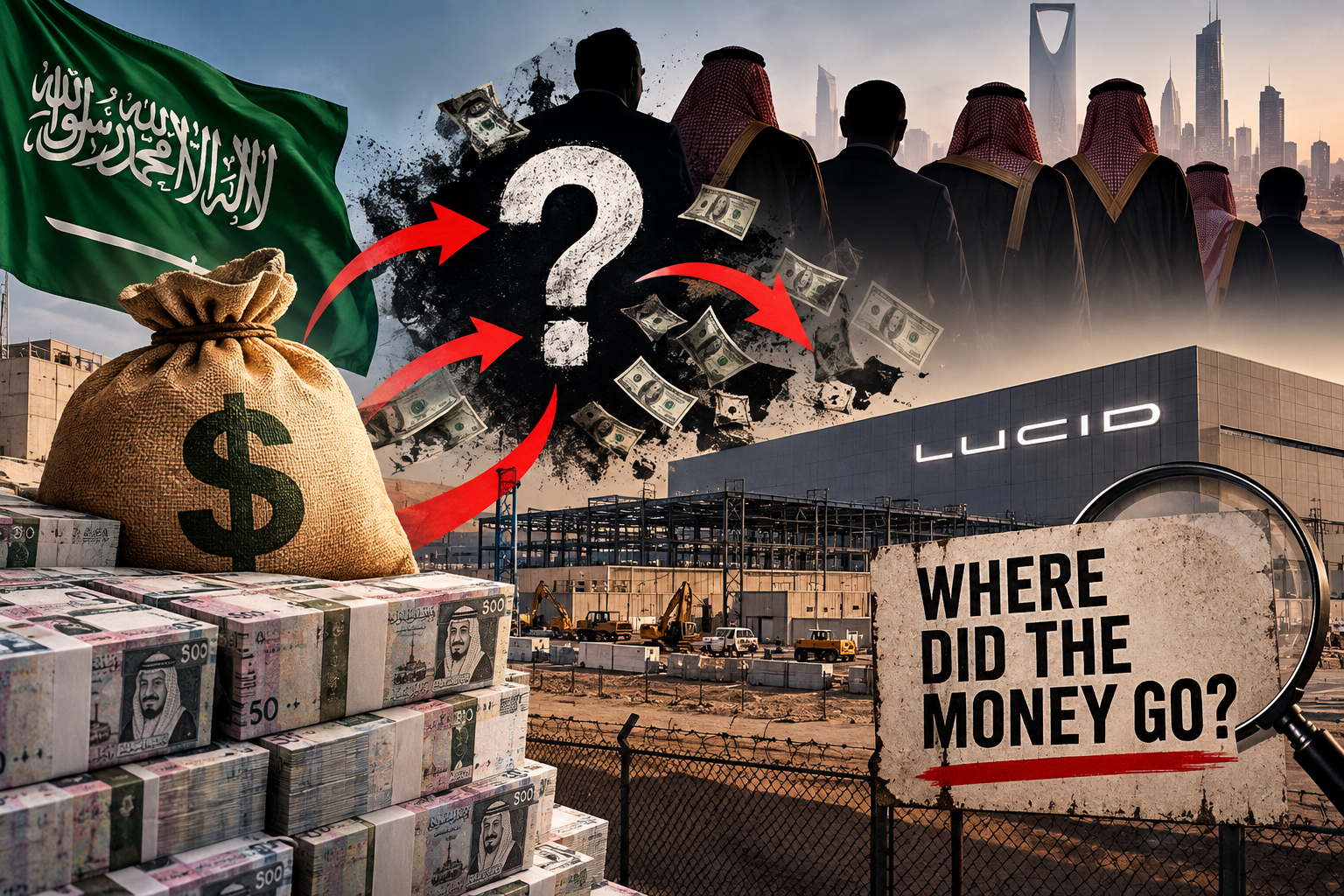
Where does domestic manufacturing begin and where do government financing, procurement, and related party contracts meet?
A separate investigation from PIF’s purchases of Lucid shares
In 2022, Lucid began developing its Saudi AMP-2 plant in King Abdullah Economic City. The project was presented as a gateway to domestic electric-vehicle manufacturing, substantial future production capacity, and thousands of jobs. In 2023 it opened an initial kit-assembly operation with installed capacity of 5,000 vehicles a year. Complete vehicle production, with a further targeted annual installed capacity of 150,000, had not begun when this report was prepared; Lucid expects it to begin in 2027. Installed capacity is not actual output. [1][2][3]
The plant is also a web of transactions: a site lease, Ministry of Investment support, a development-fund loan facility, drawn bank debt, construction contracts, workforce-training reimbursements, and a government contract to buy vehicles. Lucid discloses these entities among related-party relationships with PIF or its affiliate Ayar. The question is how much public money and demand have actually been committed, who obtained the contracts, and how much Saudi industrial value has been delivered. [3]
1 The industrial promise and the current stage
In May 2022, a Lucid announcement described a completed plant expected to make 150,000 electric vehicles per year and create more than 4,500 jobs in King Abdullah Economic City. Turqi Alnowaiser, then a PIF deputy governor and head of international investments, spoke about the project’s role in Saudi economic transformation. These were forecasts for the completed project, not observed output or employment. [1]
At its September 2023 opening, Lucid stated that phase one reassembled vehicle kits premade at its US AMP-1 plant. It described 5,000 vehicles of initial annual installed capacity and eventual total annual capacity of 155,000 after expansion. It anticipated hundreds of Saudi employees initially and thousands later. Yasir Al-Rumayyan and Turqi Alnowaiser attended the opening, alongside company officials. Attendance is documented but does not establish who approved every financial contract. [2]
Lucid’s 2025 Form 10-K calls the semi knocked-down, or SKD, portion complete while the completely built-up, or CBU, portion remains to be built. The expansion toward a further 150,000 units of installed CBU capacity began in 2024. In its June 2026 filing Lucid forecasts complete vehicle production in 2027. The plant exists; the industrial capability used to justify the full-scale vision remains under construction. Annual actual vehicle counts, locally sourced content, domestic engineering, and Saudi jobs are therefore indispensable. [3][4]
2 The Saudi transaction ledger
| Entity or relationship | Disclosed figure | What the figure means |
| SIDF industrial financing | Up to SAR 5.19bn (~$1.4bn) | Conditional loan ceiling; zero outstanding on June 30, 2026 |
| MISA cash support | SAR 366m (~$97.5m) in 2023 | Cash support reported as received |
| MISA asset disclosure | $127.5m at June 30, 2026 | Capital expenditure support recorded against plant assets; reconcile with cash figure |
| Gulf International Bank | SAR 1.89bn (~$503.1m) | Separate bank debt outstanding at June 30, 2026 |
| Al Bawani construction | SAR 2.56bn (~$682.4m) | Cumulative capital expenditures incurred under design and construction contracts |
| HRDF training | SAR 29.3m and SAR 24.7m ceilings | Two maximum reimbursement commitments, not total cash received |
| Government vehicle purchases | 50,000 minimum plus up to 50,000 optional | Contractual framework, not 100,000 deliveries |
These figures must not be added into a single “Saudi loss”: they represent undrawn credit, drawn debt, support, construction expenditures, training ceilings, and vehicle procurement. [3]
The SIDF loan: a large headline and zero reported outstanding
In February 2022, Lucid’s Saudi subsidiary agreed with the Saudi Industrial Development Fund (SIDF) on a facility of up to SAR 5.19 billion for specified AMP-2 development and construction costs. Drawdowns depend on conditions; financed assets and equipment secure the obligation. The loans carry no stated interest but entail service fees. Lucid reported zero outstanding under this agreement on both December 31, 2025 and June 30, 2026. Earlier reports also showed zero at December 31, 2024 and June 30, 2025. Reporting that Saudi Arabia had already paid Lucid $1.4 billion through SIDF would therefore be wrong. Zero at reporting dates does not on its own describe every possible draw and repayment between those dates. [3]
Why was such a large facility announced without an outstanding balance by mid-2026? Did Lucid have no need to draw, fail to meet conditions, or use other financing? Available disclosures do not establish which explanation is correct. SIDF’s agreement also identifies abandonment or failure to begin KAEC operations among default events. [3]
MISA support, milestones, and a conditional ownership right
The Ministry of Investment (MISA) agreed to support specified AMP-2 capital spending contingent on construction and operating milestones. According to the filing, MISA may suspend later support if operations fail to begin within 30 months from the commencement of construction or the agreed scope of operations is not achieved within 55 months. Whether either condition was triggered requires the contract’s controlling construction date, its definition of operating scope, and the ministry’s assessments. [3]
On specified defaults including abandonment or material, chronically low use of AMP-2, MISA may require transfer of ownership at fair market value less the amortized value of the support provided. Lucid’s Saudi subsidiary can instead avoid transfer by paying that amortized support value. This is neither automatic seizure nor transfer without compensation. [3]
Lucid states that it received SAR 366 million, about $97.5 million, in cash support in 2023. Elsewhere its June 2026 asset note identifies $127.5 million of capital expenditure support received from MISA and primarily deducted from the AMP-2 building balance. These figures must not be equated or added before a reconciliation of their components, dates, and accounting treatment is obtained. [3]
GIB debt: the outstanding loan separate from SIDF
Lucid separately reported SAR 1.89 billion, about $503.1 million, outstanding on its Gulf International Bank Saudi Arabia credit facility at June 30, 2026, against a facility size of SAR 1.9 billion. This bank debt is separate from the zero-outstanding SIDF facility. The questions are how the funds were used, what security was granted, and whether any Saudi public entity provided a guarantee or assumed additional risk. The filing establishes debt outstanding, not misuse. [3]
3 Construction, land, and related parties
Lucid reports agreements with Al Bawani for design and construction services connected to AMP-2, disclosed as related-party transactions. Cumulative capital expenditures incurred under those agreements reached SAR 2.56 billion, about $682.4 million, by June 30, 2026, up from SAR 2.15 billion at the end of 2025. Lucid owed Al Bawani SAR 280.8 million at June 30, 2026. An expense incurred under a construction agreement does not demonstrate that the government directly paid it. [3]
The disclosed relationships do not prove an inflated contract, a personal benefit, or misconduct. They do make procurement records, competing bids, change orders, independent price checks, conflict declarations, engineering acceptance records, and approval minutes central to the investigation. Lucid also discloses a 25-year initial lease for the plant site expiring in 2047; claiming the company purchased the land would require separate evidence. [3]
4 Training and employment
At the 2023 opening, Lucid forecast hundreds of Saudi hires during the early years and thousands eventually. Its filings show two Human Resources Development Fund (HRDF) training-reimbursement agreements, with maximums of SAR 29.3 million and SAR 24.7 million. Lucid reported SAR 10.9 million, about $2.9 million, of cash payments during 2024 and 2025. These are training-finance disclosures, not audited counts of Saudi trainees, permanent hires, engineering positions, retention, or wages. [2][3]
5 The Saudi government also buys Lucid vehicles
The 2023 vehicle-purchase agreement with the Saudi government, represented by the Ministry of Finance, provides for a minimum of 50,000 vehicles and an option for up to 50,000 more over ten years. The disclosures also allow reductions of the minimum in specified order-acceptance or delayed-delivery circumstances. The 100,000 ceiling does not show how many vehicles were actually delivered or paid for. [3][5]
Lucid recognized SAR 505.5 million, about $134.6 million, of net vehicle sales under this agreement in the first half of 2026, versus SAR 132.6 million, about $35.3 million, in the corresponding 2025 period. It reported SAR 700.9 million, about $186.6 million, due from the purchaser as receivables at June 30, 2026. A receivable is not automatically overdue; invoices and due dates are needed to establish lateness. [3]
Prices, elements of the pricing method, and annual quantities are redacted in the publicly filed purchase agreement. Redaction does not establish unfair pricing. It prevents the public from testing unit prices, shipping and assembly charges, warranty and servicing terms, or comparisons with alternative government purchases. Vehicle-level origin and local-content records are needed before Saudi government purchases can be used as evidence of Saudi domestic vehicle manufacturing. [5]
6 Four accountability hypotheses requiring evidence
An industrial promise used to justify continuing support
The government may have accepted multiple forms of financial exposure because it expected a manufacturing base and jobs. This hypothesis requires comparison of forecasts given to decision-makers at each financing stage with jobs and local value actually delivered. If internal assessments clearly separated the 5,000-capacity assembly phase from full production, they would help explain the choices; if they blurred the distinction, that would raise questions about evaluation quality. No intent to mislead is established by the public filings.
Saudi money circulating through related transactions
Funding, support, credit, procurement, rents, and construction contracts connect a network of Saudi entities and Lucid. Each may have an independent economic rationale. Presented separately, however, they obscure the net flow of Saudi resources and the net value returned. One consolidated account is needed, with no double counting and with each beneficiary and risk bearer identified.
Related-party contracting and potential conflicts
Al Bawani and the financing and property entities appear among disclosed related-party relationships. This warrants independent scrutiny of selection, pricing, approvals, recusals, and delivery. The filings reviewed here do not establish bribery, an individual’s private gain, or criminal intent. Those claims require separate documentary evidence.
Government demand before independent market demand is demonstrated
A large government purchase commitment gives Lucid a significant potential customer. Investigators should test how much of its Saudi sales arise from that agreement and whether the factory investment case would have been approved on the same terms without it. Government procurement can be legitimate; price, need, origin, and value for public money determine whether this procurement is defensible.
7 Questions to every institution involved
Conclusion
The filings do not justify saying SIDF paid Lucid $1.4 billion: the last reviewed outstanding balance was zero. Nor do they show that AMP-2 currently makes 155,000 complete vehicles a year: that figure describes planned installed capacity. They also do not establish malicious intent or personal gain merely because related parties are involved. [3][4]
They do establish a substantial accountability case: paid government support, outstanding Saudi bank credit, major related-party construction expenditures, workforce-training reimbursement, and actual government vehicle sales, all connected to a plant still assembling US-prepared kits while complete production is forecast for 2027. Each institution should publish its own transaction ledger, approval record, and delivered result. The consolidated public account is not present in the disclosures reviewed. [3]
Primary documents
[1] Lucid, Saudi manufacturing announcement, May 18, 2022. https://ir.lucidmotors.com/news-releases/news-release-details/lucid-advances-global-sustainability-vision-announcing-new/
[2] Lucid, AMP-2 opening announcement, September 27, 2023. https://ir.lucidmotors.com/news-releases/news-release-details/lucid-group-makes-history-saudi-arabia-it-opens-countrys-first/
[3] Lucid Group, Form 10-Q, quarter ended June 30, 2026, including Notes 6 and 15. https://www.sec.gov/Archives/edgar/data/1811210/000162828026052606/lcid-20260630.htm
[4] Lucid Group, Form 10-K, fiscal year 2025. https://www.sec.gov/Archives/edgar/data/1811210/000162828026011053/lcid-20251231.htm
[5] Government of Saudi Arabia and Lucid LLC, Electric Vehicle Purchase Agreement, August 2023, publicly filed redacted copy. https://www.sec.gov/Archives/edgar/data/1811210/000162828023037354/q3fy2310q-ex101.htm