

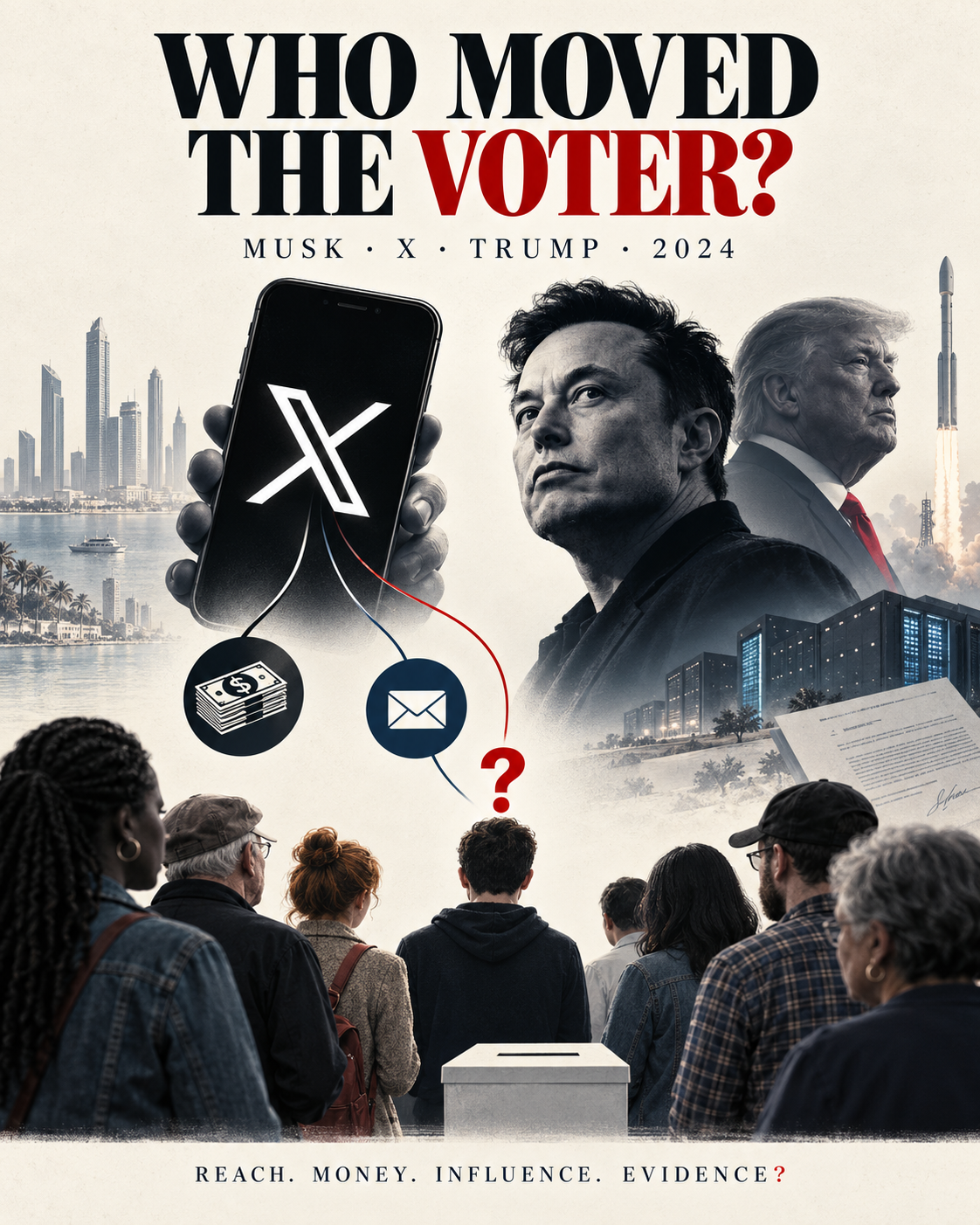
A very brief investigation into the political impact of Gulf investments and US government contracts.
Editorial scope: This investigation examines documented events, specific investigative suspicions, and the evidence still required to test allegations. The presence of investors, government awards, or events close together in time does not establish an illicit exchange.
1 Opening question
Elon Musk acquired Twitter in October 2022, before either American party formally selected its nominee for the 2024 presidential election. At the time, he had told Donald Trump to leave politics behind and expressed greater interest in Ron DeSantis. In May 2023, DeSantis launched his presidential campaign on Musk’s platform. By the summer of 2024, Musk had endorsed Trump, hosted him in a long X conversation, and committed vast financial resources to an electoral operation in competitive states. The shift, the reach of the platform, and the financing of voter contact form the central questions of this investigation. [1][2][13][46]
The question is not whether Musk had a right to favor a candidate. It is whether his combined control of a large political distribution platform, a personal account with a vast audience, and a richly funded political organization altered the decisions of American voters. A separate, related inquiry asks whether Gulf investments and subsequent public contracts illuminate material business interests that might have mattered to his conduct. No reviewed document establishes that a Gulf investor directed his election activity or that Trump awarded a contract as a reward. The inquiry therefore separates documented conduct from the hypotheses those facts warrant.
2 Method and evidence thresholds
This report distinguishes four outcomes often collapsed into the word influence: an item appearing on a screen; a user noticing or engaging with it; a changed political attitude; and a changed ballot choice or decision to vote. Impressions measure the first imperfectly and cannot be equated with unique voters or votes. Post-election self-report measures what respondents say mattered to them, but does not identify what they would otherwise have done. The strongest answer to the central question requires matched pre-exposure and post-exposure behavior with an appropriate comparison group. [11][12][15][16][17]
The evidence comprises SEC merger and investment filings, company announcements, Federal Election Commission records, original investigative reporting, independent algorithm audits, a randomized experiment, post-election survey tables, U.S. procurement announcements, and official Gulf project disclosures. A company announcement supports what was announced, not necessarily what was built, paid, or privately agreed. A procurement ceiling supports an authorization limit, not cash actually disbursed. Anonymous-source reporting can identify a lead without replacing the underlying records.
3 The first political change from Democrats to Republicans
Musk’s early relationship with Trump was not one of constant support. He took part in presidential advisory councils during the first Trump administration, then resigned after the June 2017 Paris climate decision. He later described voting for Hillary Clinton in 2016 and Joe Biden in 2020. His public turn toward Republican candidates in 2022 was a different development from his later support for Trump personally. He was not uniformly opposed to every Republican position or politician in the preceding years.
In July 2022, Musk called on Trump to leave the political stage and appeared more receptive to DeSantis. This matters for causation. An investigation that begins with an alleged long-standing plan to elect Trump cannot account for Musk’s public endorsement of an alternative Republican figure. A more precise question concerns when and why the Republican-leaning Musk became a Trump supporter. His stated concerns about immigration, the Biden administration, regulation, and speech are possible explanations based on his statements; this report cannot establish that any one was the exclusive motive.
4 Ownership of Twitter before the nominees were chosen
Twitter announced its definitive purchase agreement on April 25, 2022 at $54.20 per share, approximately $44 billion in all. The merger closed October 27, 2022. Both milestones preceded formal 2024 party nominations, although campaign preparations had already begun. The sequence establishes Musk’s platform ownership before the contest. It does not establish that helping Trump was the reason for buying the platform: his contemporaneous remarks and subsequent participation in DeSantis’s launch complicate that claim. [1][2]
SEC filings list Qatar Holding LLC’s $375 million equity commitment and the rollover of 34,948,975 existing Twitter shares owned beneficially by Prince Alwaleed bin Talal and Kingdom Holding. At the transaction’s $54.20 share price, those rolled shares represented approximately $1.89 billion in transaction value. Rollover of existing holdings differs from a new $1.89 billion cash payment. A QIA subsidiary ultimately contributed the $375 million on closing. The Saudi investor’s Twitter holdings predated Musk’s acquisition. [3][4][5][40]
The Public Investment Fund’s minority position in Kingdom Holding must not be confused with direct PIF ownership of Musk’s platform or with control over Kingdom’s decisions. The questions worth asking concern actual investor rights, voting powers, board access, access to platform data, and correspondence about U.S. political content. The cited merger filings alone do not show instructions to change political distribution or to back any candidate. [41]
5 DeSantis Kennedy Phillips and Trump on X
On May 24, 2023, Ron DeSantis formally launched his Republican presidential run on Twitter Spaces in an event featuring Musk and David Sacks. The broadcast had serious technical difficulties, but its political importance lay in a major Trump rival using Musk’s own platform as his campaign launch venue. Musk also participated in a long discussion with Robert F. Kennedy Jr., then seeking the Democratic nomination, and in a multi-person forum featuring Democratic contender Dean Phillips. The Phillips event was not a bilateral Musk interview. These formats and audiences must not be falsely presented as identical.
By August 12, 2024, when Musk held his long X conversation with Trump, the host had already publicly endorsed his guest. In the opening, he described an informal conversation that could be heard by open-minded independent voters still deciding. The transcript establishes an expressly identified undecided audience and a supportive host; it does not establish how many listeners changed their ballots. [46]
The relevant change is not merely a change of guest. In 2023 the owner offered a launch venue to Trump’s Republican opponent. In 2024 the owner himself was a declared Trump supporter, host, donor, and participant in voter mobilization. Equal treatment cannot be inferred or rejected solely from raw interview lengths: the format, time, promotion, ownership decisions, and host’s political role all differ.
6 The nine-month turning point
The working window begins with the May 24, 2023 DeSantis launch and ends with a February 16, 2024 private Palm Beach gathering hosted by Nelson Peltz. According to reporting based on people familiar with the gathering, Musk made a case for Trump to other attendees. That is an attributed account of a private meeting, not a released transcript. It places reported private support before July’s public endorsement but does not establish a precise moment of conversion or a particular hidden inducement.
The following landmarks must remain distinct: private advocacy reported by sources in February 2024; public endorsement on July 13, after the attempted assassination; the August 12 X conversation; and financial disclosures revealing the scale of the election operation. Musk’s statements in early 2024 that he was not donating to presidential candidates must be distinguished from later independent spending through a Super PAC. An absence of direct contributions to a candidate’s committee does not rule out other election expenditures.
The central unanswered questions for May 2023 to February 2024 are whom Musk met, which discussions concerned Trump or DeSantis, how his views on immigration and government changed, and whether specific economic developments were raised as reasons for a switch. Coincidence in a timeline is a lead, not an answer.
7 From public endorsement to a voter contact machine
America PAC registered as an independent-expenditure-only committee on May 22, 2024. It supported Trump’s election through advertising and voter-contact operations in battleground states. The FEC’s 2024 independent-expenditure table shows approximately $173.735 million in independent expenditures for America PAC. This is a particular FEC accounting category. It should not be substituted for Musk’s total donations to several committees or the PAC’s total receipts and disbursements. Later reporting based on FEC filings places Musk’s contributions to pro-Trump groups at more than a quarter of a billion dollars, with final-cycle estimates varying by cutoff date and included groups. [13][14]
America PAC’s existence before Musk’s public July endorsement makes its planning timeline relevant. Its work should be analyzed as two possible processes: persuasion of undecided voters or mobilization of Trump-leaning citizens with low previous turnout. Both may affect an election; they cannot be measured with the same denominator. Detailed targeting specifications, verified door contacts, field experiments, vendor contracts, and any randomized holdout groups are necessary to estimate each contribution.
Original reporting raised questions about inaccurate door-knock reporting and operational quality. This complicates any estimate that multiplies reported contacts by an assumed turnout effect. The PAC’s own field data, GPS and timestamp validation procedures, vendor correspondence, and verified voter file matches would be needed before trusting a claimed number of contacted people.
8 Political advertising on a platform owned by the donor
WIRED analyzed X’s political ad disclosures and reported 59 America PAC ads from July 8 to October 1, 2024, costing more than $166,000 and recording 32,058,424 impressions according to X. The targeting covered Georgia, Nevada, Pennsylvania, Michigan, Arizona, and Wisconsin. The PAC also bought advertising from other platforms and organized physical voter contact; its X advertising cannot be treated as the entirety of its outreach. [12]
This creates an auditable relationship: a donor’s electoral organization paid for political messages on the distribution platform owned by that same donor. Whether it received favorable pricing, extra placement, special audience access, preferential review, or normal advertiser treatment requires internal ad delivery and sales records. Impressions are exposures recorded by the platform, not 32 million distinct American voters and not 32 million changed votes.
Some investigated online registration flows associated with the PAC raised questions about how prospective registrants in swing states were directed and what data were collected. Allegations about the design and its effects require the live historical landing pages, advertising creative, jurisdiction-specific instructions, data-retention terms, follow-up communications, and the conclusions of any state inquiry. An inquiry or complaint is not a finding of intentional voter suppression.
9 A documented precedent concerning Musk account reach
Platformer’s February 2023 investigation said reporters interviewed people familiar with Twitter’s operations and reviewed internal documents. After a Musk post underperformed one from Biden during Super Bowl coverage, the account says engineers were summoned to troubleshoot reach and deployed code giving Musk’s posts exceptional ranking treatment, later reducing the initial multiplier. The investigative article provides a detailed, attributable account, but the underlying internal records are not reproduced in full for independent inspection here. [7]
The precedent is powerful and limited. It establishes a credible lead that the platform owner could cause his personal posts to receive unusual technical promotion. It does not demonstrate that the same configuration persisted into July through November 2024 or that a 2024 modification was designed to favor Trump’s election. Establishing that requires production of deployment logs, feature flags, ranking weights, testing reports, and decision approvals specific to the campaign period.
10 The unusual 2024 engagement increase
Researchers Timothy Graham and Mark Andrejevic compared Musk with other political accounts using data from January 1 through October 25, 2024. After July, view counts on Musk’s posts increased by 138 percent, reposts by 238 percent and likes by 186 percent. The comparison accounts increased by 57 percent, 152 percent and 130 percent respectively. The researchers also found improved visibility among some other right-wing accounts. The authors describe their scraping and analytic limitations, and provide code and post identifiers for scrutiny. [8][9]
July also brought a major assassination attempt, Musk’s explicit endorsement, changing political news demand and different post content. Each could raise engagement without a special ranking order. The researchers state that without access to the platform’s internal machinery they cannot tell whether changed curation boosted Musk. Their study supplies a precisely timed anomaly, not proof of a specific employee instruction or an estimated number of ballots changed. [8]
A separate audit used 120 synthetic monitoring accounts to examine X’s For You feeds around the 2024 race. It found right-leaning exposure in the default feeds of new accounts and alignment reinforcement for accounts trained toward either side. The sample describes recommendations to monitored accounts over its observation window. It does not prove direct exposure of undecided registered voters, show an instruction from Musk, or identify a causal effect on the election outcome. [10]
11 Can the feed alter political attitudes
A randomized field experiment published in Nature assigned actual U.S. X users in summer 2023 to the algorithmic For You feed or a chronological Following feed. For users moved from chronological to algorithmic delivery, researchers estimated a 4.7 percentage point increase in the probability of prioritizing issues such as immigration, crime, and inflation, and a 5.5 point increase in finding investigations into Trump unacceptable. Other effects and subgroups differed; the paper notes that some investigation-related effects concentrated among more loyal Trump supporters. [11]
The experiment shows that feed ordering can change some political attitudes under the studied conditions. Because it took place about a year before Musk endorsed Trump, it cannot show that his 2024 campaign messages made identifiable voters change their candidate choices. The wider Twitter algorithm had shown right-leaning amplification in work predating Musk’s takeover; a rightward algorithmic effect is not, by itself, proof that Musk created it for the Trump campaign. [11]
The European Commission formally requested internal documentation about X’s recommender system and recent changes in January 2025. Its request identifies a possible documentary route, but is neither public release of the sought records nor a finding about manipulation of an American election. [35]
12 The post-election poll and its important denominator
Harvard CAPS/Harris surveyed 1,732 registered U.S. voters after the election. Its November 2024 press release summarized that 42 percent said Musk’s endorsement had some or significant impact on their vote; it gave a 31 percent figure among independents. The original detailed topline displays 41 percent for respondents who knew of Musk and were asked the endorsement-impact question, with a weighted base of 1,128. It further reports 25 percent significant and 17 percent some impact, with rounding explaining the apparent one-point discrepancy. The 41 or 42 percent must not be represented as a share of all American voters. [15][16]
The question did not ask whether respondents moved from Harris or indecision to Trump. A voter could report an effect if Musk reinforced a planned Trump vote, mobilized participation, strengthened an anti-Trump reaction, or affected how they interpreted events. The survey is a retrospective self-assessment and does not measure the counterfactual outcome without Musk. Thus the 31 percent independent figure is not a measured conversion rate to Trump. [15][16]
Pew’s longitudinal validated-voter work finds that changes in turnout and changes in candidate preference both contributed to 2024 electoral shifts, in different ways across groups. It does not attribute individual switches or turnout to Musk, X, or America PAC. A report that offers a count of Musk-converted votes without linked exposure, baseline intention, and comparison data exceeds the evidence. [17]
13 Early Gulf contacts and the 2018 Tesla episode
Musk’s discussions with Gulf capital predate both the Twitter acquisition and the Trump 2024 campaign. The SEC’s account of the 2018 possible Tesla take-private transaction describes meetings with representatives of Saudi Arabia’s Public Investment Fund. The SEC alleged that the July 31 discussion did not resolve basic deal terms, including an investment amount, an ownership percentage, or financing restrictions. This episode documents contact and a proposed investment possibility; it must not be rewritten as proof of a binding, fully specified verbal agreement. The regulatory complaint and Musk’s account of his own expectations should be distinguished. [6]
Equity from Qatar and the rollover of Saudi-held Twitter shares in 2022 further establish financial connections before the election. Such links warrant inquiry into investor governance, but do not establish an instruction to favor Trump or a payment for political influence. A credible claim of an electoral arrangement needs an identifiable instruction, recipient, decision, and contemporaneous documentary or testimonial corroboration. [3][4][5]
14 Gulf investment in xAI across the election boundary
xAI’s May 2024 Series B announcement names Prince Alwaleed and Kingdom Holding among backers. Its December 2024 Series C announcement names Kingdom Holding, Abu Dhabi’s MGX, the Qatar Investment Authority, and the Oman Investment Authority among several Gulf and non-Gulf participants. The USD 6 billion Series C is the size of the entire multinational financing round, not Gulf investment alone. Kingdom Holding publicly disclosed a fresh USD 400 million contribution in its December Series C transaction, bringing its then disclosed two-round xAI investment to USD 800 million. The individual MGX, QIA, and OIA check sizes were not established in the materials reviewed. [18][19][20]
This matters for the chronology. Gulf investment in Musk-related enterprises existed before Trump’s win, and additional investment was recorded after the election but before his January 2025 inauguration. Saying all agreements began after Trump took power is false. Conversely, observing pre-election equity followed by subsequent public business does not prove that 2024 meetings produced an oral electoral agreement.
Public reports place Musk with Sheikh Tahnoon bin Zayed in the United States in September 2024, and describe his engagement with Saudi minister Abdullah Al-Swaha in December 2024 while leaving the precise meeting location insufficiently established here. His 2023 World Governments Summit exchange in Dubai and 2024 Future Investment Initiative appearance in Riyadh were remote video appearances, not demonstrated visits to those cities. A known late-2025 Abu Dhabi meeting falls outside the 2023–24 visit review. Any article must separate physical travel, remote participation, and a meeting elsewhere.
15 Gulf services investments and projects after 2024
HUMAIN, a company owned by Saudi Arabia’s PIF, and xAI announced a November 2025 framework to develop more than 500 MW of data center and computing capacity in Saudi Arabia and deploy Grok models. HUMAIN announced a USD 3 billion equity investment in xAI’s Series E in February 2026. The framework and share purchase are two separate developments. An announced capacity target is not evidence that all facilities were delivered or of a published contract price. HUMAIN said its investment subsequently became a position in SpaceX after the xAI combination. [21][22]
Qatar Airways said it flew a Boeing 777 equipped with SpaceX’s Starlink service on October 22, 2024, and announced a larger fleet rollout. This establishes an operating commercial service before Trump took office. Without a disclosed price, the research cannot quantify total Qatar Airways payments to SpaceX. Procurement of inflight connectivity is not Qatar’s purchase of SpaceX shares. [23]
Dubai’s Roads and Transport Authority announced a February 2026 agreement with The Boring Company to begin the Dubai Loop. It estimated a 6.4 km four-station first phase at AED 565 million, and the full proposed route at around AED 2 billion. Those are project cost estimates, not verified payments to The Boring Company or purchases of its equity. Las Vegas had already operated a Loop passenger service beginning in 2021; the existence of a working U.S. example does not establish that the Dubai system had opened to passengers by this report’s cutoff. [24]
Saudi permission for Starlink aviation and maritime services, Tesla’s entry into the Saudi car market, MGX’s technology partnerships, and Gulf holdings in xAI occupy distinct financial categories. A regulatory market opening, a commercial service contract, a project estimate, and a share subscription cannot be added into one investment total. MGX publicly describes its board’s review of the portfolio and technology alliances but its public news items are not full minutes recording how any specific investment vote was reached. [36][48]
16 Trump Gulf diplomacy and the Biden baseline
Trump visited Saudi Arabia, Qatar, and the UAE on a major official Gulf trip in May 2025, with his administration publicizing broad commitments and commercial agreements. He had previously traveled to Rome in April for Pope Francis’s funeral, so May was not literally his first trip outside the United States. The White House’s aggregate announced deal figures cover numerous participants and various forms of commitment; they are not dollars paid to Musk’s companies. [25][44]
The previous Biden administration maintained substantial Gulf relations. Its September 2024 U.S.-UAE statement discussed defense and technology cooperation, while the State Department announced U.S.-Qatar strategic-dialogue milestones. The precise investigative comparison must concern particular policies or decisions across administrations, not an assumed total absence of Gulf relations before 2025. An announced diplomatic reset or warmer rhetoric does not, by itself, explain an American voter’s ballot or any company award. [26][27]
17 Federal awards before and after January 2025
SpaceX had received important NASA and national-security work before Trump’s second administration. The proper baseline is the procurement history for each mission and technology, including when competition began, who qualified, and how final assignments were determined. Large subsequent awards are newsworthy, but chronological succession from Musk’s political support to a contract is not proof of a reward.
On April 4, 2025, Space Systems Command announced National Security Space Launch Phase 3 Lane 2 awards with anticipated contract values of USD 5.9236 billion for SpaceX, USD 5.3664 billion for United Launch Services, and USD 2.3862 billion for Blue Origin. Seven FY25 missions were assigned to SpaceX for USD 845.8 million under the program, and two to ULA for USD 427.6 million. Mission assignments within the program must not be added to the anticipated overall framework value as though they were unrelated extra contracts. [28][29]
In July 2025 the Defense Department’s AI office announced awards to xAI, OpenAI, Google, and Anthropic, each with a USD 200 million ceiling. This is not a USD 200 million immediate payment to xAI, nor an exclusive Musk-company selection. In 2026 Space Force announced a competitively awarded USD 2.29 billion Space Data Network delivery order to SpaceX and a competitively described USD 4.16 billion space-based airborne moving target indicator agreement. NASA announced a USD 946 million modification for three additional crew missions within an existing commercial crew relationship. The Space Force also announced USD 1.6 billion for 18 Falcon 9 task-order launches in August 2026. Specific procurement files are needed to evaluate the formal competition statements. [30][31][32][33][45]
The $5.9236 billion anticipated launch value, assigned tasks under it, prototype award ceilings, stand-alone awards, and later contract modifications must each be labeled by category and checked for overlap before any total is calculated. Award, authorized ceiling, obligations, payments, company revenue, and personal profit are six different measures.
18 Musk government role the public rupture and access to records
Musk was a departing DOGE adviser, not a cabinet minister removed from office by a presidential dismissal. The White House documented the May 30, 2025 farewell event. A few days later, Musk attacked Trump’s tax and spending bill and the two men traded public accusations; Trump threatened possible action on the government contracts of Musk’s companies. Their subsequent hostility prevents a simplistic account of a permanently aligned partnership, but does not settle the fairness of any individual award. [34][38]
The documentary question concerns his official meetings, any financial-disclosure and recusal documentation, conversations with agencies procuring products from his businesses, and any contacts with Gulf investors during his government service. An August 2026 GAO report identified gaps in records provided to it concerning some DOGE personnel and Executive Office of the President ethics and records-management activities. A gap in the material supplied to auditors is not proof of misconduct by Musk; it does make precise records requests more important. [37]
19 Four intersecting paths and what each could establish
The political path runs from DeSantis to private pro-Trump advocacy reported in February 2024, public endorsement in July, and organized support during the election. The platform path concerns ownership, the reported 2023 reach intervention, X’s 2024 recommendation patterns, and targeted political ads. The financial path covers Gulf equity in Twitter and xAI and later services and projects. The government path covers Musk’s advisory role and U.S. procurement decisions. The intersection of paths raises a question; it does not merge four separate institutions into one documented conspiracy.
The threshold-changing evidence would look like a dated communication about a specific objective; an identifiable recipient and decision-maker; records showing a platform, investment, or procurement decision taken as a result; and independent evidence of any electoral outcome claimed. Even a documented connection among two parties does not automatically establish illegality or a quid pro quo. The same rigorous test must be applied to both damaging and exculpatory documents.
20 Questions for Musk and X
1. Between July 13 and November 5, 2024, did the owner account have special ranking, feed frequency, filter-exemption, or distribution settings? Identify deployment and rollback dates, authorizations, and experiment results.
2. Did Musk or anyone acting for him request adjustments to the reach of his own election messages, Trump-related interviews, or America PAC posts? Supply instructions, engineering tickets, and relevant internal messages.
3. How did impressions from followers, nonfollowers, U.S. users, and battleground states change around each 2024 system release? How were duplicate impressions counted?
4. What were X’s written safeguards separating a politically active owner from moderation, recommendation, and political ad placement decisions?
5. Did America PAC receive ordinary or exceptional ad rates, approvals, targeting features, or sales support compared with similarly situated committees?
21 Questions for America PAC
1. Which voter segments did your 2024 operations target: undecided voters, weak Trump supporters, registered nonvoters, first-time voters, or combinations of these groups?
2. Did you conduct randomized holdouts or pre- and post-contact surveys that distinguish candidate persuasion from increased turnout? Publish methods and uncertainty ranges.
3. How many distinct eligible voters, rather than ad impressions, received the X ads, and what was each group’s exposure frequency?
4. How did you independently verify door knocks and vendor-reported voter conversations? What exceptions were identified and corrected?
5. What information did registration-related sites and petition drives collect, what notices did users receive, and was it used for cross-platform ad matching?
22 Questions for Gulf investors and U.S. agencies
1. For Qatar Holding, Kingdom Holding, MGX, QIA, OIA, and HUMAIN: list dates, decision bodies, investment sizes, shareholder rights, information rights, and any discussion of U.S. election content or political distribution.
2. For meetings in 2023 and 2024: distinguish in-person meetings from video events, identify location and attendees, and provide contemporaneous agendas or minutes for any claimed investment agreement.
3. For federal contracting agencies: identify solicitations, offerors, technical scores, price evaluations, source-selection documents, and final decision-makers for each named award.
4. During Musk’s DOGE service, did he participate in meetings concerning a competitor, procurement, regulation, or contract affecting his own companies? Identify ethics advice and recusal or authorization records.
5. For each award figure: publish the maximum ceiling, amounts obligated to date, amounts paid, task orders already counted in the ceiling, and any changes to the original terms.
23 Findings and publication limits
Documented: Musk publicly endorsed Trump; used X to host him while addressing an audience that included undecided independents; financed substantial pro-Trump campaign activity; and a Musk-backed PAC bought geographically targeted X ads. The FEC and X ad disclosures make an attempt to influence American voters a grounded finding, not a guess about a private intention. [12][13][14][46]
Supported investigative suspicion: A detailed original report describes promotion of Musk’s personal account in 2023; a 2024 independent analysis found an unusual rise in his account’s reach; an independent X audit observed political distribution patterns; and a randomized 2023 experiment showed changes in certain political attitudes from feed ordering. These facts justify asking whether special platform decisions increased pro-Trump distribution in 2024. They do not prove that such a decision occurred during the election period. [7][8][10][11]
Unresolved: how many people changed candidate choice or turnout because of Musk; whether his investor relationships influenced his 2024 conduct; whether Gulf money financed an electoral intervention; and whether an American award was granted as a political reward. Poll respondents reporting that his endorsement mattered are not a count of people converted to Trump. Gulf equity and a succession of awards are not evidence of an agreement without a record connecting a specific party, request, decision and outcome. [15][16][17]
The investigation’s decisive next materials are X’s 2024 ranking and ad-delivery logs, America PAC’s verified targeting and experimental impact data, investor decision minutes and communication records, Musk’s official calendars and ethics documentation, and source-selection files for specified contracts. Until these are produced and independently tested, the strongest responsible conclusion is a substantial, documented effort to influence voters, paired with a serious but unproven suspicion about whether platform control increased its reach and changed individual votes.
Source directory
Bracketed source numbers in the report link directly to the original records or reporting below. Reporting about private meetings is attributed as reporting, and source entries describe the scope of what each source can establish.
[1] Twitter acquisition announcement and closing
[2] October 2022 Twitter closing filing
[3] SEC co-investor disclosure: Qatar and Prince Alwaleed
[4] SEC disclosure on rolled-over Saudi shares
[5] SEC Qatar Investment Authority closing filing
[6] SEC complaint describing 2018 Saudi PIF discussions
[7] Platformer original reporting on 2023 account promotion
[8] Queensland University of Technology 2024 account analysis
[9] Authors code and reproducibility materials
[10] 2024 X recommendation audit of 120 monitoring accounts
[11] Nature randomized field experiment on X feeds conducted in 2023
[12] WIRED analysis of America PAC advertising disclosures
[13] FEC America PAC committee profile
[14] FEC table of 2024 independent expenditures
[15] Harvard CAPS Harris November 2024 press statement
[16] Harvard CAPS Harris original topline tables
[17] Pew 2024 validated voter panel analysis
[18] xAI May 2024 Series B disclosure
[19] xAI December 2024 Series C disclosure
[20] Kingdom Holding December 2024 exchange announcement
[21] xAI HUMAIN Saudi framework announcement
[22] HUMAIN press announcement of USD 3 billion investment
[23] Qatar Airways October 2024 Starlink launch
[24] Dubai RTA February 2026 Dubai Loop announcement
[25] White House May 2025 Gulf trip deals statement
[26] Biden UAE strategic partnership statement September 2024
[27] Biden administration Qatar strategic dialogue
[28] Space Force April 2025 NSSL contracts
[29] Space Force FY25 NSSL mission assignments
[30] Department of Defense July 2025 AI awards
[31] Space Force May 2026 space data network
[32] Space Force 2026 air target indicator award
[33] NASA September 2026 crew contract extension
[34] White House May 30 2025 departing DOGE adviser
[35] European Commission request for X recommendation records
[36] MGX 2025 board disclosures
[37] GAO August 2026 DOGE ethics and record report
[38] Reuters June 2025 public Trump Musk dispute
[39] Pew X users and politics June 2024
[40] Qatar Holding initial financing confirmation
[41] Kingdom Holding history of PIF minority stake
[42] xAI January 2026 Series E investor list
[43] Saudi exchange 2024 Kingdom annual position
[44] Trump Middle East itinerary confirmed by April 2025 briefing
[45] Space Force additional 18 launches August 2026
[46] Musk Trump August 2024 conversation transcript

