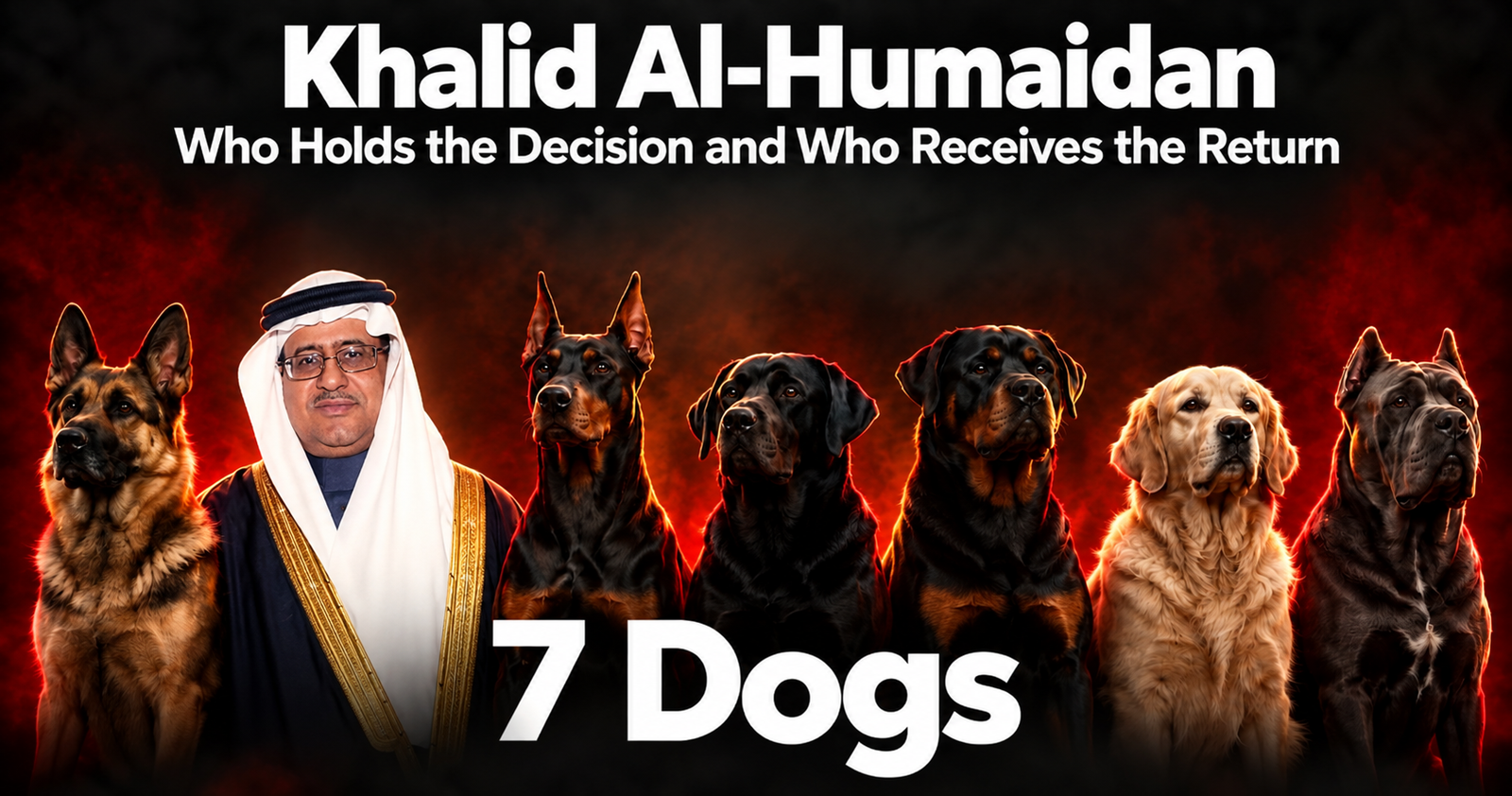
From Mabahith and Yemen Networks to Mohammed bin Nayef’s Fall,
the Reconstruction of Saudi State Security, Khashoggi, and the Opening to Iran
An Expanded Investigation — THE DEEP FILES
There is an easy way to write the story of Khalid bin Ali Al-Humaidan: list the positions he held from his entry into the Saudi security establishment until he became President of the General Intelligence Presidency (GIP).
But that is the least important way to tell it.
The real question is not simply: Who is Khalid Al-Humaidan?
How did Khalid Al-Humaidan remain at the center of Saudi security and intelligence while a crown prince, an interior minister, a deputy intelligence chief and a Royal Guard commander changed around him; while entire security bodies were redistributed; and while the agency he headed underwent institutional restructuring after the killing of Jamal Khashoggi? What did he know, what did he decide, and where did his authority and responsibility begin and end at each stage?
This investigation does not assume that remaining in office is evidence of wrongdoing. But remaining in office is not a reason to close the questions either.
CHAPTER ONE — A MAN FROM THE HEART OF MABAHITH
Khalid bin Ali Al-Humaidan did not come to intelligence from the diplomatic corps or academia. He came from the General Directorate of Investigations — Mabahith.
Saudi biographical accounts place his birth around 1955 and report that he studied criminal justice in the United States before pursuing a long career in the Saudi security establishment, eventually reaching senior leadership in Mabahith.
At one stage of his career he was responsible for international cooperation within Mabahith, before becoming Deputy Director General.
This background matters. Al-Humaidan was not an “external-intelligence man” throughout his career. He emerged from the institution associated with domestic security and then, in January 2015, moved to the leadership of the General Intelligence Presidency.
That transition gave him experience on both sides of the security architecture: the internal-security environment from which he came, and the intelligence service he later headed.
CHAPTER TWO — 29 JANUARY 2015: THE BEGINNING OF THE LONG TENURE
In the opening days of King Salman’s reign, a royal order ended Al-Humaidan’s military service and appointed him President of the General Intelligence Presidency at ministerial rank. He also became a member of the Council of Political and Security Affairs.
Mohammed bin Nayef was then at the center of Saudi political and security power. The official record repeatedly places Al-Humaidan within the senior security circle operating alongside him.
In May 2015, for example, Mohammed bin Nayef’s meeting with FBI Director James Comey included Musaed Al-Aiban, Saad Aljabri and Khalid Al-Humaidan. In another May 2015 meeting with French President François Hollande, Aljabri, Al-Humaidan and Abdulaziz Al-Huwairini were among the Saudi officials present.
In April 2017, less than three months before Mohammed bin Nayef’s removal, Al-Humaidan was still appearing in the senior security environment around him.
Saudi Press Agency references: https://www.spa.gov.sa/1361055 ; https://www.spa.gov.sa/1357783 ; https://www.spa.gov.sa/1611708
The record therefore does not support rewriting Al-Humaidan as a figure who had always existed entirely outside Mohammed bin Nayef’s security architecture. He was part of the national-security structure that operated with him. That makes what happened later more important, not less.
CHAPTER THREE — THE OLD SECURITY NETWORK
Before the major transformation of 2017, a recurring group of names appears across senior security and international meetings: Mohammed bin Nayef, Saad Aljabri, Abdulaziz Al-Huwairini, Khalid Al-Humaidan and Musaed Al-Aiban.
This was not a proven clandestine “cell,” and there is no evidentiary basis for describing it as one. It was an institutional network of senior officials whose responsibilities repeatedly intersected.
Mohammed bin Nayef was Interior Minister and Crown Prince. Aljabri was one of his most prominent security advisers. Al-Huwairini led Mabahith. Al-Humaidan had moved to the leadership of GIP. Al-Aiban occupied a senior political and legal advisory position.
The later trajectories are striking: Aljabri went into exile; Mohammed bin Nayef lost his positions; Al-Huwairini eventually headed the new Presidency of State Security; Al-Humaidan remained President of GIP; and Al-Aiban remained within the upper national-security architecture.
CHAPTER FOUR — YEMEN: THE NETWORK PREDATED THE WAR
Saudi influence in Yemen did not begin with Operation Decisive Storm in March 2015.
Documents later published in the Saudi Special Committee Cables archive describe an older ecosystem of contacts, allocations, tribal figures, politicians and sources. These are published leaked documents, not judicial findings. Each document requires document-level authentication and contextual verification before its contents can be treated as conclusive fact.
Archive: https://saudicables.dropsitenews.com/
Some of the published material nevertheless places Al-Humaidan directly within this environment during his Mabahith career.
CHAPTER FIVE — ALI YASLAM AL-HUMAIRI
One important thread concerns Ali Yaslam Baawadah Al-Humairi.
According to a published document, Al-Humaidan, while serving as a senior Mabahith official, handled a file involving contact with the Yemeni figure. The material describes contact in Cairo, arrangements connected to a Saudi visit and entry, accommodation and airline tickets, continued communication, and coordination involving other officials or intermediaries.
Names appearing in the chain include Mohammed Ali Al-Shaddadi and Ahmed Al-Zahrani.
The English archive title uses the term “asset.” That title alone is not sufficient evidence to state as fact that Al-Humairi was formally recruited as an intelligence asset.
The questions for Al-Humaidan are therefore narrower and stronger: What was the nature of the relationship Mabahith sought to establish with Al-Humairi? Who authorized the travel and accommodation expenditures? What security task, if any, was expected from him? Did the relationship continue after Al-Humaidan moved to GIP?
CHAPTER SIX — A SERIOUS AQAP CLAIM, AND A REQUEST FOR VERIFICATION
Other published material conveyed an allegation that former Yemeni President Ali Abdullah Saleh had directed or allowed Al-Qaeda in the Arabian Peninsula to take Rada’a, Abyan and other areas.
Importantly, the published record indicates that Al-Humaidan did not simply accept the allegation. He requested documentation and details to verify it.
A follow-up identified Yemeni expatriates minister Mujahid Al-Qahali as the source of the allegation and indicated that he was willing to travel and meet Mohammed bin Nayef.
This detail must remain in the investigation because it shows a different intelligence mechanism: allegation, request for documentation, and attempted verification. Omitting it merely because it does not support a predetermined negative narrative would distort the evidence.
CHAPTER SEVEN — HUSSEIN AL-AHMAR: MONEY, ACCESS AND SECURITY UTILITY
Other documents concern Hussein Al-Ahmar. According to the published material, Mabahith met him, discussed security observations and recommended continued contact, including possible use for limited security missions in Yemen serving Saudi security interests.
Separate internal reports contained allegations about his conduct and alleged contacts involving Qatar, Iran and Houthi-related matters. These are internal allegations, not judicial findings against Hussein Al-Ahmar.
The broader question is more important: On what basis did Saudi institutions decide which Yemeni political or tribal figure received support, which allocation was reduced, and which individual was regarded as useful for security purposes?
CHAPTER EIGHT — AHMED ASIRI APPEARS IN THE YEMEN FILE BEFORE BECOMING AL-HUMAIDAN’S DEPUTY
Ahmed Asiri’s relevance does not begin with the Khashoggi case.
Published Special Committee/Yemen material places him in discussions concerning Yemen years earlier, including material related to Hussein Al-Ahmar. He later became one of the most visible Saudi officials associated with the Yemen campaign.
Then, in April 2017, he became Deputy President of the General Intelligence Presidency under Khalid Al-Humaidan.
This continuity deserves examination: What role did Asiri’s Yemen experience play in his selection for the intelligence post, who recommended him, and what operational authorities accompanied the appointment?
CHAPTER NINE — SAR 85.2 MILLION: FOLLOW THE AUTHORIZATION CHAIN
Published documents also describe substantial financial channels.
One thread refers to two six-month periods of SAR 42.6 million each — SAR 85.2 million across the two referenced periods — in connection with support associated with Ali Mohsen Al-Ahmar and Sheikh Othman Mujalli, through an account under Chief of Staff Hussein Al-Qubail and linked in the documents to earlier royal instructions.
There is no document in the material reviewed that proves Khalid Al-Humaidan personally authorized or controlled the SAR 85.2 million.
The correct investigative questions are therefore: Who recommended the payments? Who approved them? Which institution had disbursement authority? Through which account did the money move? Who ultimately received it? What measurable political, security or intelligence result was obtained in return?
CHAPTER TEN — SAR 5 MILLION, SAR 50 MILLION, AND TRIBAL FRONTS
Other published material describes SAR 5 million connected to support for anti-Houthi tribal fronts around Dammaj, with a subsequent request after the first tranche was reportedly spent.
Another document refers to authorization for SAR 50 million to support border tribes opposing the Houthis, including weapons, supplies and financing, with Defense, Interior and Finance involved alongside the Yemeni government.
Again, the reviewed material does not establish that Al-Humaidan personally signed the SAR 50 million decision.
The investigative method must therefore remain: proposal → recommendation → authorization → account → recipient → stated purpose → measurable outcome.
CHAPTER ELEVEN — SAR 10 MILLION AND A $150,000 DOCUMENT OFFER
In another file, Yemeni sheikhs complained about aid distribution and alleged that Amin Al-Ukaymi had received SAR 10 million without justification. That is the complainants’ allegation, not an independent audit finding.
A separate thread describes a source, Major Khalid bin Nasser Al-Ahraq, communicating through Mohammed Ahmed Al-Walas about purported secret documents involving Abdul-Malik Al-Houthi, an Iranian party and Hussein Al-Ahmar, offered for $150,000.
The material reviewed does not prove that the $150,000 was paid.
The public-interest questions are basic: How much was offered? How much was actually paid? Who received it? What information was delivered? Who assessed whether that information was authentic and worth the price?
CHAPTER TWELVE — WAS LOYALTY A FUNDING CRITERION?
The most sensitive implication of the Special Committee material is the picture it presents of allocations to Yemeni sheikhs and political personalities being reassessed according to utility, relationships and cooperation.
If the underlying original documents confirm that loyalty or political utility was explicitly used as a criterion for particular allocations, the issue moves beyond conventional foreign assistance into the financing of political and security influence.
The Saudi public is entitled to ask: How much did the state spend over decades on these networks? Who audited the accounts? Who measured the return? How many people received regular payments? And how effective were these networks when the 2015 war began?
CHAPTER THIRTEEN — SAUDI ARABIA HAD YEARS OF INTELLIGENCE ON THE HOUTHIS BEFORE THE WAR
Pre-war Saudi intelligence reporting described Houthi recruitment and training, weapons smuggling, mines, military movements, geographic expansion, alleged Iranian involvement and cooperation with remnants of Ali Abdullah Saleh’s system.
Saudi Arabia therefore did not enter 2015 without a long intelligence history on Yemen.
Al-Humaidan became GIP President roughly two months before the March 2015 intervention. That creates a central accountability question: What assessment did GIP provide before the intervention?
What did it estimate about the likely duration of the conflict, Houthi capabilities, Iranian involvement, tribal alignments and the prospect of decisive victory? How did those assessments compare with what followed?
CHAPTER FOURTEEN — APRIL 2017: THE SECURITY ARCHITECTURE BEGINS TO MOVE
Before the June 2017 succession change, a significant change occurred inside Al-Humaidan’s own agency.
Youssef Al-Idrissi had served as Deputy President of GIP and had previously acted as intelligence chief after Prince Bandar bin Sultan’s departure. On 22 April 2017, Al-Idrissi was retired and Ahmed Asiri was appointed Deputy President of GIP.
Contemporaneous Saudi reporting of the 22 April package: https://www.aleqt.com/2017/04/23/article_1174721.html ; https://www.aleqt.com/2017/04/23/article_1174731.html
Asiri did not arrive from a conventional intelligence career. He had been an adviser in the Defense Minister’s office and the public spokesman for the Yemen coalition. The Defense Minister was Mohammed bin Salman.
The unanswered questions are direct: Did Khalid Al-Humaidan request Asiri’s appointment? Who nominated Asiri? Why was Al-Idrissi replaced at that moment? What authorities were delegated to the new deputy?
CHAPTER FIFTEEN — A NEW NATIONAL SECURITY CENTER
The same 22 April 2017 royal-order package created a National Security Center organizationally linked to the Royal Court.
Mohammed bin Saleh Al-Ghufaili was appointed National Security Adviser, made a member of the Council of Political and Security Affairs, and assigned supervision of the Council’s secretariat.
At that moment Mohammed bin Nayef was still Crown Prince, Interior Minister and chairman of the Council of Political and Security Affairs.
The timing does not prove that the Center was created to weaken him. It does require questions: When was this institutional design prepared? What precise powers did the Center receive? What did supervision of the Council secretariat mean in practice — agenda control, minutes, coordination, information flow, or something narrower? Who designed the relationship between the Royal-Court-linked Center and the Council chaired by Mohammed bin Nayef?
CHAPTER SIXTEEN — THE NIGHT OF 20–21 JUNE 2017
On 21 June 2017, Mohammed bin Nayef was removed as Crown Prince, Deputy Prime Minister and Interior Minister. Mohammed bin Salman became Crown Prince.
The official account stated that 31 of 34 members of the Allegiance Council supported the selection, and Mohammed bin Nayef was publicly shown pledging allegiance to Mohammed bin Salman.
Later journalistic reconstructions described a far more contentious night at Al-Safa Palace, including claims that Mohammed bin Nayef was separated from his security detail, that guards’ weapons or phones were taken, and that he was pressured until morning. These details are attributed press accounts, not an official Saudi admission.
The evidentiary distinction matters. The official transfer of office is established. Specific coercive actions described by journalistic sources require attribution and further corroboration.
CHAPTER SEVENTEEN — WHERE WAS KHALID AL-HUMAIDAN?
We specifically searched for evidence placing Al-Humaidan in the operational execution of Mohammed bin Nayef’s removal.
No reliable source reviewed establishes that he ordered Mohammed bin Nayef’s isolation, confiscated his phone, disarmed his guards, commanded the force inside the palace, contacted Allegiance Council members, or personally compelled him to step aside.
That is not a defense of Al-Humaidan. It is the present boundary of the evidence.
The unanswered questions remain: When did Al-Humaidan learn that Mohammed bin Nayef would be removed? Was GIP informed in advance? Did the agency prepare a risk assessment? Did Al-Humaidan communicate with the CIA or another foreign intelligence service about the transition? Did GIP perform any task during the night or immediately afterward?
CHAPTER EIGHTEEN — THE ROYAL GUARD AND AL-SAFA PALACE
The Royal Guard commander at the time was Lieutenant General Hamad bin Mohammed Al-Ohali. A June 2017 report documents him serving as Royal Guard chief around King Salman at Al-Safa Palace.
Source: https://www.arabnews.com/saudi-arabia/king-to-spend-last-10-days-of-ramadan-in-makkah-1115906
The Royal Guard, rather than GIP, is the institution more directly associated with the security environment of the royal palace. Yet no strong public source reviewed identifies the specific officer who allegedly ordered the confiscation of weapons or phones from Mohammed bin Nayef’s detail.
About a month later Al-Ohali was replaced as Royal Guard chief by Suhail bin Saqr Al-Mutairi. Al-Mutairi was not an outsider; he had previously served as Assistant Chief of the Royal Guard.
No official evidence reviewed establishes that Al-Ohali’s replacement was punishment for the events of 20–21 June. The question remains: What role did the Royal Guard play that night, and who issued the relevant orders?
CHAPTER NINETEEN — MBN-ERA COMMANDERS WHO REMAINED
Khalid bin Qarar Al-Harbi commanded the Special Emergency Forces. Mifleh Al-Otaibi commanded the Special Security Forces. Both were senior operational commanders within Mohammed bin Nayef’s security architecture before his removal.
After the transition, both were promoted.
No evidence reviewed proves that either man participated in removing Mohammed bin Nayef. The more defensible conclusion is that significant operational commanders from the former system were retained and re-linked into the new architecture.
This complicates any simplistic story of a complete purge. Parts of the old security machine survived the political transition.
CHAPTER TWENTY — 20 JULY 2017: THE REDISTRIBUTION OF SECURITY POWER
One month after the succession change, Royal Order A/293 created the Presidency of State Security.
The restructuring transferred major components from the Ministry of Interior, including the General Directorate of Investigations (Mabahith), Special Security Forces, Special Emergency Forces, Security Aviation, the General Directorate of Technical Affairs, and the National Information Center, together with functions connected to counterterrorism, counter-terrorist financing and financial investigations.
Official Saudi Press Agency order: https://www.spa.gov.sa/1649683
This was not a cosmetic renaming. It redistributed core instruments of internal security, intelligence, technical capability, data and financial-security functions.
CHAPTER TWENTY-ONE — PEOPLE, MONEY, DOCUMENTS AND INFORMATION
Royal Order A/293 went beyond transferring organizational names. It provided for the transfer of the relevant civilian and military personnel, budgets, budget items, documents and information.
The Bureau of Experts at the Council of Ministers was tasked with reviewing affected laws and completing the determination and transfer of functions, bodies, departments, employees, occupied and vacant positions, budgets, property, items and appropriations.
Official source: https://www.spa.gov.sa/1649683
This was a redistribution of people + money + intelligence + records + operational units.
That creates a major documentary question: Who represented each institution before the Bureau of Experts? Which officials decided what stayed with Interior and what moved to State Security? What was the financial value of the assets, contracts and appropriations transferred?
CHAPTER TWENTY-TWO — THE IDEA DID NOT BEGIN IN 2017
A crucial fact prevents an easy but inaccurate narrative.
Royal Order A/293 explicitly referred back to a proposal submitted by Prince Nayef bin Abdulaziz in 2012 to amend the Interior Ministry’s organizational structure and separate the state-security sector into a new body.
Official source: https://www.spa.gov.sa/1649683
The concept of an independent State Security body therefore was not invented after Mohammed bin Nayef’s removal.
But that produces a different and potentially more important question: Why was Prince Nayef’s proposal not implemented for roughly five years, including during Mohammed bin Nayef’s tenure as Interior Minister, and why was it activated approximately one month after Mohammed bin Nayef lost the ministry?
The public record reviewed does not prove that Mohammed bin Nayef personally rejected or obstructed his father’s proposal. It establishes only that the separation was not implemented during his tenure.
Royal Order A/293 also states that the 2017 action followed what was presented to the King by the Interior Minister. At that time the Interior Minister was Abdulaziz bin Saud bin Nayef, newly appointed after Mohammed bin Nayef’s removal.
The missing link is therefore documentary: When was the 2012 file reopened? Who reopened it? When did the new Interior Minister make his presentation? Was any implementation work underway before 21 June 2017?
CHAPTER TWENTY-THREE — ABDULAZIZ AL-HUWAIRINI AND THE NEW BODY
Abdulaziz Al-Huwairini, already the head of Mabahith, was appointed President of State Security at ministerial rank while initially continuing as Director General of Mabahith.
Official source: https://www.spa.gov.sa/1649683
That placed the same official at the head of the new institution and, during the transition, at the head of its most important incoming component.
Abdullah bin Abdulkarim Al-Issa was appointed Assistant President of State Security at ministerial rank. His publicly available pre-appointment biography is comparatively limited, raising legitimate questions about his prior responsibilities, selection and role in the transition.
The central questions for Al-Huwairini are: Were you involved in preparing, recommending or reviewing the July 2017 restructuring? When were you first informed that Prince Nayef’s 2012 proposal would be implemented? What role did you play in determining the assets, personnel, intelligence holdings and contracts transferred?
CHAPTER TWENTY-FOUR — WHO WAS THE DIRECT INSTITUTIONAL BENEFICIARY?
If the question is which institution received the major internal-security components formerly under the Interior Ministry, the answer is not Al-Humaidan’s GIP.
They moved to the Presidency of State Security under Al-Huwairini.
Al-Humaidan retained the General Intelligence Presidency.
The post-restructuring architecture therefore became clearer: Al-Humaidan → General Intelligence; Al-Huwairini → State Security; the Interior Ministry → a ministry from which several of the former concentrated security functions had been removed.
This distinction matters when assigning institutional responsibility. Al-Humaidan should not be credited with receiving powers that the royal order actually assigned elsewhere.
CHAPTER TWENTY-FIVE — THE FINANCIAL CLAIM: WHERE ARE THE SAVINGS?
Saudi public explanations of the State Security restructuring included claims that the new structure would improve efficiency and generate major financial savings, with contemporary reporting referring to savings in the tens of billions of riyals.
Contemporary report: https://saudigazette.com.sa/article/513421/SAUDI-ARABIA/King-Salman
That claim is testable.
How much did the relevant Interior Ministry sectors cost before separation? What was the subsequent State Security budget? What was the value of transferred assets? How many employees moved? Which contracts moved? Were the promised savings actually achieved? Was an independent public assessment ever released?
These are accounting questions, not ideological ones.
CHAPTER TWENTY-SIX — AHMED ASIRI: THE NUMBER TWO INSIDE AL-HUMAIDAN’S AGENCY
Then came the institutional crisis that cannot be separated from GIP’s chain of command.
Ahmed Asiri was Deputy President of the General Intelligence Presidency. Khalid Al-Humaidan was President.
In October 2018, journalist Jamal Khashoggi was killed inside the Saudi consulate in Istanbul. Asiri was removed from his post.
Saudi prosecutorial announcements later described the former deputy intelligence chief as having issued an order connected to returning Khashoggi to the Kingdom by persuasion and, if persuasion failed, by force, according to the prosecution’s account at the time.
This creates unavoidable institutional questions for Al-Humaidan: What authority did the Deputy President possess? Could he authorize an overseas operation without informing the President? Which categories of operation required Al-Humaidan’s approval? What did Al-Humaidan know before the operation, if anything? When did he first learn about it?
CHAPTER TWENTY-SEVEN — ADMINISTRATIVE ACCOUNTABILITY IS NOT THE SAME AS CRIMINAL GUILT
The publicly released 2021 U.S. intelligence assessment on Jamal Khashoggi did not list Khalid Al-Humaidan among the individuals it identified in connection with participation in, responsibility for, or complicity in the operation.
ODNI assessment: https://www.dni.gov/files/ODNI/documents/assessments/Assessment-Saudi-Gov-Role-in-JK-Death-20210226v2.pdf
No evidence reviewed supports stating that Al-Humaidan personally ordered Khashoggi’s killing.
But absence of public evidence establishing personal criminal participation does not eliminate the separate question of administrative accountability for how an intelligence service operated under his leadership.
Criminal attribution and institutional command responsibility are different questions and must not be collapsed into one another.
CHAPTER TWENTY-EIGHT — THE POST-KHASHOGGI RESTRUCTURING REVEALS THE INSTITUTIONAL QUESTIONS
After the killing, Saudi Arabia did not merely announce that an individual official had made a mistake. King Salman ordered a restructuring of the General Intelligence Presidency.
The official language is important. The restructuring process addressed the agency’s regulations, authorities, procedures and methods, and sought clearer definition of powers, responsibilities and hierarchical command.
Subsequent official announcements described work involving organizational structure, policies, procedures, governance, legal frameworks and qualification mechanisms.
These are not minor administrative adjustments. They raise the question of what controls existed before October 2018 and why additional controls were considered urgently necessary afterward.
CHAPTER TWENTY-NINE — WHAT THE EMERGENCY REFORMS TELL US
Among the announced measures were the creation or strengthening of functions involving strategy and development, legal affairs, performance evaluation and internal review, and mechanisms for reviewing intelligence activities and the personnel assigned to them.
The obvious accountability question is: If these mechanisms were urgent solutions after Khashoggi, what equivalent safeguards existed beforehand?
Who reviewed sensitive operations? Who verified legality? Who examined human-rights implications? Who could stop an operation? What written authority governed the Deputy President’s operational power?
CHAPTER THIRTY — AL-HUMAIDAN HELPED RESTRUCTURE THE AGENCY HE HEADED
The committee tasked with restructuring GIP included Mohammed bin Salman as chairman, the Interior Minister, Musaed Al-Aiban, Ibrahim Al-Assaf, Khalid Al-Issa, Adel Al-Jubeir, Khalid Al-Humaidan and Abdulaziz Al-Huwairini.
That means Al-Humaidan participated in redesigning the institution he headed.
The question is not whether this automatically constituted wrongdoing. The question is how potential conflicts were managed: Was there an independent external review? Did any body outside GIP assess the performance of the President himself? Were all relevant prior operations examined? Were full findings recorded, and can any non-operational portion be released?
CHAPTER THIRTY-ONE — FROM MBN TO MBS: AL-HUMAIDAN REMAINED
This may be the defining fact of Al-Humaidan’s career.
Saad Aljabri left the system. Mohammed bin Nayef lost power. Ahmed Asiri was removed. The Royal Guard leadership changed. The Interior Ministry lost major security bodies. Mabahith became part of State Security.
Khalid Al-Humaidan remained President of the General Intelligence Presidency.
This is not proof of a bargain, betrayal or conspiracy. No evidence reviewed establishes that he betrayed Mohammed bin Nayef in exchange for survival.
But the durability of his position across repeated institutional upheaval makes his knowledge of the system unusually important.
CHAPTER THIRTY-TWO — THE U.S. SECURITY RELATIONSHIP CONTINUED
Al-Humaidan was part of senior Saudi-U.S. security engagement before the succession transition.
In June 2015, when Mohammed bin Salman met U.S. Director of National Intelligence James Clapper, Al-Humaidan was officially present.
Saudi Press Agency: https://www.spa.gov.sa/1372153
He also appeared in the broader security environment around Mohammed bin Nayef during contacts with senior U.S. officials, including FBI Director James Comey.
After Mohammed bin Nayef’s removal, institutional security cooperation continued.
We found no public evidence establishing that Al-Humaidan informed the CIA in advance of the June 2017 succession change or that the CIA approved it. Those claims should not be made without evidence.
The questions remain legitimate: What did U.S. intelligence know, when did it know it, and what communications — if any — passed through GIP?
CHAPTER THIRTY-THREE — ALJABRI, AL-HUWAIRINI AND THE TRANSITION
The June 2017 transition produces a revealing institutional triangle.
Saad Aljabri ultimately remained abroad. Abdulaziz Al-Huwairini moved from Mabahith into leadership of the new State Security Presidency. Khalid Al-Humaidan remained at GIP.
Aljabri’s later U.S. civil litigation named Mohammed bin Salman, Bader Al-Asaker, Saud Al-Qahtani, Ahmed Asiri and others in serious allegations. Al-Humaidan was not named as a defendant in that complaint. That absence does not prove non-involvement in every relevant event, but it matters when describing what the litigation actually alleged.
U.S. court materials treated Aljabri’s claims as allegations rather than judicial findings on their truth. Court reference: https://law.justia.com/cases/federal/district-courts/district-of-columbia/dcdce/1%3A2020cv02146/220747/134/
Reports concerning Al-Huwairini’s situation around the succession and alleged messages involving Aljabri require careful authentication before publication as fact. The stronger documented point is the institutional outcome: Al-Huwairini emerged as head of State Security, while Al-Humaidan remained head of GIP.
CHAPTER THIRTY-FOUR — FROM INTELLIGENCE CHIEF TO STRATEGIC ENVOY
Al-Humaidan’s later role extended beyond conventional intelligence management.
In April 2021, Saudi Arabia and Iran held direct talks in Baghdad after years of severed diplomatic relations. Al-Humaidan led the Saudi side; Saeed Iravani represented the Iranian side. Yemen was among the principal issues.
United States Institute of Peace / Iran Primer: https://iranprimer.usip.org/blog/2021/may/04/secret-iran-saudi-talks
Later reporting also described additional Saudi-Iranian rounds and contacts involving senior Iranian security figures. Where those details rely on journalistic sourcing rather than official confirmation, they must remain attributed.
The broader fact is significant: the same intelligence chief who had been in office through years of the Yemen war became one of Saudi Arabia’s principal channels for direct security dialogue with Iran.
CHAPTER THIRTY-FIVE — WHAT DID AL-HUMAIDAN LEARN ABOUT YEMEN BEFORE NEGOTIATING OVER YEMEN?
This is where the beginning of the investigation meets its later chapters.
Al-Humaidan was present in the Saudi security environment dealing with Yemen before the 2015 war. He became intelligence chief shortly before the intervention. He remained in office through years of conflict. Then he led talks with Iran in which Yemen was a central issue.
What changed in the Saudi intelligence assessment between March 2015 and April 2021? Did GIP conclude that military means alone could not achieve the Kingdom’s objectives? If so, when? What assessment was submitted to the political leadership? What lessons were drawn from earlier tribal, political and intelligence networks in Yemen?
CHAPTER THIRTY-SIX — CYBERSECURITY AND THE REAPPEARANCE OF THE SAME SECURITY NODES
Al-Humaidan later appears within the leadership architecture of Saudi cybersecurity alongside other enduring national-security figures.
The National Cybersecurity Authority’s board includes Khalid Al-Humaidan and Abdulaziz Al-Huwairini, while Musaed Al-Aiban chairs the board.
Official NCA board: https://nca.gov.sa/en/board-of-directors/
This brings together General Intelligence, State Security and senior political/legal national-security coordination within one cybersecurity governance structure.
Their presence together is not evidence of misconduct. It is evidence of institutional continuity and concentration of national-security responsibility among a small group of long-serving officials.
CHAPTER THIRTY-SEVEN — WHERE IS THE MONEY?
One of the largest remaining gaps is financial transparency.
We know that the 2017 State Security restructuring moved institutions, assets, personnel, information and budgets.
But the public cannot easily reconstruct a complete financial picture answering: What does GIP cost? What does State Security cost? How much is spent on surveillance and technical systems? Who are the suppliers? What is spent on security aviation? Which technology contracts moved from Interior to State Security? Which contractors benefited from the restructuring?
Secrecy can protect operational details. It does not automatically answer whether non-operational aggregate spending, procurement governance and audit mechanisms can be disclosed.
CHAPTER THIRTY-EIGHT — FOLLOW THE SECURITY MONEY
The next phase of investigation should therefore examine the General Directorate of Technical Affairs, the National Information Center, surveillance and communications procurement, security aviation, cyber systems, intelligence procurement and international contractors.
The investigative chain must remain: Contract → Entity → Decision Maker → Payment → Capability → Use.
This is stronger than assuming that every surveillance technology used by Saudi Arabia belonged to GIP or was personally approved by Al-Humaidan.
CHAPTER THIRTY-NINE — PEGASUS CANNOT SIMPLY BE ATTACHED TO AL-HUMAIDAN’S NAME
There is extensive reporting concerning surveillance technology and Saudi-linked targeting, including the Pegasus ecosystem.
But the evidence reviewed does not justify stating that Khalid Al-Humaidan personally purchased or authorized Pegasus.
The correct questions are: Which Saudi entity procured each surveillance capability? Who signed the contract? Which institution operated the system? Who could select targets? What authorization process existed? Did GIP have a role, and if so, what role?
Personal responsibility must be established through documents, contracts, orders, testimony or equivalent evidence — not inferred merely from a job title.
CHAPTER FORTY — THIS IS NOT ONLY A STORY ABOUT ONE MAN
Reducing the investigation to whether Khalid Al-Humaidan is personally “good” or “bad” would miss the larger issue.
The investigation concerns a system through which intelligence, security bodies, foreign political networks, military power, domestic security, data, budgets and diplomatic backchannels intersect.
Much of that decision-making is necessarily protected from ordinary public view. The public-interest question is what accountability mechanism exists when secrecy covers not only operations, but also large expenditures, institutional failures and the chain of responsibility.
CHAPTER FORTY-ONE — PUBLIC MONEY AND PUBLIC ACCOUNTABILITY
The money appearing in the Yemen files is state money. The budgets moved to State Security are state money. Intelligence and security procurement is state expenditure.
The question is not whether Saudi Arabia has the right to maintain intelligence and security services. States do.
The question is: What mechanism determines whether a secret decision succeeded, failed, was financially justified, or produced no adequate return? Who audits that determination? Who can challenge it? What can ultimately be disclosed to the public without compromising legitimate operations?
CHAPTER FORTY-TWO — QUESTIONS FOR KHALID AL-HUMAIDAN
1. What role did you personally play in managing relationships with Yemeni political figures, tribal figures or sources before becoming GIP President?
2. What financial support could Mabahith recommend for such networks, and who had final authorization?
3. Were the results of these expenditures subjected to financial and operational audit?
4. What assessment did GIP provide before the 2015 intervention in Yemen?
5. What duration of conflict did the agency anticipate?
6. Did GIP warn of the possibility of a prolonged war?
7. Who nominated Ahmed Asiri to become your deputy in April 2017?
8. Did you request or approve his appointment?
9. What authorities did you delegate to him?
10. When did you first learn that Mohammed bin Nayef would be removed as Crown Prince?
11. Did GIP receive instructions concerning the June 2017 succession transition?
12. Did you communicate with the CIA or any other foreign intelligence service about the transition?
13. Did GIP participate in any capacity in events at Al-Safa Palace?
14. What, if anything, did you know about the Khashoggi operation before it occurred?
15. When were you first informed of it?
16. Could the Deputy President of GIP authorize an overseas operation without your approval or notification?
17. What deficiencies did the post-Khashoggi GIP restructuring identify?
18. Why were additional legal, internal-review and intelligence-activity review mechanisms considered necessary?
19. Was a complete internal investigation produced, and can any non-operational portion be released?
20. Was your own performance as agency President independently reviewed?
21. What changed in Saudi assessments of Iran and Yemen before you led the Baghdad talks in 2021?
22. What is GIP’s present relationship to Saudi cybersecurity governance?
23. What safeguards govern the procurement and use of surveillance technologies?
24. Would GIP support publication of non-operational aggregate financial information sufficient for the public to understand the cost and oversight of the institution?
CHAPTER FORTY-THREE — QUESTIONS FOR ABDULAZIZ AL-HUWAIRINI
When did you first learn that Prince Nayef’s 2012 proposal to separate State Security from Interior would be implemented?
Did you participate in preparing, recommending or reviewing the July 2017 State Security proposal?
Did substantive preparation begin before or after 21 June 2017?
What was the financial value of the assets and budgets transferred from Interior?
How many employees and positions moved?
Which major contracts were transferred?
Were the financial savings publicly associated with the restructuring ultimately achieved?
CHAPTER FORTY-FOUR — QUESTIONS FOR MUSAED AL-AIBAN
Did you participate in drafting, reviewing or providing legal advice on the April, June or July 2017 national-security royal orders?
When did you learn that the Crown Prince would be changed?
Did you provide legal or procedural advice concerning Mohammed bin Nayef’s removal?
Who prepared the justifications presented to members of the Allegiance Council?
What role did you play in the post-Khashoggi restructuring of GIP?
What independent mechanism reviewed the performance of an agency whose own President sat on the restructuring committee?
CHAPTER FORTY-FIVE — QUESTIONS FOR THE ROYAL COURT
Who contacted members of the Allegiance Council on 20–21 June 2017?
When did those consultations begin?
Who drafted or presented the justifications for changing the Crown Prince?
Was the decision considered in a collective meeting, through individual contacts, or both?
What role did the Royal Guard play at Al-Safa Palace?
If published accounts concerning the separation of Mohammed bin Nayef from his security detail and the collection of phones or weapons are accurate, who issued those orders?
Are official records available that could resolve conflicting public accounts of the succession night?
CHAPTER FORTY-SIX — QUESTIONS ABOUT AHMED ASIRI
Why was Youssef Al-Idrissi replaced by Ahmed Asiri in April 2017?
Who nominated Asiri?
What was the precise written job description of the Deputy President of GIP?
What categories of operation could the deputy approve?
Were there financial, geographic or operational limits on that authority?
Were those authorities changed after the Khashoggi case?
CHAPTER FORTY-SEVEN — WHAT WE KNOW, AND WHAT WE DO NOT
We know that Al-Humaidan came from Mabahith and became President of GIP.
We know that he worked inside the senior security architecture that operated with Mohammed bin Nayef.
We know that Ahmed Asiri became his deputy approximately two months before Mohammed bin Nayef’s removal.
We know that Mohammed bin Nayef lost his positions in June 2017.
We know that Al-Humaidan remained.
We know that the Presidency of State Security was created one month later.
We know that major security bodies, budgets, personnel, documents and information were transferred to it.
We know that the underlying concept of separating State Security from Interior traced back to Prince Nayef’s 2012 proposal.
We know that Al-Huwairini became head of the new body.
We know that Asiri was removed after the Khashoggi killing.
We know that GIP was then subjected to restructuring addressing governance, law, authorities and command arrangements.
We know that Al-Humaidan remained.
And we know that he later led Saudi Arabia’s direct security dialogue with Iran.
What we do not know is precisely what makes further investigation necessary.
CONCLUSION — THE MAN WHO REMAINED, AND THE QUESTIONS THAT REMAINED WITH HIM
It would be wrong to turn Khalid Al-Humaidan into a cartoon figure personally responsible for everything the Saudi state did during the past decade.
It would be equally wrong to look at more than a decade at the head of one of the state’s most important intelligence institutions and conclude that questions about decision-making, oversight, money and chain of command are none of the public’s concern.
Between Mohammed bin Nayef and Mohammed bin Salman, Al-Humaidan remained.
Between Mabahith and General Intelligence, Al-Humaidan remained.
Before the Yemen war and through years of it, Al-Humaidan remained.
Before Ahmed Asiri entered his agency and after Asiri left it, Al-Humaidan remained.
Before Khashoggi and after the restructuring of GIP, Al-Humaidan remained.
And from confrontation with Iran, he eventually moved to sitting across from Iranian representatives in Baghdad.
That continuity is not a crime.
But it gives Al-Humaidan something else: exceptional institutional knowledge.
The final question is therefore not: What can we accuse Khalid Al-Humaidan of?
It is: What does Khalid Al-Humaidan know about the decisions, operations, money and redistribution of power that passed through or around the institution he has led for years, and how much of that can the Saudi public legitimately know?
The documents available to us provide parts of the answer.
The missing parts should not be filled with speculation.
They should become questions — questions for Al-Humaidan, Al-Huwairini, Al-Aiban, the Royal Court, the Ministry of Interior, the Presidency of State Security, and the General Intelligence Presidency.
Secrecy can be a necessary part of intelligence work.
But secrecy should not become a permanent substitute for accountability.
SOURCE AND EVIDENCE NOTE
This investigation distinguishes among official records, judicial or regulatory records, attributed journalistic reporting, and published leaked documents.
Saudi Press Agency and other official Saudi records are used for appointments, institutional structures, royal orders and official meetings. U.S. government and court records are used where relevant to external assessments or litigation. Journalistic reconstructions are attributed as such. The Saudi Special Committee Cables are treated as published leaked documents requiring document-level authentication and contextual verification.
An official’s institutional position is not treated as proof that the official personally authorized every act carried out by that institution. Where personal authorization or participation is not established, the issue is framed as a question rather than a factual accusation.
Key public sources referenced in the investigation include:
https://www.dni.gov/files/ODNI/documents/assessments/Assessment-Saudi-Gov-Role-in-JK-Death-20210226v2.pdf