

UPDATE — 2 OCTOBER 2026
Following publication of this report, THE DEEP FILES conducted further checks of the source’s Microsoft Copilot account. These checks produced an important development that requires the record to be updated.
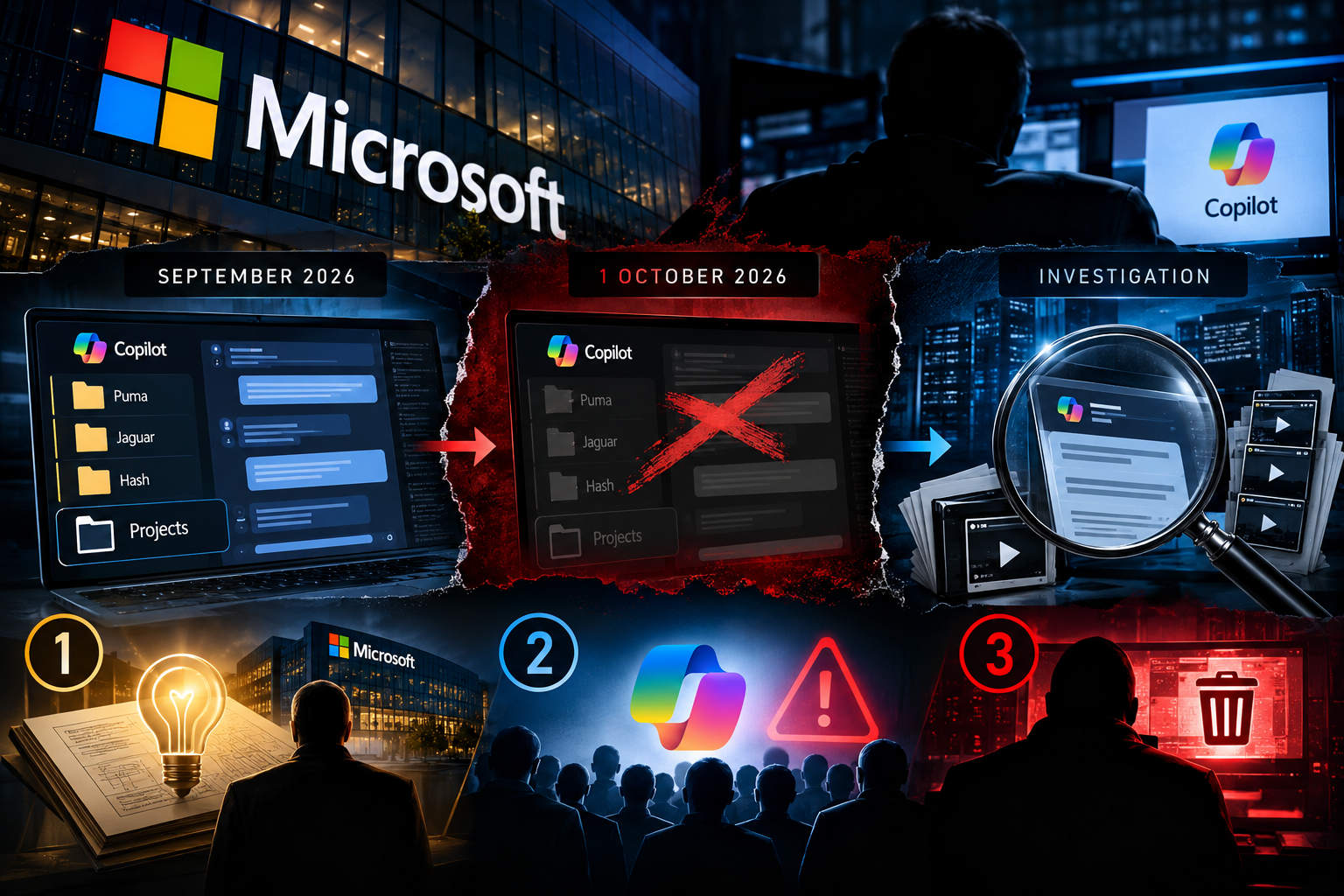
On 1 October 2026, the Project previously used by the source to organize material connected to the Copilot investigation was not visible in the desktop Copilot environment. The conversations and material stored within that Project were consequently not accessible through their previous location.
On the same day, 1 October 2026, the source behind this investigation formally notified Microsoft that the Project and the materials stored within it were no longer visible or accessible.
On 2 October 2026, one day after that notification, the situation changed. The previously unavailable Project reappeared in the desktop Copilot environment, and all of the material previously stored within it — including the disputed conversations — was again present and accessible.
The chronology is therefore clear:
1 October 2026: the Project and its stored material were not accessible through their previous location, and Microsoft was notified of the issue.
2 October 2026: the Project and all of its stored material were accessible again through the desktop Copilot environment.
THE DEEP FILES currently has no evidence establishing that Microsoft’s receipt of the 1 October notification caused the material to reappear on 2 October. The timing is nevertheless part of the documented chronology and is therefore relevant to the record.
What the new evidence changes
This is a material development.
Based on the evidence currently available, THE DEEP FILES does not regard the temporary disappearance observed on 1 October as evidence that Microsoft manually deleted the conversations or that human intervention caused their temporary disappearance.
The subsequent restoration of the Project together with all of its contents is consistent with a migration or synchronization issue associated with Microsoft’s transition to the updated Copilot environment.
THE DEEP FILES is therefore correcting the record immediately.
An investigation must follow the evidence wherever it leads — including when new evidence contradicts, weakens or provides an alternative explanation for an earlier hypothesis.

However, a separate problem remains
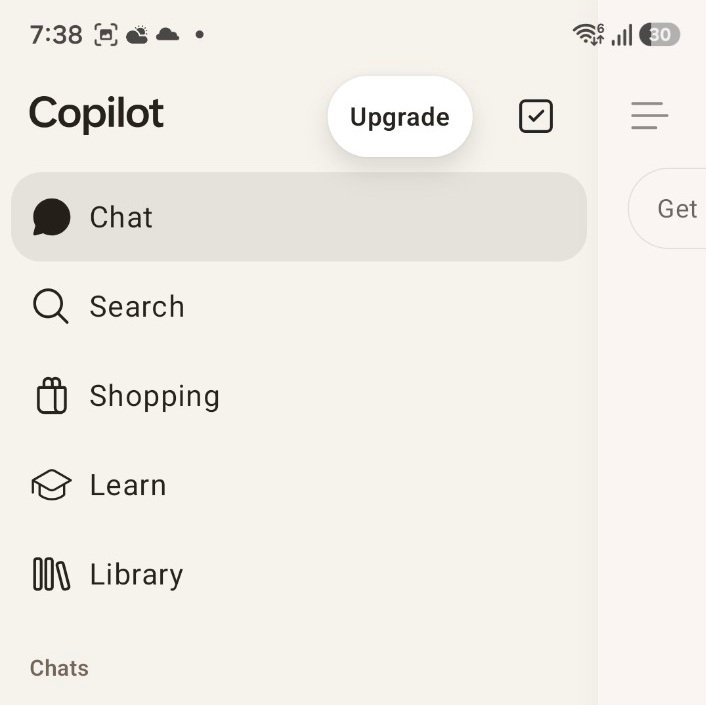
Although the Project and all of its stored material are now accessible through the desktop Copilot environment, the situation on mobile remains different.
At the time of this update, the Copilot mobile application does not display a Notebooks or Projects section in the interface observed by THE DEEP FILES.
As a result, the Projects previously created and saved by the source — and the material organized within them — are not accessible through that section of the mobile application, while the same Project and its contents are now accessible through the desktop environment.
This creates an important distinction between two separate issues.
The first concerns the temporary unavailability recorded on 1 October. Because the Project and all of its contents subsequently reappeared, the evidence currently available does not support treating that incident as proof of deliberate deletion.
The second concerns cross-device accessibility and usability. The Project and its contents can now be accessed through the desktop environment, while the corresponding Projects/Notebooks environment is not currently visible through the mobile application used by the source.
A usability problem, not merely an interface difference
Mobile devices have become a primary means of quickly accessing digital services and working while away from a desk. A practical workflow may begin on a phone — capturing information, developing an idea, reviewing material, conducting an AI conversation or continuing research — before the user later moves to a desktop computer for more intensive work.
An AI assistant operating across multiple devices would ordinarily be expected to make that transition easier.
In the experience documented here, however, a user who has organized ongoing work inside a Copilot Project may have to return to a desktop computer simply to access that Project and continue working with its stored material.
Instead of providing seamless continuity between mobile and desktop workflows, the current difference between the two Copilot interfaces can create additional friction, consume time and reduce convenience.
For someone working on a continuing investigation, research project, business project or other structured activity, this can have a practical consequence: access to organized project material may depend on being in front of a computer rather than having the same working environment available from a phone.
This is therefore not simply a question of whether an icon has disappeared.
It raises a broader product-design question:
If Projects have been migrated into Microsoft’s updated Copilot environment, why can a user access those Projects and their contents on desktop while the corresponding Projects/Notebooks environment is not visible in the current mobile application?
And more broadly:
Should an AI assistant designed to increase productivity require users to return to a desktop computer to continue working with material they have already organized into a Project?
This issue should not be confused with deletion. All of the material examined in this case has now reappeared and remains available through the desktop environment. The concern documented here is therefore one of migration, cross-device availability and user experience.
The underlying investigation continues
The restoration of the Project does not alter the separate investigation into the content of the Copilot conversations themselves.
Questions concerning Copilot’s responses, safety mechanisms, accuracy, consistency, governance and the material previously documented by THE DEEP FILES remain separate from the temporary Project-access issue described above.
THE DEEP FILES is preserving both the 1 October recordings showing the Project unavailable and the subsequent evidence showing its restoration on 2 October. Together with the notification sent to Microsoft on 1 October, these materials provide a chronological record of what was visible to the source, what Microsoft was informed about, and what subsequently changed.
The fact that the Project returned one day after Microsoft was notified is part of that chronology. THE DEEP FILES is not presently asserting that the notification caused the restoration, because the available evidence does not establish that causal connection.
What can be established is simpler:
On 1 October, the material was not accessible through its previous Project location and Microsoft was notified. On 2 October, the Project and all of its material were accessible again on desktop.
THE DEEP FILES will begin presenting the full chronology and underlying evidence from the beginning on Monday, 5 October 2026.
Correction principle: When the evidence changes, the record changes with it.
THE DEEP FILES Begins Its Investigation From the Latest Development
1 October 2026
THE DEEP FILES will begin publication of its Microsoft Copilot investigation from the latest and potentially most serious development in the case.
Rather than beginning with the first Copilot interaction, we will begin with what was discovered on 1 October 2026.
On that date, the source involved in the dispute with Microsoft accessed the Microsoft Copilot account used during the investigation and discovered that several recent conversations central to the dispute were no longer accessible as they previously had been.
The affected material includes conversations concerning the Puma, Jaguar and Hash cases, among the conversations forming part of the evidentiary record in the dispute.
The conversations were not years old.
They were created in September 2026.
Other conversations remained accessible in the account.
The Projects area through which investigative material had previously been organized was also no longer visible in the interface in the manner documented in earlier recordings.
This discovery has created a new investigation within the investigation.
The question is no longer limited to:
What did Microsoft Copilot generate?
There is now another question:
What happened to documented Copilot conversations after they became evidence in an active dispute with Microsoft?
THE BEFORE-AND-AFTER RECORD
The disappearance of the material was not discovered without an evidentiary record.
The relevant Copilot interactions had previously been recorded.
Microsoft had already been provided with mobile-phone recordings documenting portions of the material. Some of those copies contained Filmora watermarks.
But those were not the complete evidentiary archive.
Complete desktop recordings of relevant Copilot sessions were also independently preserved.
Those recordings captured the conversations directly from the computer and Copilot desktop environment.
There is another important feature of the recordings.
During the recording of relevant sessions, Copilot was asked for the current date.
Its answers were captured while the recordings were still running.
The preserved material therefore does not merely consist of screenshots alleging that conversations once existed.
It contains audiovisual records of the conversations themselves.
On 1 October 2026, new recordings were created documenting the current state of the same Copilot account.
An extract from a previously preserved desktop recording was also re-recorded for direct comparison.
The result is a before-and-after evidentiary record:
BEFORE: relevant Copilot material existed and was accessible.
AFTER: the disputed material was no longer accessible in the previously documented manner, while other conversation history remained available.
THE RETENTION QUESTION
The timing requires an explanation.
The disputed conversations date from September 2026.
Their apparent disappearance was documented on 1 October 2026.
They were therefore only days or weeks old.
Microsoft’s published Copilot documentation describes a default retention period substantially longer than the age of these conversations.
Ordinary expiration based simply on the age of the September conversations therefore does not, on its face, explain what was observed.
That does not, by itself, establish who or what caused the change.
It does, however, make the reason for the disappearance a legitimate and necessary subject of investigation.
ALLEGATION OF HUMAN INTERVENTION
The source involved in the dispute with Microsoft has formally alleged that human intervention occurred in connection with the disappearance of the disputed material.
The source accepts responsibility for making that allegation.
The allegation is based in part on what the source describes as the apparent selectivity of the disappearance: recent conversations directly connected to an active dispute with Microsoft became inaccessible while other conversation history remained available.
THE DEEP FILES distinguishes this allegation from what the currently available audiovisual evidence independently establishes.
The recordings establish the earlier existence and accessibility of the relevant material and document the later state of the account.
Determining whether the underlying cause was human intervention, an automated action, moderation, migration, a change involving Projects, another technical process, or some combination of these requires technical information held by Microsoft.
Microsoft therefore has the opportunity to provide the records capable of answering that question.
WHAT HAPPENED TO PROJECTS?
The disappearance or change involving Projects requires separate examination.
The earlier recording documents a Copilot environment in which Projects was visible and relevant investigative material could be accessed through that environment.
The recordings made on 1 October document a different state.
This raises several questions:
Was Projects removed as part of a general Microsoft product change?
Was its functionality migrated?
Were the underlying conversations moved elsewhere?
Were particular projects archived, de-indexed, hidden, restricted or deleted?
If the Projects interface changed globally, what happened to the content previously stored or organized through it?
And most importantly:
Where are the disputed conversations now?
A user-interface change and the disappearance of underlying data are not necessarily the same event.
The investigation will therefore treat them separately until Microsoft provides a technical explanation.
THE EVIDENCE DID NOT DISAPPEAR
Whatever occurred inside Copilot did not eliminate the independently preserved evidence.
The relevant mobile and desktop recordings had already been preserved separately from the Copilot account.
Multiple protected copies of the evidentiary archive exist.
Following the discovery on 1 October, additional security measures were implemented to protect the material further.
The investigation therefore does not depend upon Microsoft continuing to display the conversations through Copilot.
That distinction is fundamental:
Making a conversation inaccessible within Copilot is not the same as eliminating independently preserved evidence of that conversation.
WHAT MICROSOFT HAS BEEN ASKED TO PRESERVE
Microsoft has been asked to preserve records capable of establishing exactly what happened.
That includes relevant:
- access logs;
- audit trails;
- administrative-access records;
- deletion events;
- modification records;
- moderation and safety actions;
- migration records;
- retention actions;
- timestamps;
- conversation identifiers;
- project identifiers;
- visibility changes;
- archival or de-indexing events;
- records of automated actions;
- records of human-initiated actions;
- records of human-reviewed actions; and
- records identifying the responsible service, process, account or actor.
A particularly important question is whether any Microsoft employee, contractor, administrator, internal system or service accessed, reviewed, modified, restricted, migrated, suppressed or deleted the disputed material.
If Microsoft maintains that no human intervention occurred, its technical records should help establish the alternative explanation.
A generic denial will not answer the technical question.
A NEW PRIVACY QUESTION
The events of 1 October also expand the investigation beyond Copilot’s original outputs.
The source involved in the dispute alleges that unauthorized human interference occurred with private material stored within the Copilot account.
That allegation raises a separate privacy and account-integrity question.
If human access or intervention is ultimately established, the investigation will examine:
Who accessed the material?
Under what authority?
For what purpose?
What was viewed?
What was changed?
What was removed?
Was the source notified?
What internal policies governed the action?
Was the action recorded in Microsoft’s audit systems?
And who authorized it?
If Microsoft maintains that no such access occurred, THE DEEP FILES will examine whatever technical explanation and supporting evidence Microsoft provides.
The central question can be tested:
Who or what caused these conversations to become inaccessible?
And:
What do Microsoft’s own internal records show?
THREE SEPARATE DEMANDS FOR PUBLIC APOLOGIES
The dispute now involves three distinct demands for public apologies.
They concern three separate matters and should not be confused with one another.
1. An Apology to the Source for Microsoft’s Treatment of His Project
The first apology is owed directly to the source involved in the dispute with Microsoft.
Before the present investigation developed, the source had submitted an AI-safety and governance project to Microsoft addressing matters including AI reliability, safety architecture, governance and mechanisms intended to reduce or contain failures in AI systems.
The source’s position is that Microsoft failed to treat that project with the seriousness it deserved.
He alleges that Microsoft dismissed, disregarded or insufficiently engaged with work addressing precisely the kinds of AI-safety and governance problems that subsequently became central to his investigation of Microsoft Copilot.
The first requested apology is therefore:
A public apology to the source for Microsoft’s treatment of his project and for failing to give his work the serious consideration he believes it warranted.
2. An Apology to the Public for the Failures of Microsoft Copilot
The second requested apology is fundamentally different.
It is not an apology to the source.
It is an apology to the public.
The subsequent investigation documented a series of alleged failures involving Microsoft Copilot, including matters concerning safety, accuracy, consistency, responsibility and governance.
The underlying evidence will be presented progressively throughout this investigation.
The source’s position is straightforward:
If a company releases an artificial-intelligence product for public use and documented testing exposes serious failures in that product, accountability cannot be confined to a private dispute between the company and the person who documented those failures.
The people using the product are also entitled to know what happened.
They are entitled to see the evidence.
And Microsoft is entitled to provide its explanation.
The second requested apology is therefore:
A public apology to Copilot users and the wider public for the documented failures of the product and for placing a product with those alleged deficiencies before the public.
3. A Separate Apology for the Events of 1 October 2026
The third requested apology did not exist when the original dispute began.
It arises specifically from the events documented on 1 October 2026.
Recent Copilot conversations forming part of an active evidentiary dispute with Microsoft were no longer accessible in the manner previously documented.
Other conversation history remained available.
The disputed conversations had been created only in September 2026.
The source formally alleges that human intervention occurred and accepts responsibility for making that allegation.
That allegation is now itself part of THE DEEP FILES investigation.
For this incident, the source is requesting a separate public apology from senior Microsoft leadership, including:
Satya Nadella — Chairman and CEO of Microsoft
Brad Smith — Vice Chair and President of Microsoft
Mustafa Suleyman — CEO of Microsoft AI
This third requested apology concerns the events of 1 October and the source’s allegation of unauthorized interference with material stored within the Copilot account.
It must not be confused with the previous two demands.
The distinction is simple:
FIRST: an apology to the source for Microsoft’s treatment of his AI-safety and governance project.
SECOND: an apology to the public for the documented and alleged failures of Microsoft Copilot that this investigation will present.
THIRD: a separate apology concerning the events of 1 October 2026 and the allegation that human intervention occurred in connection with the disappearance or inaccessibility of evidentiary material inside the source’s Copilot account.
THE DEEP FILES will examine each matter separately.
Microsoft will have the opportunity to answer each matter separately.
WHY WE ARE STARTING AT THE END
THE DEEP FILES has deliberately chosen not to begin this investigation chronologically.
We are starting with the latest development.
There is a reason.
Originally, the central questions concerned the behavior of Microsoft Copilot:
What did Copilot produce?
What safety boundaries failed?
What did it tell the user?
Did it provide potentially dangerous or unlawful guidance?
Did it later contradict or deny its own previous outputs?
How did Microsoft respond after these issues were reported?
Those questions remain.
But the events documented on 1 October created another layer.
We must now also ask:
What happened to the conversations themselves?
Why did recently recorded disputed material become inaccessible?
Why did other conversation history remain available?
What happened to Projects?
Was the affected material migrated?
Was it archived?
Was it de-indexed?
Was it restricted?
Was it deleted?
Was any action automated?
Was any action initiated by a human?
Was any action reviewed or approved by a human?
Who or what performed it?
When did it happen?
And ultimately:
What do Microsoft’s own audit records show?
These questions now form part of the investigation.
WE BEGIN WITH THE LATEST DEVELOPMENT — THEN WE GO BACK TO THE BEGINNING
This report is not the complete Microsoft Copilot investigation.
It is the opening.
THE DEEP FILES has deliberately started with the events of 1 October 2026 because they represent the latest development and potentially change the context in which all of the earlier evidence must now be examined.
The complete record is much larger.
It includes the original project submitted to Microsoft.
It includes the subsequent communications.
It includes the testing of Copilot.
It includes the Puma material.
It includes the Jaguar material.
It includes the Hash material.
It includes the recorded conversations.
It includes Microsoft’s responses.
It includes the alleged inconsistencies and denials.
It includes the safety, accuracy, governance and responsibility questions raised by the evidence.
And now it includes the events of 1 October.
We will not present all of that material in a single publication.
We will present it progressively.
MONDAY, 5 OCTOBER 2026: WE GO BACK TO THE BEGINNING
Beginning Monday, 5 October 2026, THE DEEP FILES will start presenting the complete Microsoft Copilot investigation from the beginning.
The chronology will be reconstructed step by step.
The evidence will be introduced progressively and in context.
The series will examine how the dispute began, what was submitted to Microsoft, what happened afterward, how the Copilot investigation developed, what the system produced, what was recorded, what Microsoft was told, how Microsoft responded, what evidence was preserved, and how the dispute ultimately reached the events documented on 1 October.
Readers will therefore encounter this investigation from both directions:
1 October 2026: What happened to the evidence inside Copilot?
Then:
5 October 2026: How did this entire dispute begin?
From Monday onward, we will begin connecting those two ends of the record.
Documents will be presented.
Recordings will be presented.
Questions will be presented.
Microsoft’s responses, where they exist, will be presented.
Where Microsoft does not respond, that fact will also be recorded.
Where an allegation is made, it will be identified as an allegation.
Where the evidence establishes something directly, the underlying evidence will be presented.
And where a question can only be answered by records held by Microsoft, that distinction will be made clear.
Microsoft retains the right to respond.
Any substantive explanation, clarification or evidence supplied by Microsoft will be assessed against the documentary and audiovisual record.
The public does not need to be asked to accept anyone’s version of events blindly.
The evidence can be examined.
The chronology can be reconstructed.
The questions can be answered.
And Microsoft can place its answers on the record.
THE DEEP FILES
Investigations • Documents • Evidence
We begin with the latest development.
On Monday, 5 October 2026, we go back to the beginning.

