

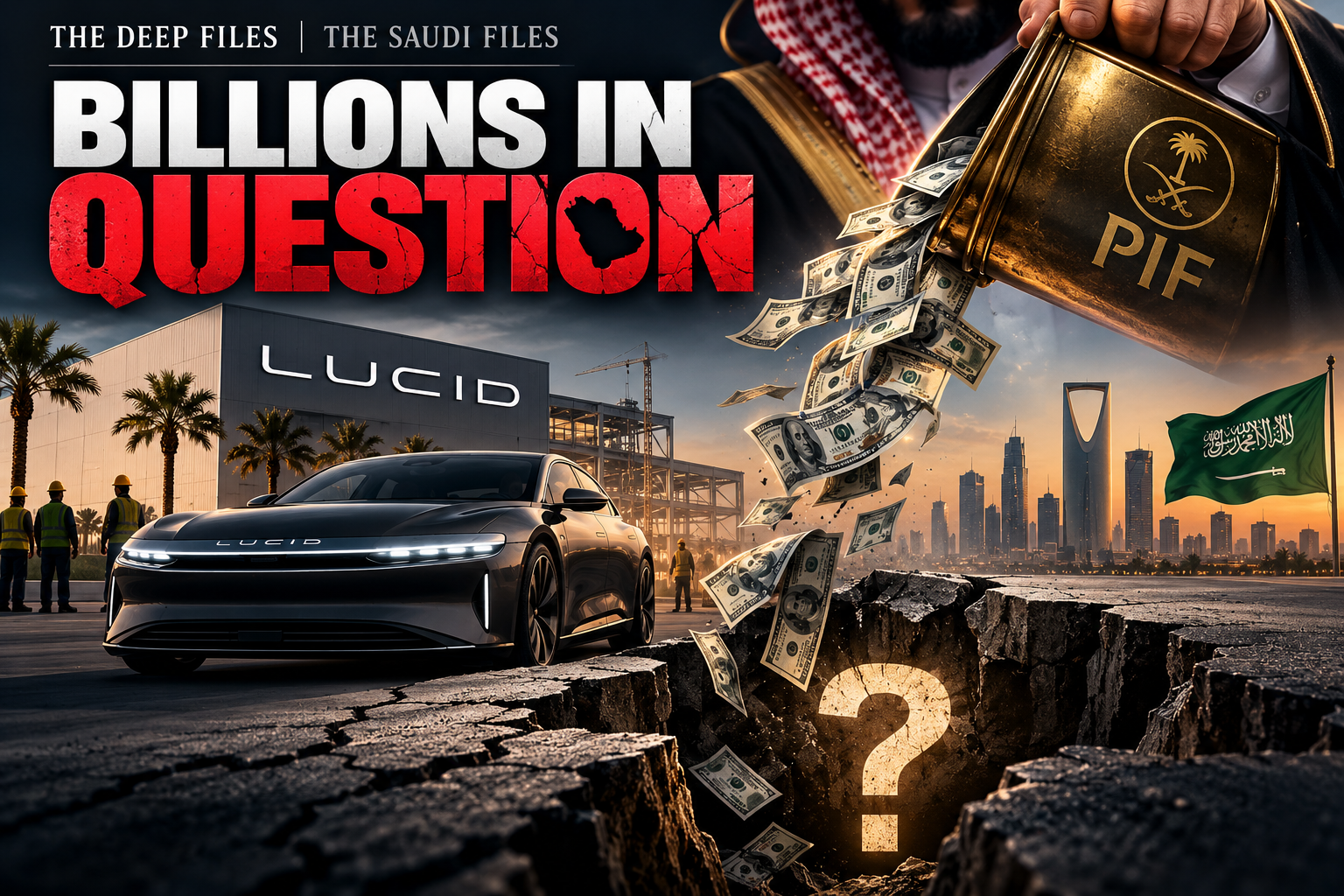
Eight years of financing, mounting losses, and an industrial promise still being buil
Wasting the Saudi people’s money
In September 2018, Saudi Arabia’s Public Investment Fund (PIF) announced an agreement to invest more than $1 billion in Lucid Motors. Lucid had not begun commercial production of its first car. PIF said the money would complete development and testing of the Lucid Air, build an Arizona factory, and bring the vehicle to market. [1]
Eight years later, Lucid makes and delivers electric vehicles, and PIF controls it directly and through Ayar Third Investment Company. Yet Lucid reported a $2.70 billion net loss in 2025 and a $2.06 billion net loss in the first half of 2026. Operating activities used $2.41 billion in cash during those six months. These are Lucid’s figures, not PIF’s realized investment loss. [2][3]
At its Saudi plant, Lucid says it reassembles vehicle kits manufactured in the United States and expects complete vehicle production in the Kingdom to begin in 2027. The core question is what financial and industrial return Saudi Arabia has received for its expanding commitments. [3]
The financial scale
| Measure | Reported amount |
| Net loss in 2023 | $2.83 billion |
| Net loss in 2024 | $2.71 billion |
| Net loss in 2025 | $2.70 billion |
| Net loss in first half of 2026 | $2.06 billion |
| Combined losses across these periods | More than $10.3 billion |
| First half 2026 revenue | Approximately $688 million |
| First half 2026 operating cash used | $2.41 billion |
| First half 2025 operating cash used | $1.26 billion |
The combined $10.3 billion is Lucid’s accumulated net loss for the specified periods. It cannot be called a realized Saudi loss. Revenue grew from approximately $494 million in the first half of 2025 to $688 million in the corresponding 2026 period; meanwhile operating cash use rose from $1.26 billion to $2.41 billion and net loss from approximately $906 million to $2.06 billion. [2][3]
What did PIF buy in 2018
Lucid began as Atieva, focused on batteries and electric powertrains. It shifted toward developing a complete electric car and adopted the Lucid Motors name in 2016. Peter Rawlinson joined in 2013 and later became chief executive. Commercial Lucid Air production began in September 2021, about three years after the Saudi agreement. [1][2]
What valuation did PIF place on this preproduction company? What were its cash position, liabilities, intellectual property, engineering milestones, and remaining funding needs? What ownership, board, voting, and protective rights did the first investment buy? The valuation and capitalization documents from the 2018 closing are necessary to answer these questions.
An account supplied for investigation places Atieva’s preinvestment value at approximately $150 million and describes imminent bankruptcy. Neither claim has been established by the records reviewed here. Contemporary financial statements, transaction documents, or valuation evidence would be needed. PIF’s later majority voting stake cannot be projected backward onto its initial investment. By 2026, Lucid described itself as a Nasdaq controlled company because PIF held more than half the voting power directly and through Ayar. [4]
Repeated financing and the Ayar loan
Ayar purchased $750 million in convertible preferred stock in August 2024, alongside the establishment of a delayed draw loan facility. In April 2026, Lucid reported approximately $548.9 million in net proceeds from issuing further preferred stock to Ayar. These securities differ from common shares and debt; their amounts should be traced separately. [3]
Lucid drew $500 million from the Ayar loan in April 2026 and another $800 million in July. The amended facility capacity was approximately $2.48 billion; disclosed draws through July were $1.3 billion. The June 30 interest rate on the $500 million then outstanding was 9.54%. A drawn loan is a debt owed to Ayar; the undrawn ceiling is not cash spent. [3]
For each transaction, a public ledger should provide the date, payer, cash paid, instrument, conversion or repayment terms, ownership effect, proceeds later received, and the officials who recommended and approved it. Without that reconciliation, no defensible total of PIF’s realized gain or loss is available.
Cash needs and operational reset
Lucid produced 4,774 vehicles and delivered 3,953 in the second quarter of 2026. It announced workforce reductions in February and June, recording $71.6 million in related charges in the first half. It expects to require further financing for planned operations and expansion. [3][5]
At June 30, Lucid had approximately $2.47 billion of remaining minimum battery cell purchase commitments based on then-current prices, plus roughly $700 million in open purchase-order commitments for plant and equipment across its US and Saudi sites. These are Lucid obligations, not automatic Saudi government payments. Cash and cash equivalents were approximately $733 million at that date; this figure must be read together with other available assets, borrowing capacity, and July’s further Ayar draw. [3]
The Saudi plant and public support
Lucid selected King Abdullah Economic City for AMP-2. According to its half-year 2026 filing, it began by reassembling Lucid Air kits premade in the United States and expects complete vehicle production in 2027. Assembly can generate jobs and learning, but it must be distinguished from full production. Published figures are needed for vehicles assembled, local components, Saudi employees, engineering capability, exports, and domestic value added. [3]
The Saudi Industrial Development Fund committed a facility of up to SAR 5.19 billion, approximately $1.4 billion, for AMP-2 costs. Its ceiling is not proof that all funds were drawn. Lucid also reported $127.5 million in capital expenditure support received from the Saudi Ministry of Investment, primarily recorded as a deduction from the AMP-2 building’s carrying value. This support is separate from PIF’s equity and Ayar’s loan. [3]
Saudi Arabia is an investor and a customer
Under a 2023 agreement, Saudi government purchasers may buy a minimum 50,000 Lucid vehicles, with an option for up to 50,000 additional vehicles over ten years. The 100,000 maximum is neither a delivery count nor an amount already paid. Actual deliveries, prices, vehicle origins, and Saudi content are needed to assess public value. [2]
| Saudi role | Account to publish |
| Investor | Cash invested, holdings received, current value, proceeds realized |
| Lender | Drawn principal, interest, repayments, outstanding credit risk |
| Industrial supporter | Support paid and industrial loans actually drawn |
| Vehicle buyer | Vehicles delivered, prices paid, and manufacturing origin |
| Industrial beneficiary | Jobs, suppliers, technology, exports, and local value added |
Executive compensation and control
Rawlinson left the CEO and chief technology officer positions on February 21, 2025 and became a strategic technical adviser. His compensation deserves examination against the targets achieved, distinguishing cash salary, grant-date accounting values, vested awards, and realized sale proceeds. The records reviewed do not prove that Tesla fired him for failure, that Lucid removed him for losses, or that an intermediary receives a share of his income. [6]
PIF voting control warrants scrutiny of its board representation, finance approvals, and oversight. Control alone does not prove an individual Saudi official directed every Lucid operating decision. It does justify asking who reviewed each financing request, which forecasts were presented, and which targets were missed. [4]
The unverified intermediary account
An account supplied for investigation alleges that an intermediary identified as “X” became involved before the 2018 financing, sought an economic stake, made Gulf contacts, and received money or shares linked to the deal. These claims have not been verified, and this report neither identifies X nor presents the alleged payments as fact. Advisory contracts, capitalization records, transfer records, and independently testable testimony would be needed. The answerable question is whether any intermediary or connected party received a fee, shares, or other benefit for introducing or arranging the Saudi investment.
Questions sent and right of reply
What remains unaccounted for
The central missing figure is PIF’s total realized and unrealized return. Calculating it requires every acquisition cost, securities received, share adjustments, proceeds of any disposal, interest and loan repayments, outstanding debt, and the value of holdings at one stated date. Ministry support and government vehicle purchases must be reported separately. Lucid’s $10.3 billion combined net loss must not be relabeled a PIF loss, but the absence of a published investment ledger cannot erase the financial exposure.
Lucid has demonstrated that it can develop, build, and sell cars. The unresolved public-interest question is whether eight years of Saudi decisions have delivered a financial and industrial return proportionate to the resources committed. Where is the full ledger, who approved each additional commitment, and what measurable value has Saudi Arabia received?
Source documents
[1] PIF, Lucid investment agreement, September 17, 2018. https://www.pif.gov.sa/en/news-and-insights/press-releases/2018/lucid-motors/
[2] Lucid Group, Form 10-K for fiscal 2025. https://www.sec.gov/Archives/edgar/data/1811210/000162828026011053/lcid-20251231.htm
[3] Lucid Group, Form 10-Q for quarter ended June 30, 2026. https://www.sec.gov/Archives/edgar/data/1811210/000162828026052606/lcid-20260630.htm
[4] Lucid Group, 2026 proxy statement. https://www.sec.gov/Archives/edgar/data/1811210/000162828026026842/lcid-20260423.htm
[5] Lucid production and delivery release, July 2, 2026. https://www.sec.gov/Archives/edgar/data/1811210/000162828026046718/q2fy26ex991-productionandd.htm
[6] Lucid Group, 2025 proxy statement and Rawlinson transition disclosure. https://www.sec.gov/Archives/edgar/data/1811210/000110465925038701/tm2431387-2_def14a.htm

